Show HN: Redact personal data in documents with consistent labels
Article URL: https://github.com/francescor/oscura-atti Comments URL: https://news.ycombinator.com/item?id=50672402 Points: 2 # Comments: 0
Search headlines, summaries and articles to connect the dots.
Article URL: https://github.com/francescor/oscura-atti Comments URL: https://news.ycombinator.com/item?id=50672402 Points: 2 # Comments: 0
Article URL: https://github.com/Marvinviverge/virtum Comments URL: https://news.ycombinator.com/item?id=50671929 Points: 1 # Comments: 0
Article URL: https://github.com/grfdsasdvef/awesome-ebpf-linux-tracing Comments URL: https://news.ycombinator.com/item?id=50652876 Points: 1 # Comments: 0
Article URL: https://github.com/marklyons/stackmaestro Comments URL: https://news.ycombinator.com/item?id=50650650 Points: 1 # Comments: 1
Reconstruct an AI decision, and retain the records needed to explain it later. Five hands-on n8n exercises: reading saved executions, tagging decisions for search, tracing tool calls with OpenTelemetry, and proving which workflow version ran.
Costcatch is CLI tool that helps you trace and debug AI agent loops and lets you see what your agent did and what it cost.It gives a step-by-step trace of your AI agent's calls, errors, tokens, and spend - right in your terminal. Comments URL: https://news.ycombinator.com/item?id=50627927 Points: 1 # Comments: 0
Hi HN!I want to show you a project which I'm using myself to save time on worktrees creation and management. My case is a bit specific because I'm normally working on a really big monorepo, where creation of a worktree takes around a minute and 20+GB of disk space. Previously I was using a pool of worktrees which were managed by my own sessions manager. It worked, but was a bit clunky and sometimes I was running out of the worktrees anyway.As a fun side-project I decided to create a VFS for serving git branches directly from the git object store, with only one real checkout needed. I started with read only version to speed-up the reviews (I often checkout the PRs code to get LLM support) and that is very easy to do with FUSE, but it would not let me fully replace my old solution. Adding write capabilities was a bit more involved, and writing without full kernel passthrough turned out to be a few times slower. But interestingly for my workflows it does not matter. I was also running some external tests like full Linux kernel build (allmodconfig) and the performance hit vs a native build was around 2.5%. So far so good!After building the core I realised that having VFS allows me to play with other interesting features. And I implemented a few:- tree structure of branch dependencies; you can e.g. have branch 'api', on which 'store' and 'ui' depend. When you add or fetch new commits to 'api', whole tree rebases automatically- read only views showing "merged" state of each node in the tree from the previous point; e.g. you can check how 'api' branch would look like, if both 'store' and 'ui' would be merged as is; currently it has two modes: only committed or all changes- command for showing conflicts between current worktree and all other open worktrees- command for showing all worktrees touching given file of interest- agents getting real time notifications about potential conflictsWhat is also important is that it works without an issue with all native git commands. Git sees those workspaces as normal worktrees. So you can e.g. normally rebase every such worktree separately (which is one of the main differences compared to overlayfs). I'm sure some people will think this project is very similar to GitFS, EdenFS, OverlayFS, ArtifactFS, etc... spoiler alert: it is not. Most of those projects are focusing on fetching objects from remote git server lazily. Which I can imagine is very useful if you need a fresh checkout on a new instance (eg. in a CI). But that is not my use case. I have a full local checkout, and need to be able to create and delete on demand a lot of worktrees. That is it :) But I also prepared a full comparison, just in case: https://github.com/pkukielka/gitfold/blob/main/docs/comparis...I'm happy to answer any questions! Comments URL: https://news.ycombinator.com/item?id=50601881 Points: 1 # Comments: 0
hybld, is an npm package to manage static builds for incremental or selective builds in React, Next.js, and Astro.js projects, which is backed by a Headless CMS like WordPress Comments URL: https://news.ycombinator.com/item?id=50556665 Points: 1 # Comments: 1
Article URL: https://github.com/openstatusHQ/stromboli Comments URL: https://news.ycombinator.com/item?id=50523348 Points: 1 # Comments: 0
Running a frontier-scale model locally means keeping all its weights in GPU memory; the largest models no longer fit on one machine. Two NVIDIA DGX Stations...
Article URL: https://github.com/eax/w-isa Comments URL: https://news.ycombinator.com/item?id=50460697 Points: 2 # Comments: 0
Recent advances in vLLM encoder disaggregation: metadata-only multimodal requests, dedicated encoder execution, remote embedding transfer, cross-encoder caching, and lower-overhead EPD routing.
Article URL: https://github.com/Yuix-Networks/claude-orchestrator Comments URL: https://news.ycombinator.com/item?id=50437743 Points: 1 # Comments: 0
Article URL: https://github.com/alam00000/bentopdf-hyper-compress Comments URL: https://news.ycombinator.com/item?id=50416782 Points: 1 # Comments: 0
HOPE, a second-order expert pruning method for Mixture-of-Experts (MoE) language models, accounts for pairwise expert interactions by optimizing a quadratic program based on an interaction matrix derived from calibration data. Unlike first-order methods that prune experts independently, HOPE preserves cooperative expert groups, leading to better performance—especially at high pruning rates like 50%. On benchmarks such as SWE-Bench Pro, HOPE outperforms state-of-the-art first-order methods like REAP by up to +6.1%, maintaining model quality while significantly reducing memory footprint. The method requires only a single calibration pass and efficient quadratic programming, with negligible overhead. It has been validated on Qwen3.5 and GLM-4.5 models, showing consistent improvements across diverse tasks and calibration sets.
Potential Sciences, a startup backed by the UK government, is betting that training AI models on computer-generated biochemical data can speed up the plodding process of developing new drugs.
As artificial intelligence and accelerated computing continue to push the boundaries of what's possible, the latest NVIDIA CUDA release arrives to unlock...
Article URL: https://github.com/watscho/chat-gpt-telegram-bot Comments URL: https://news.ycombinator.com/item?id=50377737 Points: 1 # Comments: 0
Jev ranks warehouse tables and labels agent failures in under a second, but adding retrieval hints leaves accuracy flat across 20 models on the Agentic Analytics Benchmark.
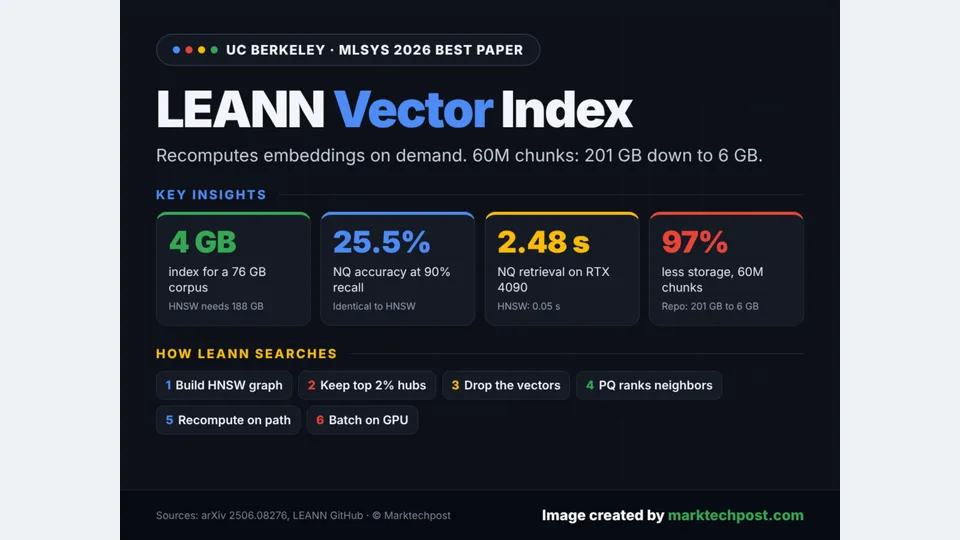
UC Berkeley’s LEANN vector index stores a pruned graph and recomputes embeddings at query time. It matches HNSW accuracy at 90% recall using 4 GB instead of 188 GB, at the cost of seconds-level search. The post Meet LEANN: An Open-Source Vector Index that Shrinks a 60M-Chunk RAG Index from 201 GB to 6 GB appeared first on MarkTechPost.