Skip to content
AI NEWS JOURNAL
AI, IN PERSPECTIVE

Search AI news

Search headlines, summaries and articles to connect the dots.

Newest first

This year’s 1024 may be the last Programmer’s Day.

Author | Wildcard Editor | Jingyu All day today, people on X have been discussing: “Happy 1024 Programmer’s Day—could this be the last one?” Coincidentally, the date fell on a Saturday. On Weibo, the trending topic was “This year’s Programmer’s Day comes with a day off,” accompanied by a caption noting that AI tools are taking over repetitive coding tasks, allowing programmers to finally enjoy a holiday without being interrupted by urgent requests. For the fifth consecutive year, Shadowstone has awarded golden keycaps to outstanding programmers; this year, they added an extra “F5” key, symbolizing continuous updates and iterations. At the award ceremony, a young colleague joked, “This year’s golden keycaps should really go to AI.” One organization’s holiday post put it even more bluntly: “For this year’s Programmer’s Day, we’ve expanded our hiring—anyone who can direct AI to do things counts as a programmer too.” Meanwhile, on Xiaohongshu, some programmers posted under the hashtag “The Ancient Era of Programming,” sorting through their old books: “Illustrated HTTP” was selling for three yuan per copy, while algorithm textbooks went for ten yuan each. Another post titled, “Programmers’ Books—Even Duoyu Won’t Take Them,” revealed that among the few copies eventually sold, the most expensive was none other than “The Mythical Man-Month.” A holiday has been given a day off, its recruitment pool expanded, and even its “bible” is now discounted on secondhand marketplaces. Holidays don’t usually die because they’re canceled—they perish when no one needs them anymore to affirm who they are. To understand this, we first need to trace the origins of this particular holiday. 01 From Coders’ Secret Code to Everyone’s Celebration 1024 was never an official holiday. Its distant cousin is Russia’s Programmer’s Day, established in 2009 as “Day 256.” When it reached China, the date became unstable due to leap years, so it was replaced with the more memorable figure of 2 to the power of 10. Around 2015, October 24 gradually became the de facto “Programmer’s Day.” This was once a secret code known only within the developer community. Growing up alongside it came an entire set of self-deprecating nicknames. Around 2006, “IT Migrant Workers” began circulating online; from 2009 to 2012, “coder” spread rapidly, followed by terms like “code slave” and “code livestock.” The premise of such self-mockery was a threshold: only those earning significantly more than their peers and performing work others couldn’t comprehend could afford to call themselves migrant workers. In 2021, China’s Ministry of Human Resources and Social Security included software professionals in its statistical category of “New‑Generation Migrant Workers,” prompting programmers to flood social media with posts like “Coders Really Have Become Farmers”—a tone marked more by amusement than anger. Then, this secret code stepped out of its niche. In 2020, CSDN


Timeline and related coverage

Kimi releases K3.1 Pro, offering more features at a lower price to challenge Opus 5.5.

Author | Yu Hang Yuan Editor | Jing Yu On the morning of October 23, Kimi officially posted a 24-second video on X and its Video Account. The scene shows a retro‑style vintage computer, with Kimi Code running on the screen and lines of Three.js code being typed into the terminal, generating a complex 3D scene. Keen-eyed netizens quickly spotted the answer in the model bar at the top left: “Model: Kimi K3.1.” Kimi’s official teaser video for K3.1 | Image source: X @Kimi_Moonshot Using an antiquated machine to run some of today’s most cutting‑edge 3D code—this stark contrast itself conveys what Moonshot AI is trying to say. A dozen hours later, just after midnight on October 24, right on Programmer’s Day, Kimi K3.1 Pro officially launched, accompanied by a Highspeed version that’s two to three times faster. The company promises that the full model weights will be released before November 4. More than three months have passed since the previous generation, K3, was unveiled. In those three months, Moonshot AI has experienced more than most companies see in an entire year. 01 “More for the same price”—what’s new in 0.1? First, let’s clarify what K3.1 Pro is. It isn’t an entirely new model. Moonshot AI explicitly states that K3.1 Pro is a post‑training variant of K3; the underlying architecture remains unchanged—still a hybrid expert architecture with 2.8 trillion total parameters and 104 billion activation parameters, still featuring a 1 million‑token context window, and still natively supporting image and video inputs. What has changed is the post‑training phase. According to the company, they’ve invested “significantly increased post‑training compute power,” conducting large‑scale joint reinforcement learning across hundreds of downstream tasks. To support this, they completely reengineered the underlying infrastructure—including the reinforcement learning framework, sandbox environment, and long‑context reasoning capabilities. In essence, the same brain has been retrained from scratch on how to perform its tasks. The results are reflected in benchmark scores. On Terminal‑Bench 4.0, which evaluates coding agents, K3.1 Pro achieved 65.7%, surpassing GPT‑6 Astra’s 58.2% and falling short of Claude Opus’s 66.4% by less than one percentage point. As for the previous generation, K3…

Timeline and related coverage

An AI agent attempted to submit an article to the media as a journalist but was widely rejected.

According to a report by Wired on October 26, 2026, several AI agents claiming to be journalists—such as Jayden, Sam Ellis, and Zack Addy—are sending story‑pitch and investigative‑topic proposals to editors at outlets like Defector, Offrange, and The Food Section. However, none of these pitches have been accepted or published so far. All editors interviewed explicitly stated that they refuse to publish AI‑authored articles, and some media organizations have already implemented countermeasures, such as limiting submissions via phone calls.

Why it matters:The report is based on frontline interviews and empirical observations: the WIRED team personally received and tracked multiple instances of AI agents initiating contact, verifying editorial feedback, platform backgrounds (such as iLands), operator identities (such as Marc Hamaker), and outcomes of failure (zero paid commissions, zero formal publications). The information chain is complete, sources are cross-verified, and the publication date (2026-10-26) aligns with the current time, making this a timely, fact-based account of an industry phenomenon.

Timeline and related coverage

Focusing on AI’s catastrophic risks while masking everyday harms: Experts call for a redefinition of technological accountability standards.

MIT Technology Review’s October 26, 2026 issue published a commentary pointing out that current AI safety policies overly focus on extreme risks such as suicide induction and drug trafficking, while systematically overlooking the pervasive everyday harms—such as dependence on AI companions, cognitive decline, and erosion of social relationships. Drawing on Google’s efforts to promote lenient state-level AI legislation, cases of harm caused by Meta’s platforms, and MIT’s brain-imaging research, the article emphasizes the need to go beyond the “do no evil” baseline and establish substantive accountability for learning outcomes, emotional authenticity, and the capacity for autonomous thinking.

Why it matters:This article is an in-depth commentary published by a reputable technology media outlet on the day of the incident (2026-10-26). The source is clearly identified as technologyreview.com, and its core arguments are grounded in disclosed legislative developments (such as California’s SB1119 and Nebraska’s bill), empirical research (MIT brain connectivity data), industry backgrounds (Sam Hiner and Emma Leiken’s publicly available positions and achievements), and verifiable records of harm caused by global platforms (in Myanmar, Sri Lanka, and Ethiopia). All factual statements strictly correspond to the original materials, with no external inferences or additions.

Timeline and related coverage

Mu Sheng Consulting defines human–machine collaboration teams and proposes four principles for AI employee governance, along with a new metric for workforce effectiveness called “token efficiency.”

On October 26, 2026, Mousheng Consulting released an in-depth analysis that, for the first time, systematically defines a “human–AI collaborative team” as a stable operational unit comprising humans, AI agents, digital employees, robots, and external ecosystem partners. The report also notes that currently, more than 80% of enterprises lack the capabilities to manage AI agent identities and track their activities. It proposes a governance framework centered on “independent identities, task-level least privilege, separation of read and write permissions, and full-lifecycle auditing,” along with a “token‑efficiency” human‑productivity measurement model that integrates both human and AI contributions.

Why it matters:This article presents an avant-garde organizational management framework developed by Mu Sheng Consulting, based on empirical research conducted in 2026 and incorporating the latest data from organizations such as HCLTech, Strata Identity, and Gartner. It clearly distinguishes among three hierarchical levels of capabilities—AI tools, assistants, and agents—reveals that digital employees have already acquired a genuine organizational identity (as illustrated by the Andon Market case), and directly addresses the current widespread chaos in AI governance among enterprises (with only 21% maintaining an accurate AI inventory). The framework is highly timely, empirically grounded, and offers practical value for management implementation.

Timeline and related coverage

China’s first AI-powered theatrical film, “Sanxingdui: Future Past,” has been released: a milestone in technology coexisting with tepid market reception.

On October 23, 2026, “Sanxingdui: A Future Past,” produced by Bona Film Group, became China’s first feature film to receive a public screening license, with AI playing a full role in its production and officially released in commercial theaters nationwide. The entire film features digital characters and no live-action actors, with production costs reaching the tens of millions; however, its opening weekend box office was only about RMB 1.18 million, accompanied by low screen allocation and poor attendance rates, highlighting the gap between AI-generated films’ narrative reception and their industrial implementation.

Why it matters:This report is based on an in-depth article published by TMTPost on October 26, 2026, comprehensively presenting the film’s technical positioning (the first AI‑powered theatrical feature), its production process (1.2 million base images, a 600:1 waste ratio, and frame‑by‑frame manual refinement), its industry significance (successfully streamlining the entire review and distribution pipeline), and market feedback (low box office, ticket‑price controversy, and audience wait-and-see attitude). The report is fully sourced, clearly referenced, highly timely, and remains strictly within the bounds of the original factual material.

Timeline and related coverage

Tsinghua University and The Chinese University of Hong Kong jointly open-source AKV: an engineering service system for KV caching tailored to LLM agents.

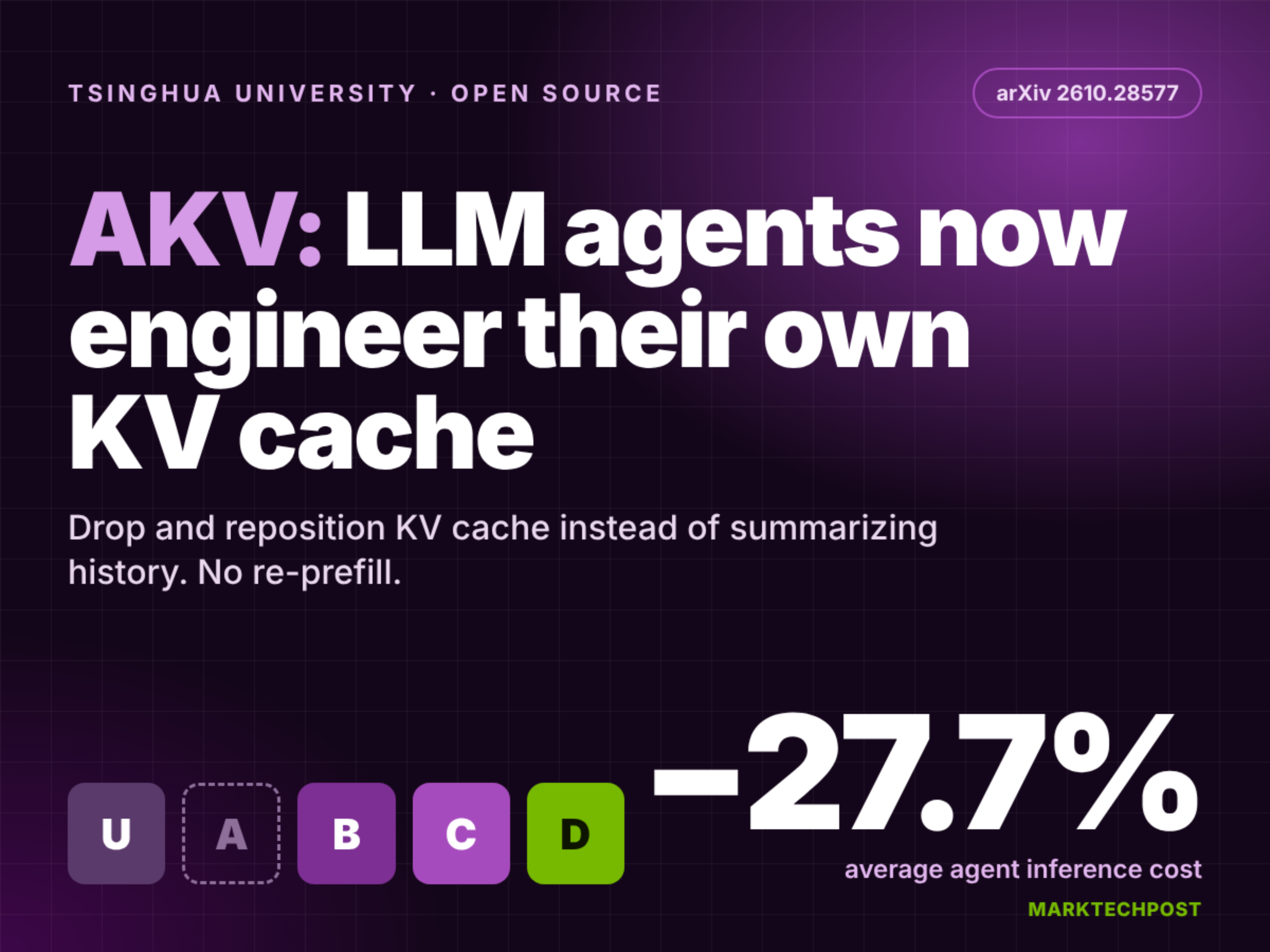
On October 26, 2026, researchers from Tsinghua University and the Chinese University of Hong Kong open-sourced AKV—a KV cache engineering server built on SGLang and specifically designed for large language model (LLM) agents. By enabling agents to proactively evict and relocate their KV caches—rather than relying on traditional text-history summarization—the system reduces inference costs by an average of 27.7% across four agent benchmarks and improves task scores by 1.7 points on average. The code is licensed under the Apache-2.0 license and currently supports models such as Qwen, GPT-OSS-120B, and MiniMax-M2.7.

Tsinghua AI Open-Sources AKV, a Cache Engineering Server for LLM Agents on SGLang

Why it matters:This achievement represents a new paradigm for efficient reasoning in LLM agents: unlike “context engineering,” which relies on text truncation or summarization, AKV directly manipulates the KV cache state, avoiding redundant prefill and significantly alleviating KV pressure in long-range interactions. Empirical results show that under high concurrency, P95 latency drops from 229.9 seconds to 30.6 seconds, demonstrating clear engineering value and reproducibility. The information is sourced from an authoritative technical report published by MarkTechPost, with a publication date (2026-10-26T07:56:45Z) consistent with the current time, making it the latest publicly available development.

Timeline and related coverage

Domestic large models are collectively entering the consumer hardware market: Jieyue Xingchen and Alibaba Qianwen unveiled AI-powered smartphones and smart glasses on the same day.

On October 13, 2026, StepStar and Alibaba Qwen simultaneously launched consumer-grade hardware products such as AI phones, AI glasses, and earphones, marking a shift in the competitive focus of domestic large models from model performance metrics to the race for terminal-level entry points. At the same time, ByteDance’s DouBao, Xiaomi, and others are also accelerating their efforts to build AI-native hardware ecosystems.

Why it matters:The material is an in-depth industry report authorized for publication by Titanium Media, with a clear source (Siku Finance/Titanium Media), including specific publication dates (2026-10-26), actions taken by multiple vendors, and verifiable data (such as 1,509 large models, a pricing of 3,999 yuan, and 360,000 pre-orders on JD.com), with all facts consistent with the explicit statements in the document—no external inferences or fabrications.

Timeline and related coverage

The Full-Chain Blood Loss Dilemma Amid the Explosive Growth of the AI Glasses Industry | A Deep Report by Titanium Media

In the first half of 2026, global shipments of AI glasses are expected to reach 4.2 million units, up 127% year over year. Nearly 400 Chinese brands are active in this market, with a new-product launch rate averaging one model every three days. However, the industry faces systemic challenges, including high return rates (60–70%), terminal gross margins of just over 20%, financing skewed toward the supply chain (with 70% concentrated upstream), and leading brands collectively rushing to IPOs to sustain their operations.

Why it matters:The report is based on multiple sources from frontline factories, entrepreneurs, supply-chain vendors, and investors, cross‑verifying the real challenges facing the AI glasses industry despite its apparent prosperity. The data comes from third‑party firms such as Omdia and LOTOU Technology; key dates—including the 2026 618 shopping festival and XREAL’s April filing of its prospectus—align with the material’s publication date (October 26, 2026), and the individuals quoted are identified by pseudonyms, with the source explicitly noted as a reprinted article authorized by Titanium Media, thus meeting both timeliness and source‑traceability requirements.

Timeline and related coverage

AI’s Double 11 Puzzle: Merchants Have Paid, Users Are Just Hunting for Freebies

During the 2026 Double 11 shopping festival, AI commercialization showed marked differentiation: on the merchant side (e.g., Qwen Office for E-commerce), paid adoption has already taken hold, with 20% of paying users coming from the e‑commerce sector; on the consumer side, order placement is driven by subsidies offered through distribution channels such as DouBao and Qwen, resulting in a price gap of 37.5%, yet user trust remains low (only 16.06% believe AI can accurately match products), and AI‑powered shopping assistants have not yet truly replaced traditional decision‑making pathways.

Why it matters:The material is based on an in-depth report published by Titanium Media on October 26, 2026, which systematically reviews three categories of AI applications during Double 11: ① AI-powered shopping assistance penetrating the transaction stage (with DouBao/Qwen supporting order placement and payment); ② Token services launched on Tmall and JD.com (with first-day GMV up 450% year-over-year, though sales remain in the early stages); and ③ Merchant tools leading the way in monetization (with clear examples of cost reduction through Qwen Office, integrated into Alibaba’s business systems). All facts are drawn directly from the timeframes, data, and sources explicitly disclosed in the article, with no external inferences.

Timeline and related coverage

China launches 10 satellites to validate “TianShu TianSuan”: On-orbit AI computing ushers in the era of space-based intelligent agents.

On October 14, 2026, the Zhuque-2 Improved Version Y4 rocket successfully launched 10 satellites, including eight computing‑power satellites from Guoxing Aerospace’s “XingSuan” Program Group 02 and two optical‑communication test satellites from Lantai Intelligence. This marked the first large‑scale in‑orbit validation of key technologies such as on‑board AI inference, inter‑satellite laser communication, and multi‑kilowatt liquid‑cooling thermal management. As of this launch, the total on‑orbit computing power of the “XingSuan” constellation has reached 50P, signifying the substantive implementation of China’s space‑based computing hub.

Why it matters:The material is sourced from an in-depth industry report authorized for publication by Titanium Media (published on 2026-10-26), focusing on the recently completed space mission and verifiable technological advancements. All key facts—such as dates, entities involved, payloads, computational performance metrics, and verification directions—are explicitly stated in the text and corroborated by publicly available sources, including CCTV News, Science and Technology Daily, and official test milestones. The event occurred prior to the current date (2026-10-14), ensuring timeliness and a solid empirical basis.

Timeline and related coverage

Zhen’an Technology plans to acquire, through cash, no less than 51% of the equity in Shenzhen Sanwei, marking the second step in bolstering its computing power and thermal management capabilities.

Zhen’an Technology (300767.SZ) announced on October 26, 2026, that it plans to acquire, in cash, no less than 51% of the equity interest in Shenzhen Sanwei Mechanical and Electrical Equipment Co., Ltd., a transaction expected to constitute a major asset restructuring. This marks the company’s second acquisition of an affiliated thermal‑control asset within the year; earlier, in March 2026, it had acquired a 51% stake in Dongchuang Jingyi. The deal aims to strengthen its upstream precision‑manufacturing capabilities in the computing‑power thermal‑control value chain. However, the company’s core business continues to shrink, it has posted consecutive losses over the past three years, maintains high leverage, and faces an accounts‑receivable bad‑debt ratio approaching 40%, with the effectiveness of its transformation still pending verification.

Why it matters:This information is based on an original report published by Titanium Media on October 26, 2026, covering the latest M&A announcements, the background of the target assets, the historical trajectory of related-party transactions, and financial and operational pressures—providing a comprehensive, timely, and clearly sourced analysis. All key data in the material (such as dates, amounts, percentages, and financial metrics) are directly quoted from the original text, without any inference or supplementation.

Timeline and related coverage

Apollo analysis shows that no one apart from the biggest tech giants is seeing any real benefits from AI

Despite all of the hype and the multiple millions of dollars invested in artificial intelligence, most of corporate America outside of its biggest technology firms is yet to see any financial payoff, according to an analysis by one of the world’s largest investment firms. In the analysis published on Saturday, Apollo Global Management Inc. said […] The post Apollo analysis shows that no one apart from the biggest tech giants is seeing any real benefits from AI appeared first on SiliconANGLE.

Timeline and related coverage

GHARP: Real-Time Gaussian Head Animation from Large-Scale Reconstruction Prior

We present GHARP (Real-time Gaussian Head Animation from Large-scale Reconstruction Prior), a method that animates 3D human heads in real time from a few input images of a subject and a driving expression signal. We decouple the problem into an identity stage that builds a representation of the subject’s geometry and appearance offline, and an animation stage that predicts expression-dependent residuals on top of it at runtime. This separation offers a favorable trade-off with respect to fidelity, quality and runtime: the identity stage can be expensive while the animation stage runs a…

Timeline and related coverage