Skip to content
AI NEWS JOURNAL
AI, IN PERSPECTIVE

Search AI news

Search headlines, summaries and articles to connect the dots.

Newest first

Closing the Analyze-to-Design Gap: An Authorization-Bounded Agent for Self-Driving Laboratories

arXiv:2611.25043v1 Announce Type: new Abstract: Artificial intelligence (AI) agents are increasingly integrated into self-driving laboratories (SDLs) to plan experiments and interpret results. However, analytical reasoning alone does not make a laboratory autonomous: autonomy in an SDL is achievable only when the agent can be trusted to act on physical hardware unsupervised and knows when to defer to a human. Here, we present an architecture that integrates an agent at the Analyze-Design interface of the Design-Make-Test-Analyze (DMTA) cycle, enabling agent-driven measurement selection and data interpretation while ensuring that state-changing operations are authorized, validated, and auditable. We demonstrate this architecture on a liquid chromatography-mass spectrometry (LC-MS) instrument in an oxidant-screening campaign for synthesizing an organic dye. Within human-defined campaign limits, the agent submitted measurement jobs, interpreted mass spectrometry (MS) and diode-array detection (DAD) data, flagged failed experiments, and produced an oxidant ranking. This ranking matched that obtained from scripted peak integration, and organic chemists confirmed the agent's spectral interpretations and failure assignments. In a simulated environment that replays the archived LC-MS data, where the agent chose which wells to inject under varying injection limits, it measured the highest-yielding condition at about its seventh injection, against 14.5 on average for a random order, and identified it in every campaign with a limit of eight or more injections. An agent can therefore close the analysis-to-design gap while its actions stay bounded and verifiable, which is a step toward greater autonomy for SDLs.

Starburst adds context support to give AI agents consistent access to business data definitions

Starburst Data Inc. is expanding its data federation platform into business context management with the introduction of Context Studio, a new capability designed to help artificial intelligence agents produce more accurate and trustworthy answers from information distributed across enterprise systems. Context Studio collects business definitions from existing data catalogs, business intelligence tools, metric stores and […] The post Starburst adds context support to give AI agents consistent access to business data definitions appeared first on SiliconANGLE.

Verifiable pXRD: Hill-climbing pXRD structure determination with LLM agents

arXiv:2611.17539v1 Announce Type: new Abstract: Autonomous crystal-structure determination from powder X-ray diffraction (pXRD) remains a key bottleneck for self-driving materials laboratories. We formulate the task of pXRD structure determination as a verifiable agentic search problem: candidate structures can be assessed during inference through forward-simulated profile agreement and during evaluation through structural matching to a known reference. To benchmark progress, we introduce pXRD-Bench, a suite of 200 simulated single-phase problems spanning in-distribution structure determination, challenging and polymorphic structures, and controlled compositional and topological distribution shifts. Agent adaptation raises selected structural recovery from 27% to 69%, with further gains from repeated sampling and verifier-guided inference-time scaling. We extend this approach to experimental multiphase pXRD through a reflexive evolution framework that learns from self-generated synthetic problems. A replaceable laboratory specification defines the sample family and measurement conditions. An evolver agent uses the known generating structures and measurement parameters to diagnose solver failures and develop persistent guidance and executable tools, which are then provided to agents on measured patterns. This supplies verifiable training experience without requiring a collection of solved experimental measurements. On 15 measured patterns from solid-state synthesis, the evolved package improves average profile agreement and transfers an analogue-substitution procedure that recovers a phase whose structure is absent from the supplied reference library. These results demonstrate how learning from verifiable synthetic experience can improve agentic characterization of experimental samples whose structures are not known in advance.

Call for Proposals: PyTorch Day China 2026

The Call for Proposals for PyTorch Day China 2026 closes November 10 at 23:59 China Standard Time. The event takes place in Beijing on December 12, bringing together PyTorch developers,... The post Call for Proposals: PyTorch Day China 2026 appeared first on PyTorch.

Final Call for Proposals: PyTorch Day China 2026

The Call for Proposals for PyTorch Day China 2026 closes November 10 at 23:59 China Standard Time. The event takes place in Beijing on December 12, bringing together PyTorch developers,... The post Final Call for Proposals: PyTorch Day China 2026 appeared first on PyTorch.

Do Pretrained Backbones Transfer to Physical Sensors? A Systematic Study of Multimodal Initialization Across the Sensor Stack

arXiv:2611.04034v1 Announce Type: new Abstract: Transfer learning from pretrained backbones has become standard practice in multi-sensor computer vision---yet two questions remain open: which pretrained weights transfer best to multi-sensor setups, and can in-domain pretraining outperform off-the-shelf solutions? Frameworks like MultiMAE demonstrate the utility of masked autoencoding in a multi-modal context, but rely entirely on dense, model-derived modalities. It is unclear how robustly these methods translate to real-world applications that use physical sensors, where the aggregation of diverse public datasets for large-scale pretraining inherently introduces modality sparsity. To investigate this systematically, we curate a multi-sensor autonomous driving collection of $2.82M$ images from 16 publicly available datasets, incorporating both physical hardware modalities (RGB, LWIR, NIR, Event) and model-derived modalities (Stereo Depth, Segmentation). We use this collection for in-domain pretraining based on the MultiMAE approach. We adapt MultiMAE's loss formulation to accommodate sparse samples, and study the effect of an enforced encoder bottleneck for modality alignment and of additional losses specific to dense reconstruction (SSIM and FFT). We then systematically compare against common pretrained backbones (ViT, MAE, DINO and MultiMAE) across downstream sensor fusion tasks. We find that MultiMAE is a surprisingly strong out-of-the-box baseline, transferring effectively even to modalities it has never seen, while our targeted modifications yield incremental but consistent improvements on multi-sensor transfer and overall robustness.

An agent that helps users snatch up iPhone foldable-screen models is reshaping e-commerce in the AI era.

Shopify AI saw transaction orders grow by a factor of 13. In the early morning of October 16, pre-orders began for Apple’s first foldable-screen phone, the iPhone Duo. Priced from $1,999, initial production capacity was tight, and delivery dates quickly slipped to January next year. This time, it wasn’t just people glued to their screens vying for the launch. This year, Agents have become the strictest “parents” to iPhone Duo scalpers. | Image source: Apple On the MacRumors forum, one user who missed out vented their frustration, while on Reddit others boasted about using Muse bots to snatch up multiple units in a single go—before even a human could click, the inventory had already been swept away by AI. Muse is Meta’s personal Agent, launched on September 8; shortly after its debut, it topped the free charts in the U.S. App Store, with downloads soon surpassing 2.5 million. According to Meta, shopping has become one of Muse’s primary use cases. Around the time the iPhone Duo went on sale, Muse even released a new version optimized for this device, with an update note that emphasized making in‑chat shopping more convenient. AI-driven shopping has moved from demo stages at product launches straight into real‑world stock‑picking scenarios. But not every retailer welcomes these new customers. In late September, Amazon began banning Muse. By October, users of Musk’s Grok Bot encountered the same warning when placing orders on Amazon: unauthorized AI agents continuing to access the platform violates Amazon’s terms of service. Meanwhile, another company, Shopify, took the exact opposite approach. On September 21, Shopify CEO Tobi Lütke announced a deep partnership with Muse, enabling Muse to process checkout through Shop Pay across all Shopify stores. And Shopify’s financial reports already show early returns from this strategy: in the first quarter of this year, orders generated via AI search grew nearly thirteenfold year over year, while store traffic driven by AI increased eightfold. Closing doors on one hand, opening them on the other—when more and more purchasing decisions are handed over to Agents, will the question of “whether or not to let Agents in” become…

Timeline and related coverage

DriveMind: Mind-Evolving Belief Tracking for Closed-Loop Autonomous Driving

arXiv:2610.32069v1 Announce Type: new Abstract: Recent multimodal large language models (MLLMs) can perceive a traffic scene, reason about it, and propose a driving action within a single model. However, existing MLLM-based drivers reason from scratch at each frame and commit to a single explanation, discarding earlier hypotheses about the scene. When the scene is ambiguous, the agent locks in on the wrong interpretation and acts on it before evidence accumulates. In this paper, we propose DriveMind, an MLLM-based driving framework that keeps several hypotheses about the scene alive at the same time and updates their weights as new frames arrive. Inspired by particle filtering, DriveMind propagates each hypothesis through a VLM, scores it against the current observation, and resamples to m

Timeline and related coverage

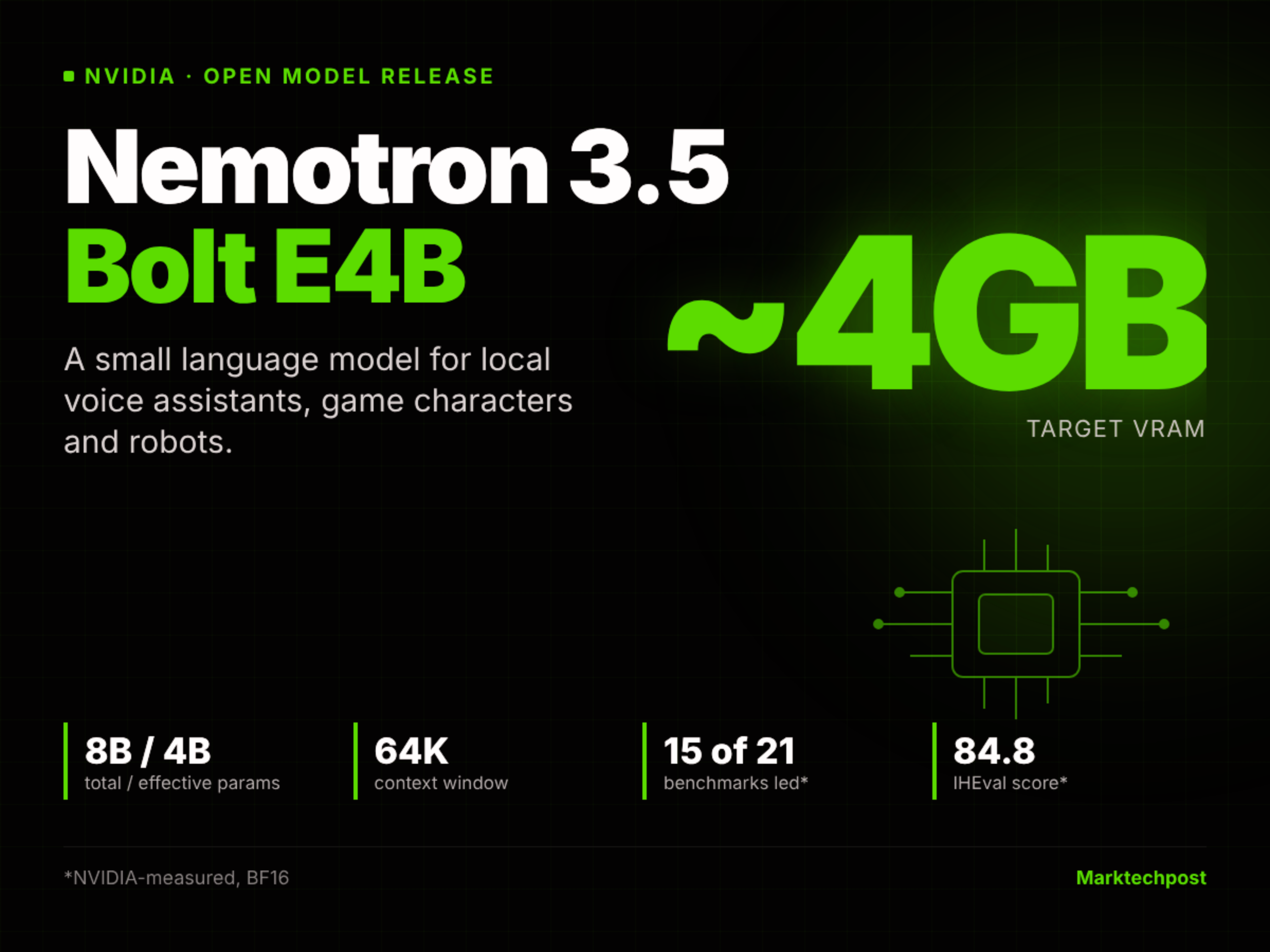
NVIDIA has released the open-source small language model Nemotron 3.5 Bolt E4B 4GB, optimized for on-device voice assistants, game NPCs, and robots.

NVIDIA, leveraging Google’s Gemma 4 E4B model and employing only reinforcement learning (RL) for post-training, has launched Nemotron 3.5 Bolt E4B 4GB—a small open-source language model with 8B total parameters, 4B effective parameters, and a 64K context window. It is designed to run on edge devices such as RTX and Jetson with approximately 4GB of VRAM, supporting multi-turn tool calls and low-latency voice interaction.

NVIDIA Releases Nemotron 3.5 Bolt E4B 4GB: An Open Small Language Model for Local Voice Agents, Game Characters and Robots
Timeline and related coverage

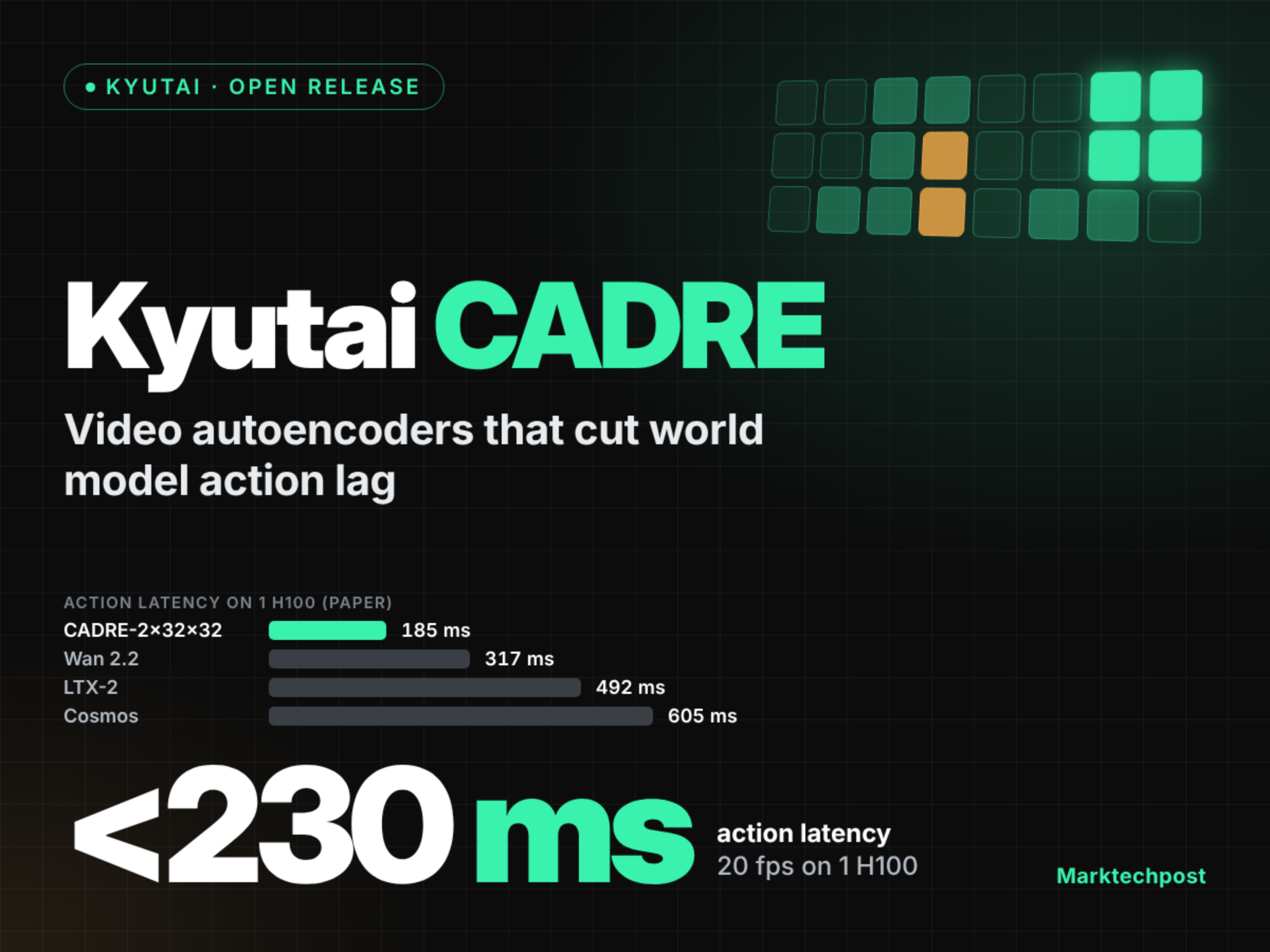
Kyutai releases the CADRE video autoencoder family: designed for interactive world models, with end-to-end action latency reduced to below 230 milliseconds.

On October 23, 2026, Kyutai unveiled CADRE—a family of seven open-source causal diffusion-based video autoencoders designed to reduce action latency in world models. On a single H100 GPU, measured response latency was as low as 185 ms, with inference throughput reaching 23.4 fps, and the scene FVD metric dropping to 162.6 (compared to 599.7 for Wan 2.2). However, in robotic manipulation tasks, its action following rate (ARR) lagged behind both Wan 2.2 and Cosmos.

Kyutai CADRE: Video Autoencoders That Cut World Model Lag Below 230 ms
Timeline and related coverage

NVIDIA CEO demonstrates the Microduck robot, sparking a pre-sale frenzy with orders exceeding 20,000 units.

At the GTC Berlin conference, NVIDIA CEO Jensen Huang demonstrated Microduck, a robot developed by Pollen Robotics and now part of Hugging Face (which has been acquired by NVIDIA). This open-source robot can perform actions such as walking, sitting, pretending to sleep, and even doing backflips—all via voice commands. Following the video’s viral success, pre-orders exceeded 20,000 units the next day, positioning it as a potential holiday-season hit toy. These robots are trained using NVIDIA’s technology stack, enabling users to customize their training and share new skills.

Why it matters:The information is generated based on the provided TechCrunch article and fact list. The material states that Microduck is manufactured by Pollen Robotics, which was acquired by Hugging Face in 2025, and that NVIDIA acquired Hugging Face in September of the same year. The pre-sale data, feature descriptions, and delivery timelines mentioned in the text are directly quoted from the material, with no external information added.

Timeline and related coverage

NVIDIA launches SimReady Central: an open-source, simulation-ready 3D asset library for robotics and AI factories.

NVIDIA, in collaboration with Hugging Face, has launched SimReady Central, a free and open-source simulation-ready (SimReady) 3D asset library built on OpenUSD. The initial release includes over 2,000 validated industrial-grade assets, covering robot bodies, end-effectors, AI factory infrastructure, and more, enabling developers to rapidly build physics-based AI training environments and digital twin scenarios.

Timeline and related coverage

Microduck open-source bipedal robot supports both simulation training and real-world deployment: NVIDIA Isaac Lab 3.0 enables a Sim-to-Real closed loop.

Pollen Robotics and Hugging Face have jointly unveiled Microduck, a low-cost, open-source bipedal robot, integrating NVIDIA Isaac Lab 3.0 and the Newton physics engine. It supports training walking policies in GPU-accelerated parallel simulations, with domain randomization and high-fidelity actuator modeling—including backlash, latency, and friction—enhancing robustness during simulation-to-real transfer. The resulting ONNX model can be directly deployed on the physical robot.

Timeline and related coverage