
Import AI 478: Math for alignment; ProgramBench; and Mirendil shows what RSI means
What is “night” to a machine?
Search headlines, summaries and articles to connect the dots.
What is “night” to a machine?
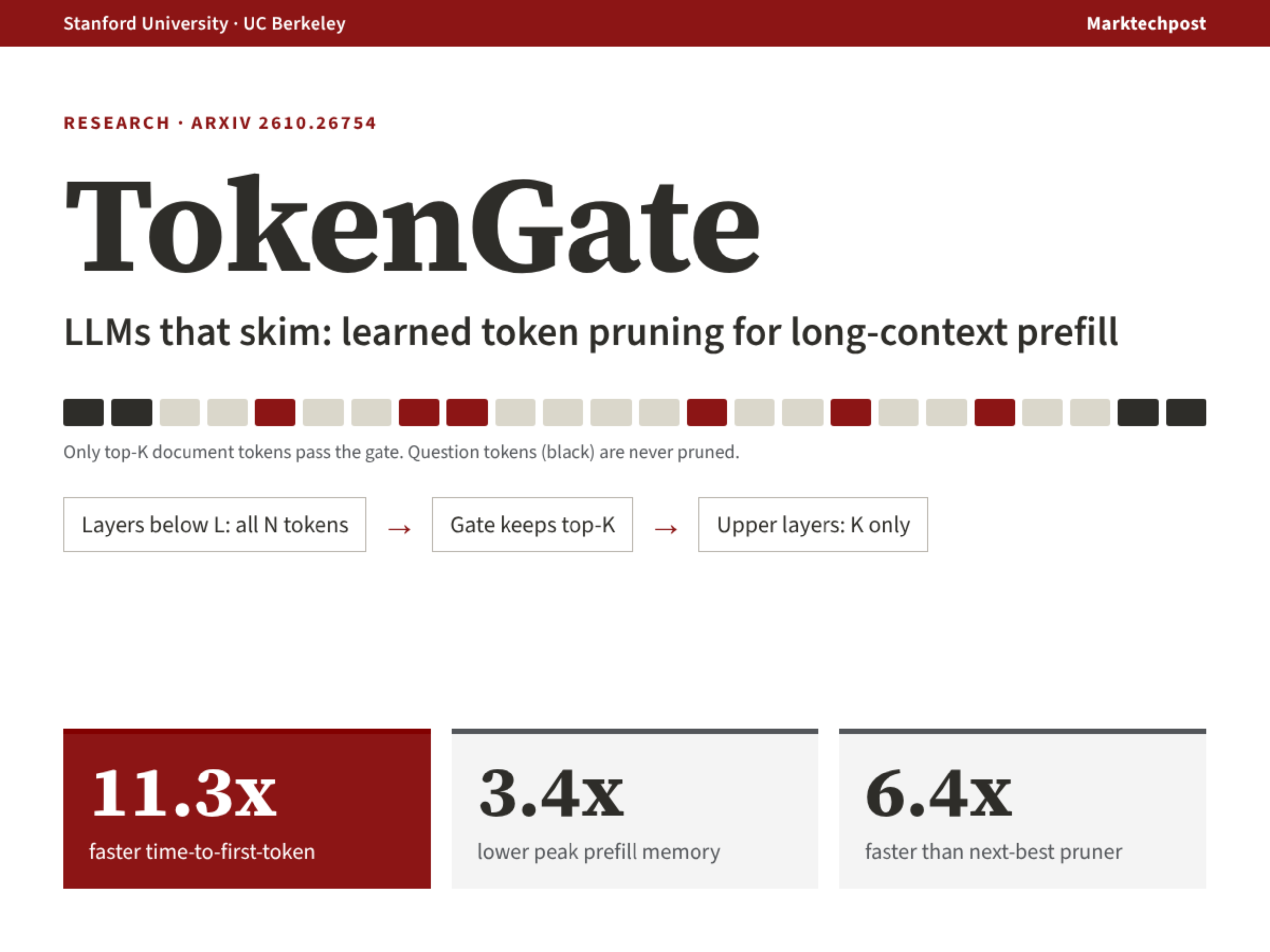
Researchers from Stanford University and the University of California, Berkeley have introduced TokenGate—a plug-and-play, learnable token-pruning module designed for existing large language models (LLMs). This approach accelerates the first-token generation time (TTFT) for long-context prefill by 1.4 to 11.3 times without sacrificing accuracy, while reducing peak memory usage by 1.5 to 3.4 times. The associated code and checkpoints have been made open source.
On October 24, 2026, Sebastian Raschka published an eight-part, over-11-hour hands-on video course on Python and PyTorch in Ahead of AI magazine (magazine.sebastianraschka.com), systematically covering the evaluation of inference models, scaling during inference, reinforcement learning (RLVR), and knowledge distillation, with all methods implemented using the pre-trained Qwen3-0.6B model.
Why it matters:This course is the author’s advanced technical educational offering, following “Building Large Language Models from Scratch.” It focuses on the core evolutionary direction of today’s mainstream LLMs—enhancing inference capabilities—covering the entire technical pipeline from setting up the foundational environment to GRPO reinforcement learning and self‑distillation. The author explicitly states that all implementations are “hand‑crafted from scratch,” fully reproducible, and highly instructive with significant engineering reference value.
PyTorch 2.15 brings a major MPS backend upgrade to Apple Silicon Macs, natively supporting FP8 tensor operations on macOS for the first time, boosting MoE model decoding speed by 5–6.5 times, reducing peak video VAE memory usage from 270 GiB to 8 GiB, and migrating numerous operators from MPSGraph to dedicated Metal kernels.
Profiling in PyTorch (Part 2): From nn.Linear to a Fused MLP