
Skip to content
AI NEWS JOURNAL
AI, IN PERSPECTIVE

Search AI news

Search headlines, summaries and articles to connect the dots.

Newest first

Genie 4 is now available

Google introduces a new Project Genie experience for eligible Google AI Ultra subscribers, featuring Genie 4—the most realistic and interactive world model yet—enabling real-time prompt-based changes to environments, native audio adaptation, and extended session capabilities. Upgrades to Genie 3 include longer runs, 360-degree panorama grounding, and real-time in-world events. The Project Genie agent allows users to create interactive worlds through natural language prompts, while the community gallery offers curated and user-generated worlds for exploration and remixing. Safety measures like SynthID watermarking and content screening are in place, and ongoing research addresses challenges such as camera latency and scene permanence.

FieldGuide: A Corpus Map for Token-Efficient Agentic Document Exploration

arXiv:2611.21647v1 Announce Type: new Abstract: Generative AI agents can help journalists explore large document collections. But exploratory workflows can require substantial token use and time, especially when the task is broad and the relevant subquestions are not yet known. This paper introduces FieldGuide, an agent-facing corpus map that organizes a document collection into a topic hierarchy and exposes tools for corpus orientation, scoped search, and bounded reading. I evaluate FieldGuide on five journalistic document-exploration tasks using 38 Chicago Police Department public-records documents, comparing it with raw-file access and retrieval-augmented generation. Across the five tasks, FieldGuide used 27% fewer tokens and 41% less elapsed time than raw-file access; relative to RAG, it used 38% fewer tokens and 21% less elapsed time. An accuracy audit identified four minor issues in FieldGuide's responses, comparable to the other conditions. In blind ratings of generated reporting leads, FieldGuide's mean ratings were higher than RAG's and lower than the raw-file condition's. These descriptive results suggest that corpus orientation may reduce runtime token use and elapsed time without severe accuracy failures. They also motivate further study of whether selective access limits broad, cross-document discovery.

Retrieval-Grounded Multi-View Reasoning for Clinically Reliable Radiology Report Generation

arXiv:2611.09993v1 Announce Type: new Abstract: Chest radiograph report generation is hampered by retrieved reports that resemble the current image but are clinically inconsistent with it, and by diagnostic-label imbalance. We present RG-MVR, a retrieval-grounded framework comprising Retrieval-Augmented Evidence Grounding, which combines dense memory summaries with visually gated sparse retrieved evidence; Adaptive Multi-view Evidential Reasoning, which weights image, memory, and retrieved evidence per case; and a Clinical Prompt Learner, which models finding mention separately from positive, negative, or uncertain status. On MIMIC-CXR, RG-MVR achieved a clinical-label F1 of 0.483 and a BLEU-4 of 0.118 (IU X-ray: 0.202 and 0.110). In an exploratory external cohort of 22 examinations, clinical-label agreement declined markedly (F1, 0.071) and unsupported statements remained common, although physicians found fewer unsupported temporal comparisons (9 vs. 20 cases) and device-related statements (7 vs. 15) than with the baseline. Evidence-aware retrieval and structured diagnostic prompting may reduce specific reporting errors, but broader external validation is required.

Cooperative Multi-Agent Reinforcement Learning via Epigraph-Form Guided Exploration

arXiv:2611.07066v1 Announce Type: new Abstract: Discovering cooperative behavior in multi-agent reinforcement learning (MARL) is challenging due to the combinatorial complexity of joint state-action spaces, which hinders the emergence of coordinated behaviors from trial-and-error alone. Intrinsic rewards are often used to aid discovery, but naively combining them with team objectives can distort the learning signal, compromising task performance. In this paper, we propose EFXPLORER, a constrained exploration framework that maximizes exploration objectives subject to a constraint that preserves established task performance. We solve the resulting problem using an epigraph reformulation that introduces adaptive exploration budgets. This approach separates intrinsic rewards from task objectives and regulates exploration through task feasibility. To further encourage diverse and temporally extended exploration, we incorporate a successor distance-based intrinsic reward that captures long-horizon dependencies. Empirically, our method outperforms strong baselines and induces novel cooperative strategies across SMAX, VMAS, and MPE benchmark suites.

Liquid AI unveils the LFM3 multimodal model family, emphasizing efficient, specialized intelligence

Recently, Liquid AI officially launched its next-generation foundation model family, LFM3. The first release includes six models with approximately 2 billion parameters, covering text, vision, audio, omni-modal, and decision-making capabilities—all built on the LFM3-1.7B-Base foundation and achieving a pre-training throughput of 22 trillion tokens. This series adopts a novel tri-hybrid layer architecture, integrating gated short convolutions, sliding windows, and other mechanisms, prioritizing fewer parameters and higher efficiency.

Liquid AI重磅发布LFM3 多模态模型家族,主打高效专用智能
Timeline and related coverage

AK_QMUL at ArGuard Shared Tasks: A Single Fine-Tuned JAIS for Arabic Harmful-Prompt Detection

arXiv:2610.36360v1 Announce Type: new Abstract: We present AK_QMUL's submissions to the ArGuard-2026 shared tasks on Arabic harmful-prompt detection: a binary safe/unsafe task (B1) and a seven-way harm-domain task (B2). Both submissions use one backbone -- JAIS-6.7B fine-tuned with 4-bit QLoRA and a linear classification head over its last-token representation. For B1 we train a four-way head that factors the label by dialect register {safe, unsafe} x {MSA, other}, we augment the training fold with MSA prompts from AraSafe, and decode with a plain argmax to score safe/unsafe. For B2 we fine-tune the same backbone as a seven-way classifier and average the softmax outputs of five random seeds. Both submissions ranked first on their track, with macro-F1 0.984 on B1 and 0.790 on B2. We report

Timeline and related coverage

Multi-Agent Retrieval-Augmented Causality Assessment (MARCA) of Individual Case Safety Reports in Pharmacovigilance

arXiv:2610.33279v1 Announce Type: new Abstract: Introduction: Increasing volumes of individual case safety reports (ICSRs) challenge expert-led causality assessment in pharmacovigilance. We developed MARCA (Multi-Agent Retrieval-Augmented Causality Assessment), a four-agent framework for Naranjo-based assessment, and evaluated agreement with human experts and exploratory differences between non-RAG and RAG-labelled scores. Methods: MARCA combined scientific literature retrieval, drug-label assessment, objective-evidence classification, and clinical causality reasoning using Gemini 2.5 Pro and DeepSeek-V3.2. Agent-generated rationales informed human-assisted scoring. A consensus expert reference standard covered 215 ICSRs and 1,562 drug-event combinations (DECs) from FAERS (Q1-Q2 2025). Agr

Timeline and related coverage

When to Stop Penalizing Actions? Martingale GRPO for VLA Reinforcement Learning

arXiv:2610.32431v1 Announce Type: new Abstract: A failed vision-language-action (VLA) rollout does not imply that every action contributed to failure. Yet in group-relative policy optimization (GRPO), a single trajectory-level advantage is assigned to all actions in a rollout. Potentially useful recovery attempts can thus be penalized alongside the errors they aim to correct. Ideal stopping conditions for failure feedback are characterized using success-probability and policy-score martingales. At these stops, the removed gradient contribution has zero conditional expectation given the retained information. Truncation therefore preserves the expectation of a reference GRPO group-gradient estimator and can reduce its covariance. One such stop occurs when the conditional probability of succe

Timeline and related coverage

POS-Signature Demonstration Retrieval for In-Context Dependency Parsing

arXiv:2610.31966v1 Announce Type: new Abstract: Demonstrations for in-context learning are often retrieved by semantic similarity, which may be a poor proxy for relevance in structured prediction. We study demonstration selection for Universal Dependencies parsing with a POS-signature policy that represents sentences with weighted part-of-speech statistics and retrieves three length-compatible, gold-parsed examples from the labeled training split. We evaluate two open-weight language models without fine-tuning on all 2,077 sentences of the UD English Web Treebank test set, comparing the policy with shot- and format-matched fixed and semantic three-shot baselines, as well as zero-shot, chain-of-thought, and critique-refinement systems. POS-signature retrieval yields the highest labeled atta

Timeline and related coverage

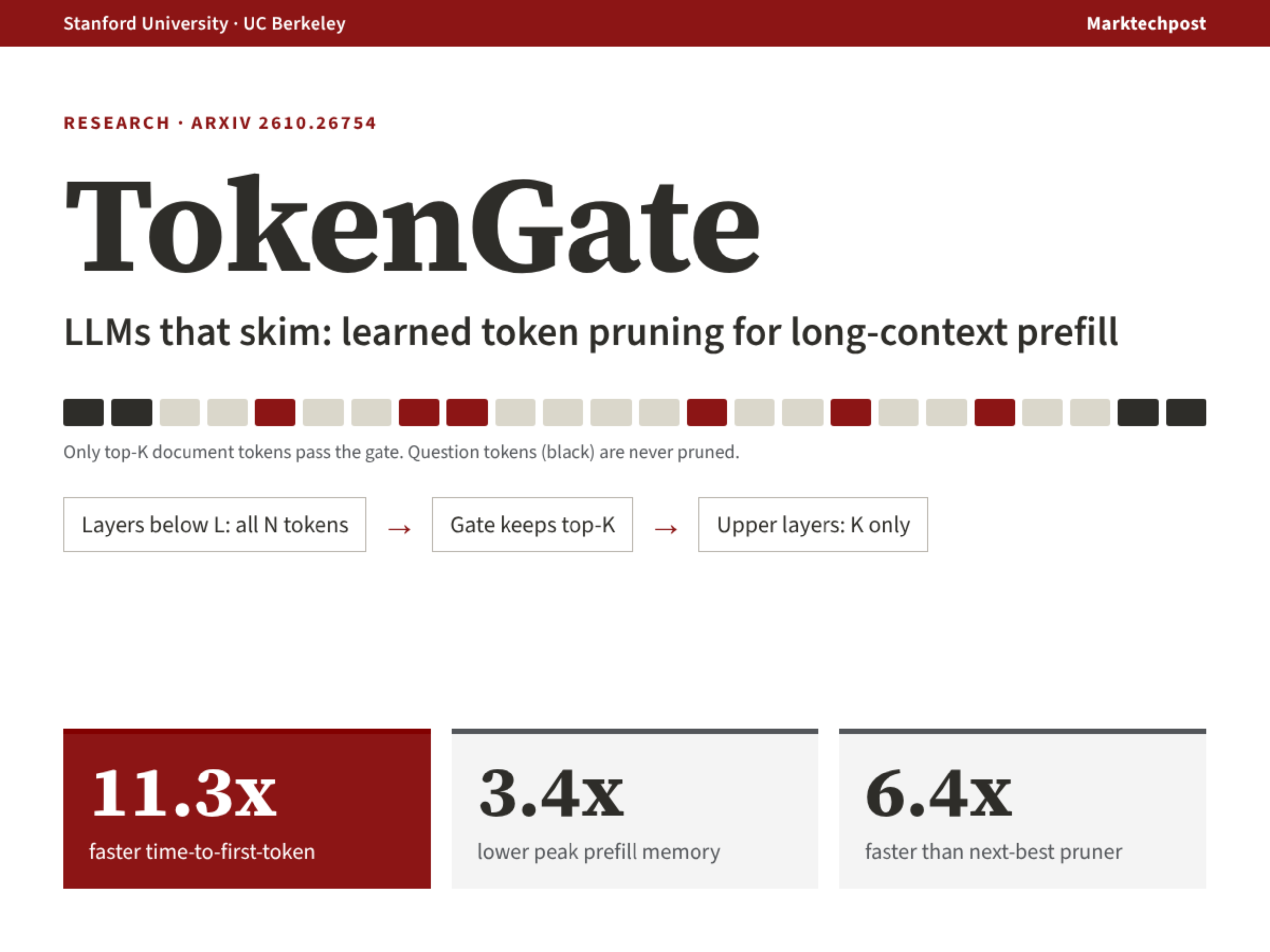
Researchers from Stanford and UC Berkeley Introduce TokenGate: Token-Gated Attention Makes Long-Context Prefill Up to 11.3x Faster

Researchers from Stanford University and the University of California, Berkeley have introduced TokenGate—a plug-and-play, learnable token-pruning module designed for existing large language models (LLMs). This approach accelerates the first-token generation time (TTFT) for long-context prefill by 1.4 to 11.3 times without sacrificing accuracy, while reducing peak memory usage by 1.5 to 3.4 times. The associated code and checkpoints have been made open source.

Researchers from Stanford and UC Berkeley Introduce TokenGate: Token-Gated Attention Makes Long-Context Prefill Up to 11.3x Faster
Timeline and related coverage

Researchers have reengineered a neural machine translation system for Sicilian, improving the quality of translations for low-resource languages.

A technical paper published on October 24, 2026, on arXiv (ID 2610.30374v1) reports the reconstruction of a small-scale neural machine translation (NMT) system for Sicilian: it leverages high-quality parallel corpora extracted from PDFs of the bilingual journal “Arba Sicula,” improves sentence alignment, tokenization, and subword segmentation that is sensitive to word stems, and migrates the original Perl‑dependent pipeline to a Perl‑free implementation. Experimental comparisons between a small Transformer trained from scratch and a fine-tuned pre-trained NLLB model demonstrate that the latter performs significantly better, particularly when translating into Sicilian.

Climbing the Ladder: Automating Data Pipelines and Reproducing Baselines in Low-Resource Settings

Why it matters:This paper presents a reproducible, engineered NMT pipeline for the endangered/low-resource language Sicilian, covering key stages such as corpus construction, model adaptation, and optimization of training strategies. All evaluations are conducted on the frozen “Arba Sicula” test set, with transparent methods and clearly defined limitations, making it a valuable technical reference.

Timeline and related coverage

New research reveals that open-book assessments primarily measure reading behavior rather than knowledge retention.

An arXiv paper published on October 24, 2026 (2610.31017v1) points out that, in document-level LoRA adapter evaluations, open-book scoring relies heavily on the model’s ability to read on the fly, rather than on whether the adapter has truly encoded knowledge specific to the document; random adapters can reproduce 82% of the performance advantage of expert adapters on open-book tasks, but on cloze tasks involving unstructured text, they only replicate 2%—statistically indistinguishable from zero.

Mostly Reading: What Open-Book Scores Measure in Document-Level LoRA Adapters

Why it matters:This study, through systematic controlled experiments—comprising 150 Wikipedia articles, the Llama-3.1-8B-Instruct model, and a two-task comparison—reveals the fundamental limitations of the current open-book evaluation paradigm: it fails to effectively distinguish between “reading” and “remembering,” posing methodological challenges to the practical utility of knowledge-editing and retrieval‑oriented adapters. The paper also reports four silent errors that lead to “clean yet incorrect results,” highlighting risks to reproducibility.

Timeline and related coverage

AQL-Lite Released: An Efficient Continuous Pre-training Framework for Modern Standard Arabic

On October 24, 2026, arXiv published paper 2610.30344v1, introducing the AQL-Lite framework, which significantly enhances the adaptability of multilingual large models to Modern Standard Arabic (MSA) through quality-first data filtering and continuous pre-training of selected parameters (CPT).

AQL-Lite: Enabling Efficient Knowledge Acquisition for Arabic LLMs via Data-Centric Continual Pretraining

Why it matters:This study directly addresses key challenges in training large Arabic-language models—namely, the abundance of noisy data, dialectal diversity, and the high costs associated with continuous pre-training—by proposing a reproducible, lightweight, and cost-effective technical approach, which has been validated on multiple authoritative Arabic-language benchmarks. All conclusions are based on the experimental setup and results explicitly reported in the paper, without any external extrapolation.

Timeline and related coverage

Amazon SageMaker AI has launched a Multi-Step Reinforcement Learning (MTRL) framework, supporting end-to-end training of agents to accomplish multi-step tasks.

AWS has launched the Multi-Turn Reinforcement Learning (MTRL) feature, enabling users to train large‑model agents on SageMaker AI using full task trajectories and final outcome feedback, without requiring step‑level annotations. A end-to-end demonstration is provided using Wordle as an example, covering AgentCore deployment, data preparation, GRPO training, reward design, and cost analysis.

Timeline and related coverage

GPT-OSS-20B Multilingual Reasoning Fine-Tuning Experiment: SFT Enables Zero-Base Behavior Acquisition, while GRPO Only Effectively Improves Performance When a Probabilistic Headspace Exists

The AWS team conducted multilingual inference fine-tuning experiments on Amazon SageMaker HyperPod using GPT‑OSS‑20B, employing LoRA for parameter-efficient fine-tuning. SFT boosted the correctness rate of inference in five languages (English, French, German, Spanish, and Italian) from 22% to 100%, though the correctness rate for the answer language remained at only 62%. GRPO further improved the answer-language correctness rate to 70% without compromising inference-language performance; however, the gains varied across languages—for example, Spanish saw a +30 percentage-point increase, while Italian experienced a -20 percentage-point decline. The experiments clearly demonstrated that GRPO cannot bootstrap new capabilities from scratch and can only optimize behaviors that already occur sporadically.

Timeline and related coverage