
Skip to content
AI NEWS JOURNAL
AI, IN PERSPECTIVE

Search AI news

Search headlines, summaries and articles to connect the dots.

Newest first

BOS Summary: The First Token Matters

arXiv:2611.23508v1 Announce Type: new Abstract: Large vision-language models (LVLMs) and language models (LLMs) often exhibit attention sinks, whereby particular positions, such as the beginning-of-sequence (BOS) token, receive a disproportionate share of attention. Under standard causal masking, however, the BOS query attends only to itself, so the representation that later tokens repeatedly access carries no information about the input. We introduce BOS Summary, a training-free inference-time method that repurposes this persistent pathway to carry input context. At a single transformer layer during prefill, BOS Summary relaxes the causal constraint for the BOS query row alone, letting BOS aggregate all visual and textual input tokens into a self-derived context representation while every other token retains standard causal attention. The enriched representation then remains accessible to the model throughout decoding, with no additional parameters, auxiliary modules, or decoding-time overhead. Across multiple VLM and LLM families and eight multimodal and text-only benchmarks, BOS Summary improves over direct and Chain-of-Thought prompting and outperforms recent sink-intervention methods on multi-step reasoning tasks. A mechanistic analysis shows that making BOS input-specific also weakens its sink dominance and redistributes attention toward content-bearing prompt tokens, indicating that changing what a sink carries reshapes how later layers allocate attention.

CaRe-KT: Continuity-Aware Retrieval-Augmented Reasoning for Knowledge Tracing

arXiv:2611.03744v1 Announce Type: new Abstract: Knowledge tracing (KT) estimates learners' evolving knowledge states from interaction histories to support adaptive learning. Retrieval-augmented KT improves these estimates using cross-learner behavioral evidence, but existing approaches typically separate evidence retrieval from downstream prediction. This creates a retrieval-inference alignment gap because evidence relevance varies with the learner's evolving state and prediction context. We propose CaRe-KT, a query-adaptive framework that maintains relevance continuity between evidence acquisition and inference without equating retrieval relevance with predictive utility. CaRe-KT introduces an Evidence-Graph Cache (EGC) that combines persistent question-level relational compatibility with interaction-level temporal validity to construct query-specific evidence subgraphs. Historical learning trajectories retrieved through these subgraphs are encoded alongside the target learner's history in a shared representation space using outcome-supervised contrastive learning. An attention mechanism combines acquisition relevance with learned query-evidence compatibility, allowing relevance to inform, rather than determine, each trajectory's predictive influence. Experiments across five benchmarks show that CaRe-KT outperforms strong KT baselines and remains robust under sparse-history and cold-start conditions. These findings support relevance continuity as a design principle for retrieval-augmented knowledge tracing.

The Emergence and Sparsification of a Syntactic Circuit

arXiv:2610.33299v1 Announce Type: new Abstract: To understand the emergence of grammatical behavior in language models, we track circuits for subject-verb number agreement in pythia-1b and ten seeds of pythia-410m across training. We find that subject-verb agreement is learned early, and is initially handled by a diffuse collection of neurons. However, after agreement behavior has stabilized, the mechanisms responsible for it continue to reorganize. The attention heads which mediate agreement often shift during training: in the case of pythia-1b, behavior is controlled by two heads early in training but by a third (different) head later. Furthermore, the circuit shrinks over training, with pythia-1b's final circuit being strikingly sparse. We take these results to be informative about how

Timeline and related coverage

Putting Transformer Theories to the Test

arXiv:2610.32104v1 Announce Type: new Abstract: Several formal theories have been developed to characterize the capabilities and limitations of the transformer architecture, each employing different abstractions that capture different features of the architecture. Due to the differences in their underlying assumptions and conceptual frameworks, these theories can disagree in their predictions about what tasks transformers find easy or hard. We map out seven theories of transformer capability (Star-free, $\mathsf{AC}^0$, $\mathsf{TC}^0$, C-RASP, MPC, BAPO, and Sensitivity) and translate their results into a common matrix of predictions across a suite of tasks covering different computational structures. We provide new theoretical results to complete this matrix. We then evaluate theoretical

Timeline and related coverage

LazyFlash: Forward-Dense, Backward-Sparse Attention for Accelerated Long-Context Fine-Tuning

arXiv:2610.31911v1 Announce Type: new Abstract: As large language models (LLMs) process increasingly long sequences, attention becomes a major computational bottleneck. Sparse attention mostly targets inference, yet many methods still train densely or cannot support sparse training, and their added complexity makes sparsity hard to turn into wall-clock speedups, leaving dense attention widely used in practice. This paper introduces LazyFlash, a forward-dense, backward-sparse attention method built on the observation that attention training is dominated by the backward pass. LazyFlash keeps the forward pass exactly dense, so the trained model remains a standard dense model that existing systems such as vLLM can serve without any change. For the backward pass, LazyFlash proposes a gradient-a

Timeline and related coverage

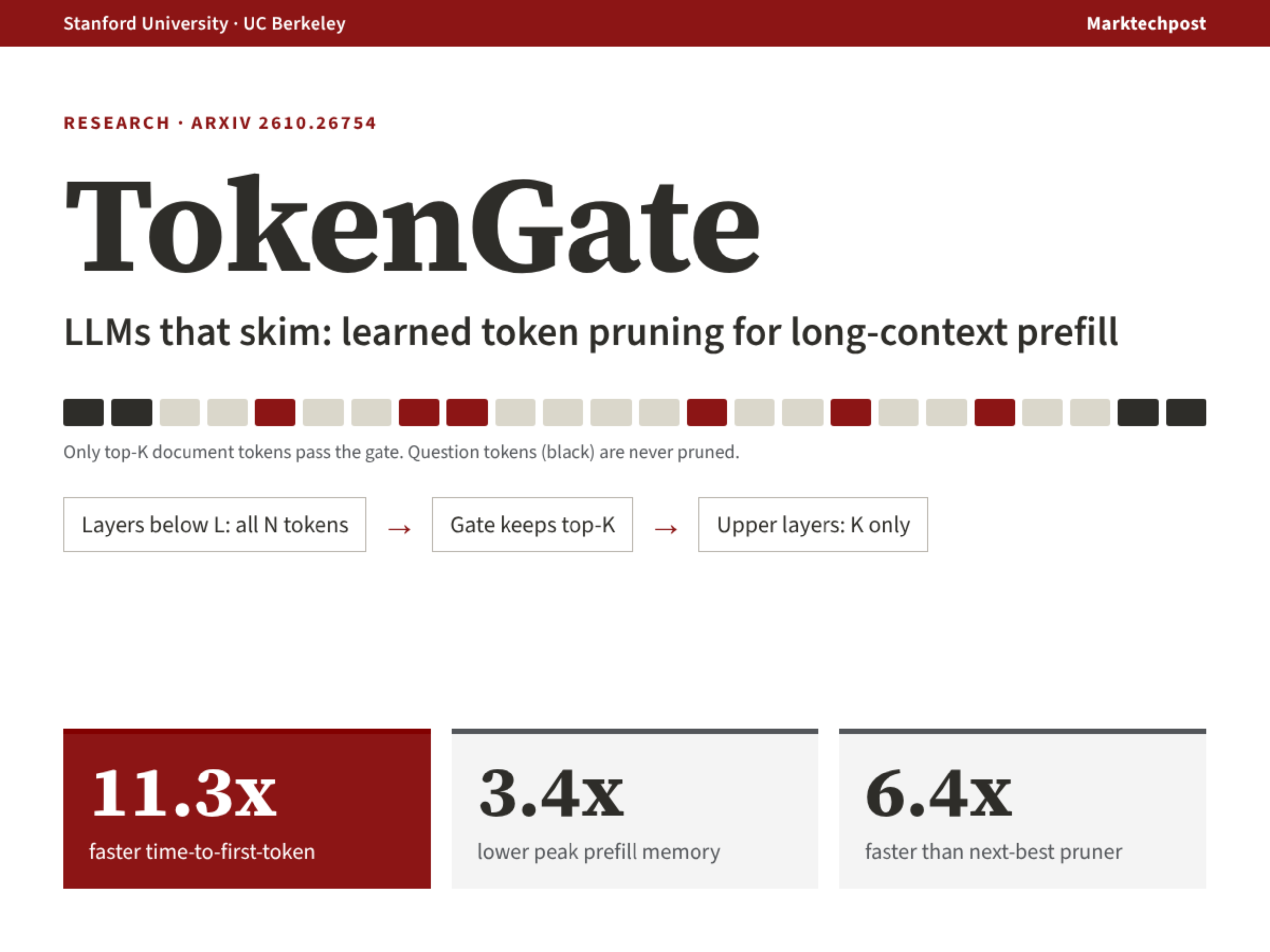
Researchers from Stanford and UC Berkeley Introduce TokenGate: Token-Gated Attention Makes Long-Context Prefill Up to 11.3x Faster

Researchers from Stanford University and the University of California, Berkeley have introduced TokenGate—a plug-and-play, learnable token-pruning module designed for existing large language models (LLMs). This approach accelerates the first-token generation time (TTFT) for long-context prefill by 1.4 to 11.3 times without sacrificing accuracy, while reducing peak memory usage by 1.5 to 3.4 times. The associated code and checkpoints have been made open source.

Researchers from Stanford and UC Berkeley Introduce TokenGate: Token-Gated Attention Makes Long-Context Prefill Up to 11.3x Faster
Timeline and related coverage

Measuring Research Progress and Linguistic Inclusion in Low-Resource Languages

arXiv:2610.30296v1 Announce Type: new Abstract: Large Language Models (LLMs) have accelerated research on low-resource and multilingual NLP, but their effectiveness in creating an equitable landscape remains unmapped. We analyze 1,158 peer-reviewed open-access papers published between 2020 and 2025, examining research attention to low-resource languages (LRLs) and representation across language and speaker populations. To assess linguistic inclusion beyond publication counts, we introduce the Linguistic Inclusion Framework (LIF), a multidimensional framework that measures linguistic inclusion in four dimensions: research growth, representation expansion, representation continuity, and distributional equity. While annual publications grew from 52 to 415, a 5.4X increase in their ACL Antholo

Measuring Research Progress and Linguistic Inclusion in Low-Resource Languages
Timeline and related coverage

Qwen1.5-32B: Fitting the Capstone of the Qwen1.5 Language Model Series

GITHUB HUGGING FACE MODELSCOPE DEMO DISCORD Introduction The open-source community has long sought a model that strikes an ideal balance between performance, efficiency, and memory footprint. Despite the emergence of cutting-edge models like Qwen1.5-72B and DBRX, the models have faced persistent challenges such as large memory consumption, slow inference speed, and substantial finetuning costs. A growing consensus within the field now points to a model with approximately 30 billion parameters as the optimal “sweet spot” for achieving both strong performance and manageable resource requirements.