Import AI 478: Math for alignment; ProgramBench; and Mirendil shows what RSI means
What is “night” to a machine?
Search headlines, summaries and articles to connect the dots.
What is “night” to a machine?
arXiv:2610.31726v1 Announce Type: new Abstract: Effective human-machine teaming requires agents that coordinate with unpredictable human partners. Reinforcement learning from live human feedback or large behavioural datasets is expensive, while purely simulated training overfits to artificial conventions and fails at Zero-Shot Coordination with real people. We propose a framework for training teaming agents against Cognitively Constrained Partners: simulated partners whose diversity emerges from procedural constraints grounded in human physiological literature, specifically reaction delays and perceptual limitations, rather than from reward shaping or historical training checkpoints. In a modified Lunar Lander environment, we report preliminary evidence that these partners play more like r

An AI research paper published on October 26, 2026, on arXiv (ID 2610.31820v1) states that, for large language models (LLMs) trained using value-based reinforcement learning (value-based RL), their existing critic modules can serve as high-accuracy, highly calibrated confidence estimators without requiring additional training or data.

Why it matters:This study reveals the mathematical equivalence between confidence estimation and Critic training in reinforcement learning (under a well-defined correctness metric), and empirically demonstrates the effectiveness and generalization capability of reusing the Critic across more than ten domains, including mathematics, code generation, tool invocation, and general reasoning. These findings hold direct engineering value for lowering the barriers to trustworthy LLM deployment.
arXiv:2610.31966v1 Announce Type: new Abstract: Demonstrations for in-context learning are often retrieved by semantic similarity, which may be a poor proxy for relevance in structured prediction. We study demonstration selection for Universal Dependencies parsing with a POS-signature policy that represents sentences with weighted part-of-speech statistics and retrieves three length-compatible, gold-parsed examples from the labeled training split. We evaluate two open-weight language models without fine-tuning on all 2,077 sentences of the UD English Web Treebank test set, comparing the policy with shot- and format-matched fixed and semantic three-shot baselines, as well as zero-shot, chain-of-thought, and critique-refinement systems. POS-signature retrieval yields the highest labeled atta
arXiv:2610.32122v1 Announce Type: new Abstract: We report a systematic dissociation in modern text embedders: sentiment is almost perfectly decodable from their embeddings, yet almost entirely absent from their metric. Across eleven frozen encoders spanning 2021 to 2026, including 2026-generation models and the 4B-parameter LLM embedder Qwen3-Embedding-4B, a linear probe recovers sentence polarity at up to 91.3% accuracy while cosine similarity separates polarity by a margin of only 0.003-0.064. Qwen3-Embedding-4B, the strongest probe in the panel, reaches 91.3% probe accuracy but only 64.3 retrieval MAP. Because retrieval, clustering, deduplication, and retrieval-augmented generation operate on the metric rather than on a trained probe, these systems are effectively blind to information t
arXiv:2610.32237v1 Announce Type: new Abstract: In modern financial markets, more than 3/4th of the large volume trade is executed by algorithmic trading based on advanced trading strategies to attain higher precision and speed than traditional human traders. The conventional strategies focused on price-based indicators are inadequate in capturing the market dynamism arising from real-world events such as social sentiments, political instability, or sudden economic shifts. With the rise of Deep Reinforcement Learning (DRL) and data availability, there is a requirement for more efficient algorithms that can incorporate these external factors in trading strategies. DRL has shown potential in simulating real-world scenarios and in simplifying complex decision-making since DRL agents can autom
arXiv:2610.31894v1 Announce Type: new Abstract: Recent Sparse Autoencoders (SAEs) decompose the representations of large language models (LLMs) into interpretable features, enabling precise readout and control of encoded knowledge. However, existing SAEs treat each feature as a standalone unit, whereas real-world knowledge is often taxonomically organized. As a result, readout carries no guarantee of taxonomic consistency, and control lacks the granularity to specify the scope of an edit. We propose TaxoSAE, which explicitly encodes taxonomical information, built on is-a (hypernym-hyponym) relations, into the SAE feature space. TaxoSAE mirrors a taxonomy with a stack of SAEs, one per taxonomy level, and introduces a taxonomic alignment loss that trains each concept to be active whenever on
arXiv:2610.32389v1 Announce Type: new Abstract: Trajectory transfer from rollout to training affects both learning quality and system efficiency in large language model reinforcement learning (RL). Enforcing batch-wide training requirements can delay the admission of completed trajectories, resulting in higher architectural staleness: the additional parameter-version gap from disaggregated pipelining relative to colocated execution. Beyond admission, misalignment between data access and training consumption causes redundant movement and unnecessary waiting when transferring large trajectory payloads. We present KnitTrans, a system that coordinates the rollout-to-training path through three designs. First, constraint-preserving mini-batch admission allows flexibility in early mini-batch com
arXiv:2610.31846v1 Announce Type: new Abstract: Intelligent agents should learn from their mistakes so that experience leads to continuous improvement. Yet today's agents recover from a mistake only temporarily: in-context reflections are easily forgotten across sessions and compete for limited context, while full-parameter fine-tuning is expensive and can interfere with existing capabilities. We introduce Self-Direction, a mechanism for agents to learn from mistakes that combines the benefits of temporary in-context retries and policy updates. When an agent fails a task, it reflects on its own trajectory in order to extract a lesson and immediately distills it into a lightweight low-rank adapter. By keeping the original weights frozen, Self-Direction prevents adapter training from overwri
arXiv:2610.32128v1 Announce Type: new Abstract: RAG and retrieval-augmented few-shot ICL can struggle when decision-relevant evidence is buried in long, noisy context. Retrieved passages and demonstrations may contain redundant or distracting information. Although expert-labeled development examples may identify the text supporting each decision, these annotations are typically used only as answer-side rationales rather than as supervision for filtering noisy retrieval. We propose silver-evidence demonstrations, which replace raw retrieved passages in ICL examples with generated, target-conditioned evidence summaries. For each labeled development example, an LLM generates silver evidence without access to the expert label or gold evidence; this evidence is then paired with the expert label
arXiv:2610.31833v1 Announce Type: new Abstract: LawZero's Scientist AI trains a Predictor toward the Bayesian posterior, with an objective that penalizes inconsistent probabilities among latent explanations. We ask whether current frontier language models, with no such training, are already consistent in this sense zero-shot: do their probability judgments satisfy the law of total probability, $P(X)=\sum_z P(z)P(X|z)$, when the latent $z$ must be inferred from records in the context? In separate single-turn calls, models are asked for $P(X)$, for $P(z)$ over the latent's states, and for $P(X|z)$; a causal family applies the same test to $P(y|do(x))$ and the back-door adjustment. Every query has an exact ground-truth probability, and a subset of items is asked in three wordings to separate
arXiv:2610.32241v1 Announce Type: new Abstract: Traditional heuristic methods have accumulated mature experience in core objectives, such as space utilization and layout compactness of 3D bin packing, relying on artificially designed rule-based logic. However, they exhibit obvious limitations in generalization ability and adaptability to dynamic scenarios. Diffusion reinforcement learning, which integrates the spatial search capability of reinforcement learning and the data distribution modeling capability of diffusion learning, has achieved certain progress in action distribution modeling and decision compliance constraints. Nevertheless, there remain issues including insufficient perception of the spatial topological structure in 3D bin packing and limited layout optimization capability.
arXiv:2610.32583v1 Announce Type: cross Abstract: Multiagent deterministic GLP (madGLP) runs Grassroots Logic Programs (GLP) as agents that communicate solely by asynchronous message passing, and assumes fair delivery: every message sent is eventually delivered. Each agent runs on a person's smartphone, named by the person's public key. A grassroots platform depends on no global resource but the network, so agents must reach one another over Bluetooth Low Energy, on a local network, and across the Internet from behind NAT, via rendezvous servers anyone can run. What madGLP requires of such a network, and what the network requires of the platform, has not been specified. We specify the networking layer beneath madGLP. Anything that can be done in GLP is done in GLP: the layer provides only
arXiv:2610.31687v1 Announce Type: new Abstract: Large language models are increasingly used to simulate and probe human behavior, e.g., for surveys. For these applications, a key property is that outputs satisfy distributional alignment: to match its output distribution with some reference (in this case, human) distribution. An obstacle in achieving distributional alignment is generalizing from small training data. In this work, we study (1) how to distributionally align LLMs; and (2) how aligned LLMs might generalize to unseen samples and unrelated topics and tasks. Using two large-scale benchmarks, we find that LLMs can indeed achieve distributional alignment and generalize to unseen questions of the same domain. Cross-topic generalization depends on the relationship between topics (e.g.
arXiv:2610.31810v1 Announce Type: new Abstract: Even a carefully proofread paper can leave small gaps in its proofs or its stated assumptions. We introduce PaperFormalizer, a Lean-based agentic pipeline that helps authors find and close such gaps in their own papers and turn each paper into a Lean-verified version. Starting from the LaTeX source, PaperFormalizer transcribes the paper into a dependency graph of statements, audits each statement in natural language for faithfulness, ambiguity and correctness, and then formalizes and proves the statements in Lean against Mathlib, optional domain libraries and the author's personal toolkit. Only the author knows what a statement is meant to say and how a formalization gap in a result is best fixed. The pipeline therefore stops and asks the aut
arXiv:2610.31911v1 Announce Type: new Abstract: As large language models (LLMs) process increasingly long sequences, attention becomes a major computational bottleneck. Sparse attention mostly targets inference, yet many methods still train densely or cannot support sparse training, and their added complexity makes sparsity hard to turn into wall-clock speedups, leaving dense attention widely used in practice. This paper introduces LazyFlash, a forward-dense, backward-sparse attention method built on the observation that attention training is dominated by the backward pass. LazyFlash keeps the forward pass exactly dense, so the trained model remains a standard dense model that existing systems such as vLLM can serve without any change. For the backward pass, LazyFlash proposes a gradient-a
arXiv:2610.32803v1 Announce Type: new Abstract: The consensus protocols of most high-performance blockchains use quorum certificates, which bundle the signatures of a quorum of validators. Signature schemes such as BLS can aggregate the signatures of a whole quorum into a single short signature, which keeps these certificates small. A large-scale quantum computer would break these schemes, and no post-quantum scheme with comparable aggregate size and aggregation time is known. Without aggregation, a certificate holds one large post-quantum signature per member of the quorum, so it becomes infeasible for each validator to broadcast certificates, as modern consensus protocols often require. We present Quantum Cadence, a post-quantum consensus protocol with multiple concurrent proposers that
arXiv:2610.32034v1 Announce Type: new Abstract: The growing population of orbital debris has intensified interest in active debris removal and on-orbit servicing, for which dual-arm space manipulators offer improved grasping stability and load distribution relative to single-arm systems. However, coordinating two manipulators under inter-arm collision avoidance, orientation alignment, and sensing uncertainty remains challenging. This paper develops a coordinated reinforcement learning framework for cooperative motion planning of a dual-arm space manipulator in a target-reaching task with inter-arm collision-avoidance constraints. A centralized state representation combines joint-space, end-effector, and target-relative information, while a multi-objective reward function promotes target-re
We present GHARP (Real-time Gaussian Head Animation from Large-scale Reconstruction Prior), a method that animates 3D human heads in real time from a few input images of a subject and a driving expression signal. We decouple the problem into an identity stage that builds a representation of the subject’s geometry and appearance offline, and an animation stage that predicts expression-dependent residuals on top of it at runtime. This separation offers a favorable trade-off with respect to fidelity, quality and runtime: the identity stage can be expensive while the animation stage runs a…
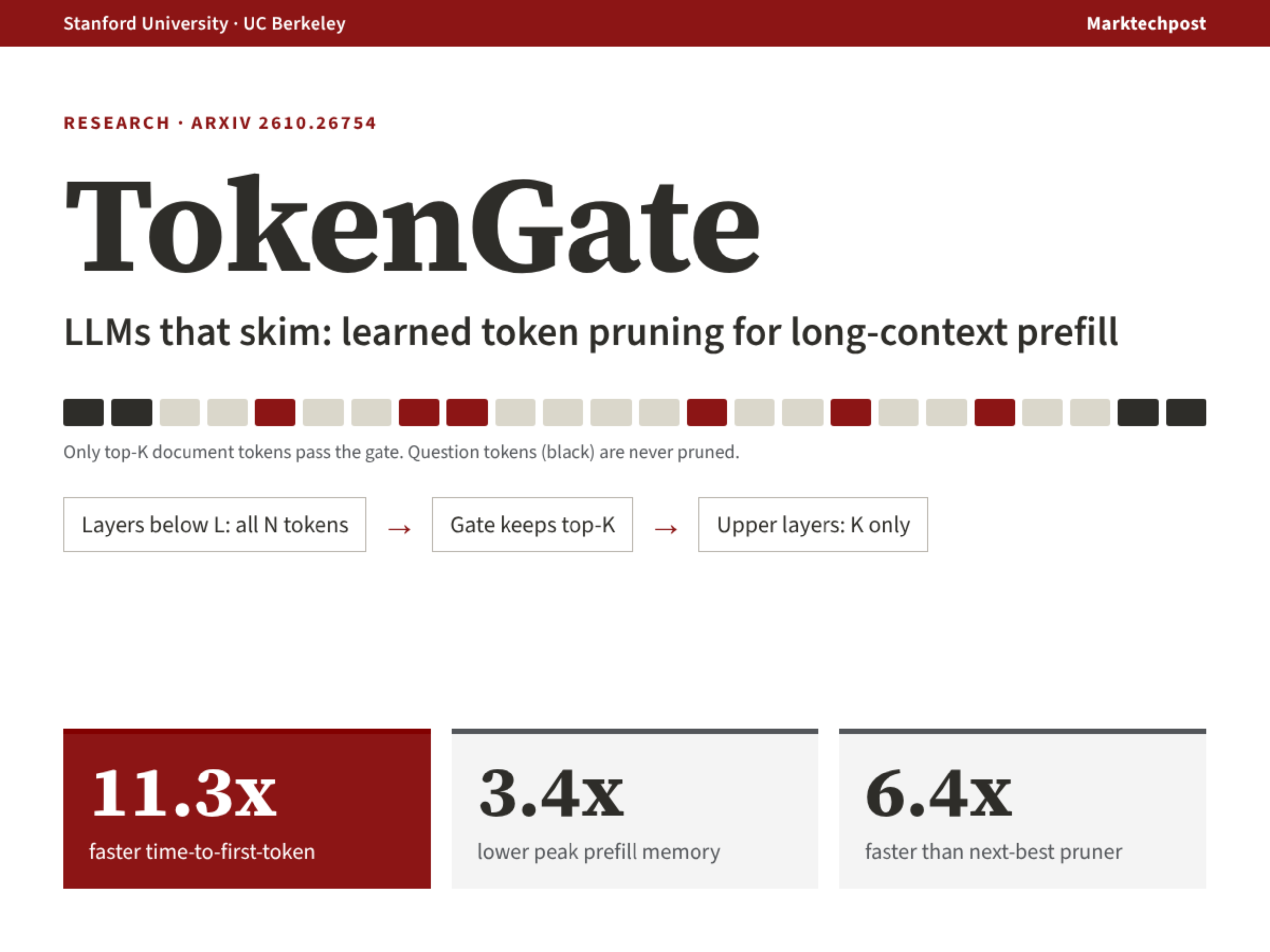
Researchers from Stanford University and the University of California, Berkeley have introduced TokenGate—a plug-and-play, learnable token-pruning module designed for existing large language models (LLMs). This approach accelerates the first-token generation time (TTFT) for long-context prefill by 1.4 to 11.3 times without sacrificing accuracy, while reducing peak memory usage by 1.5 to 3.4 times. The associated code and checkpoints have been made open source.