
Skip to content
AI NEWS JOURNAL
AI, IN PERSPECTIVE

Search AI news

Search headlines, summaries and articles to connect the dots.

Newest first

Genie 4 is now available

Google introduces a new Project Genie experience for eligible Google AI Ultra subscribers, featuring Genie 4—the most realistic and interactive world model yet—enabling real-time prompt-based changes to environments, native audio adaptation, and extended session capabilities. Upgrades to Genie 3 include longer runs, 360-degree panorama grounding, and real-time in-world events. The Project Genie agent allows users to create interactive worlds through natural language prompts, while the community gallery offers curated and user-generated worlds for exploration and remixing. Safety measures like SynthID watermarking and content screening are in place, and ongoing research addresses challenges such as camera latency and scene permanence.
AK_QMUL at ArGuard Shared Tasks: A Single Fine-Tuned JAIS for Arabic Harmful-Prompt Detection

arXiv:2610.36360v1 Announce Type: new Abstract: We present AK_QMUL's submissions to the ArGuard-2026 shared tasks on Arabic harmful-prompt detection: a binary safe/unsafe task (B1) and a seven-way harm-domain task (B2). Both submissions use one backbone -- JAIS-6.7B fine-tuned with 4-bit QLoRA and a linear classification head over its last-token representation. For B1 we train a four-way head that factors the label by dialect register {safe, unsafe} x {MSA, other}, we augment the training fold with MSA prompts from AraSafe, and decode with a plain argmax to score safe/unsafe. For B2 we fine-tune the same backbone as a seven-way classifier and average the softmax outputs of five random seeds. Both submissions ranked first on their track, with macro-F1 0.984 on B1 and 0.790 on B2. We report

Timeline and related coverage

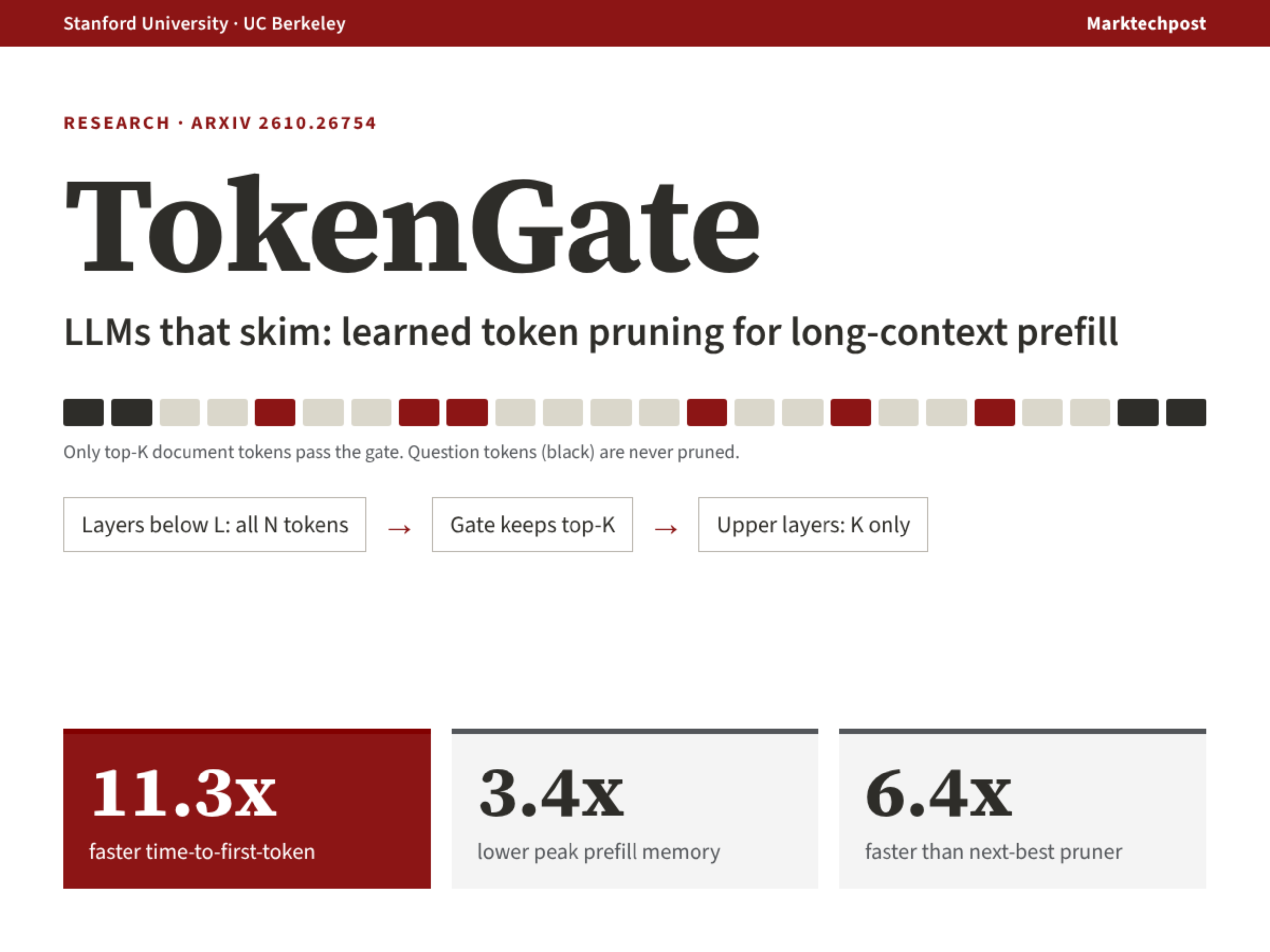
Researchers from Stanford and UC Berkeley Introduce TokenGate: Token-Gated Attention Makes Long-Context Prefill Up to 11.3x Faster

Researchers from Stanford University and the University of California, Berkeley have introduced TokenGate—a plug-and-play, learnable token-pruning module designed for existing large language models (LLMs). This approach accelerates the first-token generation time (TTFT) for long-context prefill by 1.4 to 11.3 times without sacrificing accuracy, while reducing peak memory usage by 1.5 to 3.4 times. The associated code and checkpoints have been made open source.

Researchers from Stanford and UC Berkeley Introduce TokenGate: Token-Gated Attention Makes Long-Context Prefill Up to 11.3x Faster
Timeline and related coverage

New research reveals that open-book assessments primarily measure reading behavior rather than knowledge retention.

An arXiv paper published on October 24, 2026 (2610.31017v1) points out that, in document-level LoRA adapter evaluations, open-book scoring relies heavily on the model’s ability to read on the fly, rather than on whether the adapter has truly encoded knowledge specific to the document; random adapters can reproduce 82% of the performance advantage of expert adapters on open-book tasks, but on cloze tasks involving unstructured text, they only replicate 2%—statistically indistinguishable from zero.

Mostly Reading: What Open-Book Scores Measure in Document-Level LoRA Adapters

Why it matters:This study, through systematic controlled experiments—comprising 150 Wikipedia articles, the Llama-3.1-8B-Instruct model, and a two-task comparison—reveals the fundamental limitations of the current open-book evaluation paradigm: it fails to effectively distinguish between “reading” and “remembering,” posing methodological challenges to the practical utility of knowledge-editing and retrieval‑oriented adapters. The paper also reports four silent errors that lead to “clean yet incorrect results,” highlighting risks to reproducibility.

Timeline and related coverage