
Making machines that can listen
Professor Paris Smaragdis develops computers with superhuman hearing for applications like speech recognition, music understanding, and environmental monitoring.

Search headlines, summaries and articles to connect the dots.
Professor Paris Smaragdis develops computers with superhuman hearing for applications like speech recognition, music understanding, and environmental monitoring.
Fake faces, cheap product clips, and rule-skirting story ads are pouring into short-video commerce. Platforms are answering with automated review systems. Honest advertisers are stuck paying for the cleanup.
arXiv:2610.33299v1 Announce Type: new Abstract: To understand the emergence of grammatical behavior in language models, we track circuits for subject-verb number agreement in pythia-1b and ten seeds of pythia-410m across training. We find that subject-verb agreement is learned early, and is initially handled by a diffuse collection of neurons. However, after agreement behavior has stabilized, the mechanisms responsible for it continue to reorganize. The attention heads which mediate agreement often shift during training: in the case of pythia-1b, behavior is controlled by two heads early in training but by a third (different) head later. Furthermore, the circuit shrinks over training, with pythia-1b's final circuit being strikingly sparse. We take these results to be informative about how
arXiv:2610.32104v1 Announce Type: new Abstract: Several formal theories have been developed to characterize the capabilities and limitations of the transformer architecture, each employing different abstractions that capture different features of the architecture. Due to the differences in their underlying assumptions and conceptual frameworks, these theories can disagree in their predictions about what tasks transformers find easy or hard. We map out seven theories of transformer capability (Star-free, $\mathsf{AC}^0$, $\mathsf{TC}^0$, C-RASP, MPC, BAPO, and Sensitivity) and translate their results into a common matrix of predictions across a suite of tasks covering different computational structures. We provide new theoretical results to complete this matrix. We then evaluate theoretical
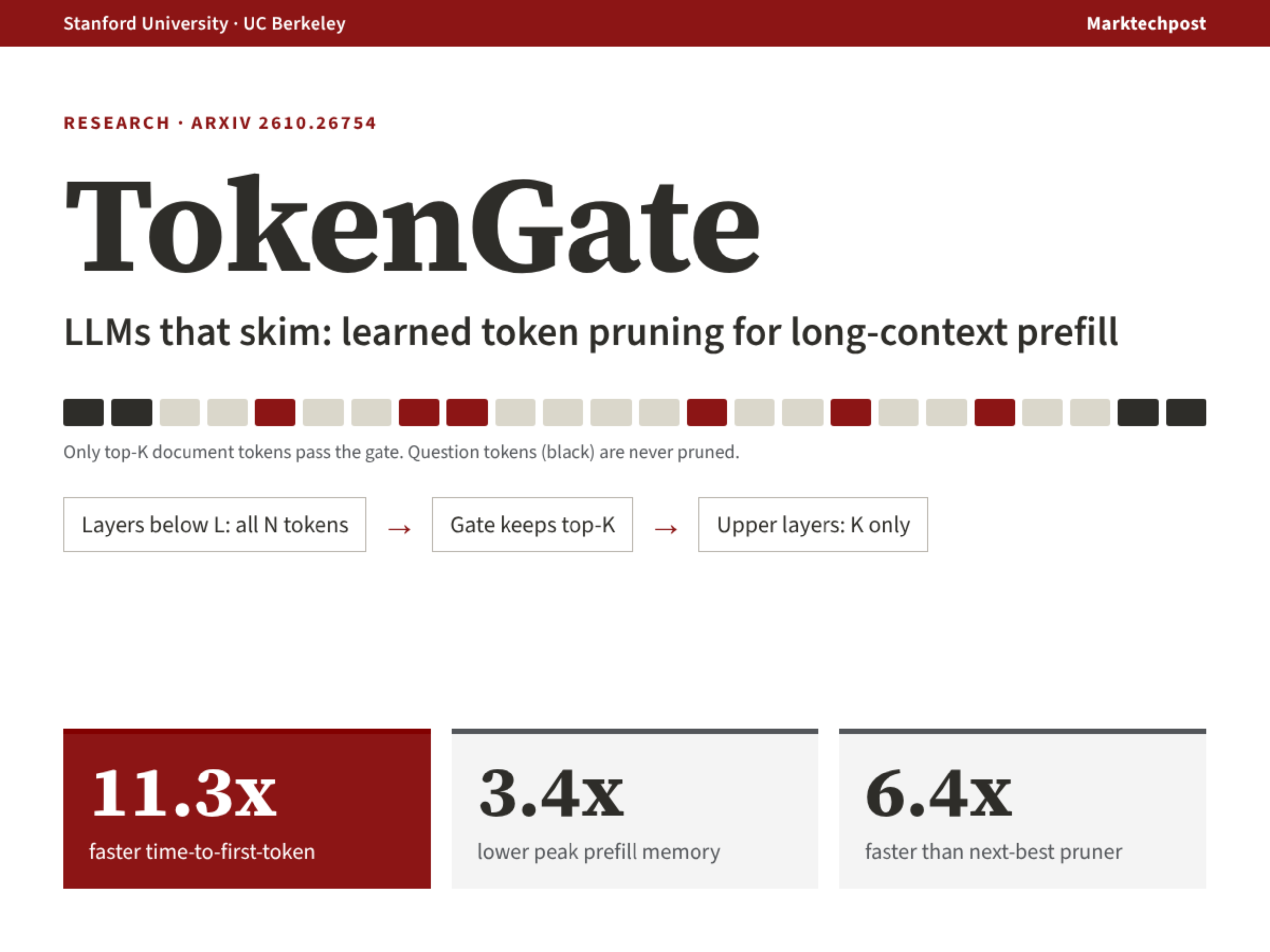
Researchers from Stanford University and the University of California, Berkeley have introduced TokenGate—a plug-and-play, learnable token-pruning module designed for existing large language models (LLMs). This approach accelerates the first-token generation time (TTFT) for long-context prefill by 1.4 to 11.3 times without sacrificing accuracy, while reducing peak memory usage by 1.5 to 3.4 times. The associated code and checkpoints have been made open source.
arXiv:2610.30296v1 Announce Type: new Abstract: Large Language Models (LLMs) have accelerated research on low-resource and multilingual NLP, but their effectiveness in creating an equitable landscape remains unmapped. We analyze 1,158 peer-reviewed open-access papers published between 2020 and 2025, examining research attention to low-resource languages (LRLs) and representation across language and speaker populations. To assess linguistic inclusion beyond publication counts, we introduce the Linguistic Inclusion Framework (LIF), a multidimensional framework that measures linguistic inclusion in four dimensions: research growth, representation expansion, representation continuity, and distributional equity. While annual publications grew from 52 to 415, a 5.4X increase in their ACL Antholo

PyTorch 2.15 brings a major MPS backend upgrade to Apple Silicon Macs, natively supporting FP8 tensor operations on macOS for the first time, boosting MoE model decoding speed by 5–6.5 times, reducing peak video VAE memory usage from 270 GiB to 8 GiB, and migrating numerous operators from MPSGraph to dedicated Metal kernels.