Skip to content
AI NEWS JOURNAL
AI, IN PERSPECTIVE

Search AI news

Search headlines, summaries and articles to connect the dots.

Newest first

GHARP: Real-Time Gaussian Head Animation from Large-Scale Reconstruction Prior

We present GHARP (Real-time Gaussian Head Animation from Large-scale Reconstruction Prior), a method that animates 3D human heads in real time from a few input images of a subject and a driving expression signal. We decouple the problem into an identity stage that builds a representation of the subject’s geometry and appearance offline, and an animation stage that predicts expression-dependent residuals on top of it at runtime. This separation offers a favorable trade-off with respect to fidelity, quality and runtime: the identity stage can be expensive while the animation stage runs a…

Timeline and related coverage

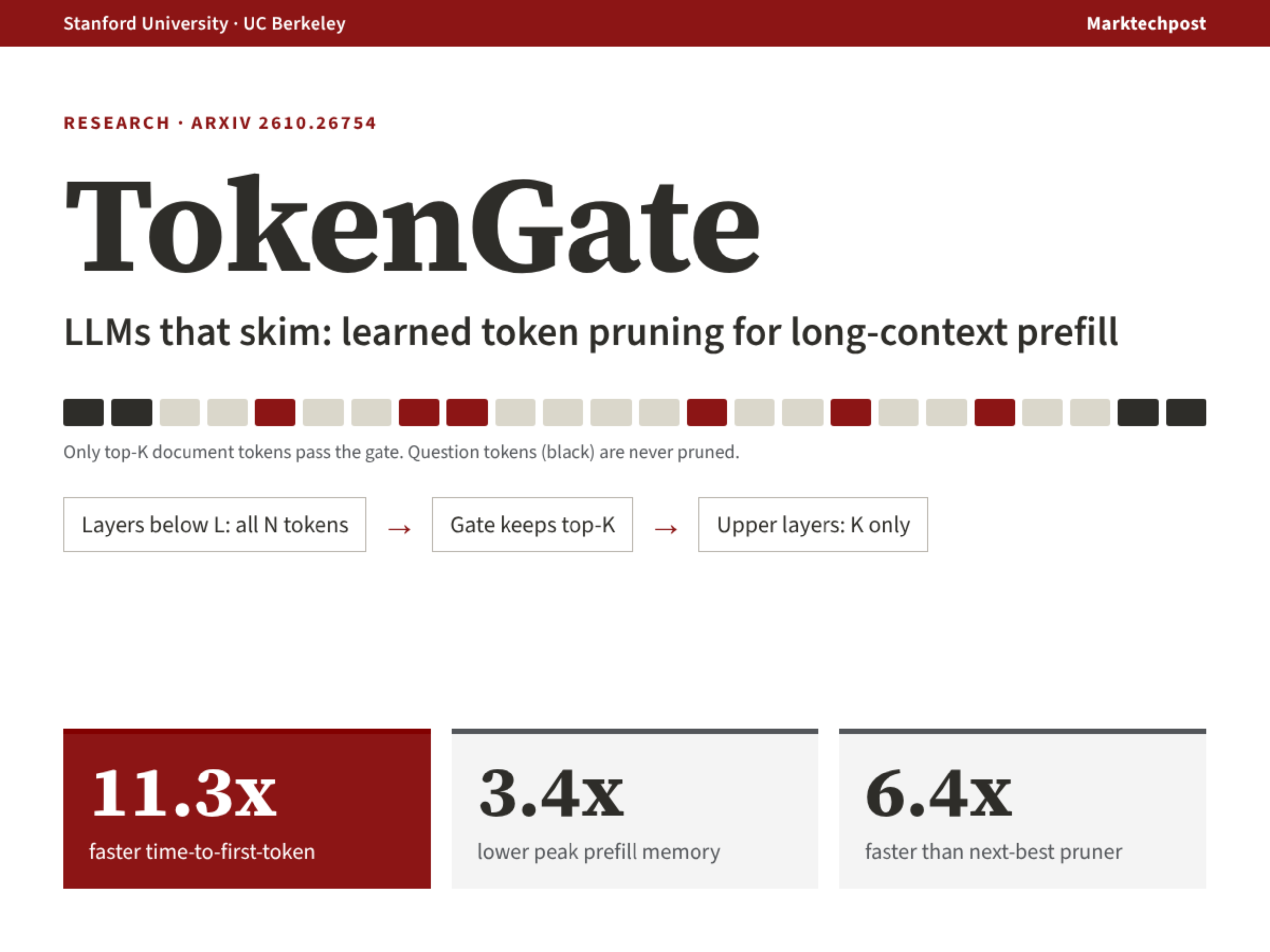
Researchers from Stanford and UC Berkeley Introduce TokenGate: Token-Gated Attention Makes Long-Context Prefill Up to 11.3x Faster

Researchers from Stanford University and the University of California, Berkeley have introduced TokenGate—a plug-and-play, learnable token-pruning module designed for existing large language models (LLMs). This approach accelerates the first-token generation time (TTFT) for long-context prefill by 1.4 to 11.3 times without sacrificing accuracy, while reducing peak memory usage by 1.5 to 3.4 times. The associated code and checkpoints have been made open source.

Researchers from Stanford and UC Berkeley Introduce TokenGate: Token-Gated Attention Makes Long-Context Prefill Up to 11.3x Faster
Timeline and related coverage

Google’s AI search feature deals a severe blow to the online publishing industry: traffic plummets, lawsuits abound, and compensation mechanisms are only just being explored.

In 2024, Google launched AI Overviews, and in May 2025 it rolled out AI Mode, causing a significant drop in search traffic from Google across several major media outlets—The New York Times saw its share of search traffic fall from 44% to 35.5% over three years. Among DCN members, 19 experienced traffic losses ranging from 1% to 25% in May–June 2025, with DMG Media reporting a peak decline of 89% in click-through rates. Publishers filed multiple lawsuits, but all were dismissed by U.S. judges; Google subsequently introduced an opt-out option, enhanced source attribution, and launched a news AI pilot involving 400 media organizations, along with a content‑paying test program.

Google’s AI search changes upended online publishing

Why it matters:The report systematically examines the structural impact of Google’s AI-powered search feature on the publishing ecosystem, covering a timeline (2024–2025), empirical data (from third-party institutions), responses from multiple stakeholders (publishers, regulators, courts, and nonprofit organizations), and recent countermeasures (opt-out mechanisms, source optimization, and licensing and paid-access pilots). The content is information-dense, timely, and policy-relevant.


Timeline and related coverage

Flint-interactive: An interactive data visualization programming language for AI agents

Microsoft Research has unveiled Flint-interactive, a domain-specific language for building highly expressive, semantically rich interactive data visualizations. Its compiler automatically maps user interactions—such as clicks and brush selections—to semantic events and uses high-level operators to drive coordinated updates across multiple elements, including charts, tables, and text, significantly reducing the cost and development complexity of creating reliable interactive visualizations with AI agents.

Timeline and related coverage

OlmoEarth v1.3 Released: A High-Performance Open-Source Satellite Embedding Model for the Global Surface

The Allen Institute for AI has released OlmoEarth v1.3, offering planet-wide satellite embedding vectors at 10-meter resolution in both 64-dimensional and 128-dimensional formats, along with the interactive exploration tool Embeddings Explorer. It supports zero-code change detection, similar-region retrieval, and lightweight classification modeling.

Timeline and related coverage

A 31-year-old unsolved problem in mathematics, the KLS conjecture, has been proven: a fundamental breakthrough has been achieved in high-dimensional geometry and the theory of randomized algorithms.

On October 4, 2026, Zhang Xinzhi, a researcher at Microsoft Research, together with his collaborators, completed a rigorous proof of the Kannan–Lovász–Simonovits (KLS) conjecture, thereby resolving a long-standing central problem that had remained open since its formulation in 1995. This achievement establishes a dimension-independent constant bound for the “plane‑cut bottleneck” in high-dimensional log-concave distributions, providing an unconditional theoretical foundation for random sampling, convex optimization, and theoretical computer science.

Timeline and related coverage

Google Research advances AI agents rooted in real-world wet labs: Building the three technological cornerstones of autonomous biological discovery

Google Research has unveiled three key technological advances—the VERID digital twin framework, a closed-loop aptamer discovery system, and a targeted epitope‑cleaving protein design workflow—enabling AI agents to achieve a traceable, verifiable, and self‑iterating molecular discovery loop in real wet‑lab settings.

Timeline and related coverage

Simulating student learning for better AI tutoring

StudentSim is a research system for evaluating and improving AI tutoring tools before they are tested with learners. It models how individuals may engage with tutors, giving feedback to improve tutor performance across subjects like chess, writing, and mathematics. The post Simulating student learning for better AI tutoring appeared first on Microsoft Research.

Timeline and related coverage

What AI gets wrong and what failure teaches us

Jennifer Neville did not want to go into computer science—but that’s exactly where she landed. Neville discusses the starts and stops that led to her professional sweet spot and her work identifying “surprising failures” making it hard for AI to handle complexity. The post What AI gets wrong and what failure teaches us appeared first on Microsoft Research.

Timeline and related coverage