
Measuring how AI agents handle everyday wet-lab science
OpenAI introduces BioBasicsBench, a 100-task benchmark measuring how well AI agents interpret raw experimental data and handle everyday wet-lab science.
Search headlines, summaries and articles to connect the dots.
OpenAI introduces BioBasicsBench, a 100-task benchmark measuring how well AI agents interpret raw experimental data and handle everyday wet-lab science.
Flipsnack focused its ChatGPT Ads campaigns on getting people to try its product, growing registrations while lowering the cost per signup.
OpenAI built an autonomous pipeline that found, validated, and generated patches for 948 local privilege-escalation vulnerabilities in the Linux kernel.
Daybreak Red brings GPT-5.6 Cyber to approved customers in AWS GovCloud (US-East) through Amazon Bedrock for authorized cybersecurity work.
arXiv:2610.38355v1 Announce Type: new Abstract: KV cache reuse accelerates LLM serving, but existing systems manage host DRAM and NVMe SSD as a tiered hierarchy where DRAM acts as an intermediate cache. Production LLM workloads break both premises of this hierarchy. First, bimodal reuse defeats DRAM temporal filtering, since workloads are dominated either by one-shot blocks with long reuse distances or by multi-gigabyte agentic sessions that exceed DRAM capacity, putting SSD on the critical read path. Second, DRAM staging and eviction-ordered layout bottleneck SSD restoration. Holding host staging buffers for in-flight prefixes causes contention under load that aborts prefetches, while incremental eviction scatters a session's blocks across the SSD and prevents large sequential reads. We p
arXiv:2610.37676v1 Announce Type: new Abstract: Automated interpretability scores an explanation of a sparse-autoencoder (SAE) feature by asking a model to predict, token by token, where the feature fires on evaluation examples or to judge whether marked tokens fit it. We find that the evaluation data standard pipelines build can be scored without reading the explanation. On Neuronpedia's stored fuzzing runs for 500 random GPT-2 small features, 91.3% of activating examples are cropped with the peak on the centre token, and a rule that says "yes" when the centre token is marked reaches balanced accuracy 0.979, against 0.838 for the stored LLM scorers (recomputed from the stored per-item verdicts, on marks rebuilt from the pipeline's code); a rule reading only the mark count reaches 0.969. T
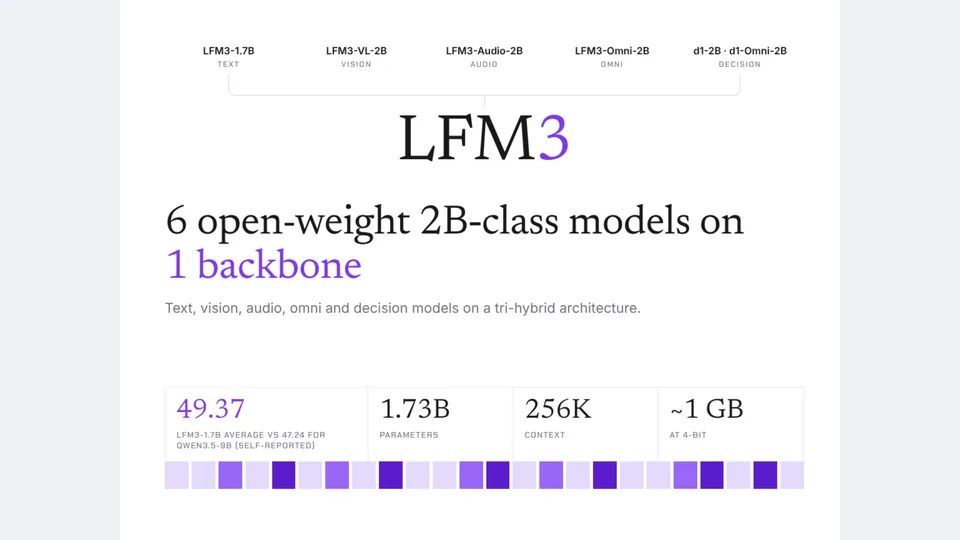
Liquid AI released LFM3, 6 open-weight 2B-class models for text, vision, audio, omni and decisions. LFM3-1.7B uses a tri-hybrid backbone, a 256K context window and fits in about 1 GB at 4-bit. The post Liquid AI Releases LFM3: 6 Open-Weight 2B-Class Multimodal Models appeared first on MarkTechPost.
Katelyn Lesse and Angela Jiang on Opus 5.5, the Claude Platform, and the engineering behind AI agents.

Katelyn Lesse and Angela Jiang join Latent Space to explain the engineering behind the Claude Platform: launching Opus 5.5, separating the model’s “brain” from the agent’s “hands,” scaling APIs, and building reliable managed agents. A new introduction ...
Mirendil released Fern 0.1, its first model, pretrained from scratch with a 10M-token context window. It targets agentic AI R&D work, scores 100% on RULER single needle at 10M, but trails frontier models on agentic coding. The post Mirendil Launches Fern 0.1, Its First Model, With 10M-Token Context appeared first on MarkTechPost.
Baidu has released Unlimited OCR 2, an MIT-licensed 3B OCR model that parses hundred-page documents in one request. Its SR-SWA attention keeps per-step decoding cost nearly flat, scoring 77.1 on MarathonDocBench The post Baidu Open-Sources Unlimited OCR 2 for Hundred-Page Document Parsing appeared first on MarkTechPost.

arXiv:2610.34436v1 Announce Type: new Abstract: A looped language model runs one block of layers $R$ times per token, so its key-value (KV) cache holds $R$ planes per recurrent layer, and self-speculative decoding (draft with a few loops, verify with all $R$) reads them all. We find that prefix keys and values matter late: at equal perturbation size, loops 25-32 are $e^{15.0}$ (Huginn-0125) and $e^{12.8}$ (Raven-Llama) times more sensitive than loops 2-9, and the planes approach the last one geometrically, at 0.88 and 0.81 per loop. Whether the deepest plane alone suffices then depends on how ripe the late planes are: on Raven, storing only it is indistinguishable from a bf16-to-fp32 change; on Huginn, 1% of positions carry 74% of its error. We turn this into RIPE, which stores the deepest
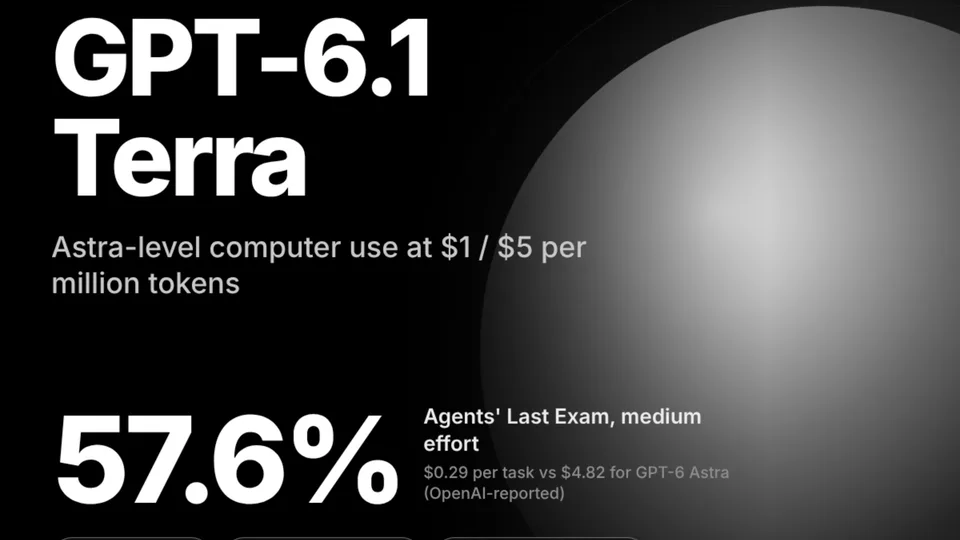
OpenAI released GPT-6.1 Terra, a fast computer-use and vision model priced at $1/$5 per million tokens. It matches GPT-6 Astra’s medium-effort Agents’ Last Exam score at $0.29 per task versus $4.82. The post OpenAI Launches GPT-6.1 Terra, Halving GPT-6.1 Sol’s API Price for Agent Work appeared first on MarkTechPost.
Build specialized multimodal models with LFM3
When you’re speaking to a device, you expect text to appear as you talk. That makes streaming automatic speech recognition (ASR) a different challenge from batch transcription, where the model... The post Optimizing Streaming Speech Recognition on Arm® Edge Devices with ExecuTorch appeared first on PyTorch.


Nanbeige LLM Lab released Nanbeige4.3-33B, a 33B dense Apache 2.0 model with 512K context. It reports 80.9 on Terminal-Bench 2.1 and will teach the upcoming Nanbeige4.3-3B. The post Nanbeige Releases Nanbeige4.3-33B, a 33B Open Agentic Coding Model appeared first on MarkTechPost.

API Documentation (Chinese) HuggingFace Demo ModelScope Demo Introduction After the release of Qwen2.5, we heard the community’s demand for processing longer contexts. In recent months, we have made many optimizations for the model capabilities and inference performance of extremely long context. Today, we are proud to introduce the new Qwen2.5-Turbo version, which features: Longer Context Support: We have extended the model’s context length from 128k to 1M, which is approximately 1 million English words or 1.
GITHUB HUGGING FACE MODELSCOPE DEMO DISCORD Introduction In recent months, our focus has been on developing a “good” model while optimizing the developer experience. As we progress towards Qwen1.5, the next iteration in our Qwen series, this update arrives just before the Chinese New Year. With Qwen1.5, we are open-sourcing base and chat models across six sizes: 0.5B, 1.8B, 4B, 7B, 14B, 32B, 72B, and 110B, and also an MoE model (see blog for more information).