nemotron-halloween
nemotron-halloween
Search headlines, summaries and articles to connect the dots.
nemotron-halloween
## New Models ### Mistral Large 4 (Le Chonk) Mistral Large 4 is Mistral's largest and most capable model to date: a 1 trillion-parameter natively multimodal Mixture-of-Experts model with 49 billion active parameters per token (52 billion including embeddings and output layers), trained from scratch on 3,800 NVIDIA Grace Blackwell GPUs in Mistral's own datacenters in Europe. Mistral Large 4 unifies instruction following, reasoning, coding, and agentic workflows in a single set of weights. While a generalist model, it shows especially good performance on workloads such as cybersecurity, finance, and law, and it surpasses frontier closed models on visual grounding. It is natively fluent in 160+ languages, including every official language of the European Union. #### Key Features Mistral Large
The weights of Mistral Large 4 (Le Chonk) are now open. A 1T parameter multimodal model, and best open-weight model for coding, trained in Europe.
Infini-AI-Lab released Hermit, an Apache-2.0 harness adapter framework that trains an external layer of instructions, skills, memory and tools from task feedback, leaving the agent’s model and harness unchanged. The post Infini-AI-Lab Releases Hermit, an Open-Source Harness Adapter Framework for AI Agents appeared first on MarkTechPost.
Google’s new frontier model leads independent evals, with access initially limited to trusted defenders.
Nvidia Corp. today released a leaderboard-winning open artificial intelligence model for multilingual audio transcription and translation, along with an open data pipeline for fine-tuning Nemotron 3.5 Transcribe. Traditional transcription AI models follow a workflow that detects speech, transcribes it, identifies and labels different speakers, then answers questions about the transcription. Transcribe does all of this […] The post Nvidia releases all-in-one adaptable Nemotron 3.5 audio transcription and translation model appeared first on SiliconANGLE.
FlashMap is a speculative decoding drafter from Polymathic AI, Princeton and USC ISI researchers. It drafts 16 tokens jointly in one pass and reaches up to 6.14x lossless speedup on Qwen3-8B. The post Polymathic AI and Princeton Researchers Release FlashMap, a Flow Map Drafter for 6.14x Faster LLM Decoding appeared first on MarkTechPost.

arXiv:2610.36353v1 Announce Type: new Abstract: Large language models (LLMs) often answer ambiguous inputs as if they had a single intended meaning. This is problematic because input ambiguity is an upstream source of uncertainty: when a prompt admits multiple valid interpretations, the key question is whether the model should answer directly at all. Existing input uncertainty methods often rely on LLM-generated statements or clarifications, but such transformations may already disambiguate the input before the ambiguity is measured. We propose a label-preserving perturbation framework for input ambiguity detection in which perturbations remain close to the original input while preserving its label. We instantiate this principle with two detectors: a black-box rule-based perturbation libra
arXiv:2610.36184v1 Announce Type: new Abstract: Bengali, spoken by over 230 million people, remains severely under-resourced in spoken language research. Existing open Bengali ASR corpora are confined to short, read or crowd-sourced speech and lack speaker diarization and long-form audio. We present Lipi-Ghor, a large-scale weakly-supervised Bengali speech corpus comprising 885 hours of audio sourced from 998 YouTube videos across 596 unique channels, spanning 17 diverse domains including audiobooks, drama, religious sermons, news, and regional dialects. Each recording is annotated in SSTT format (Speaker, Speech, Transcription, Timestamp), which combines automated diarization with Bengali YouTube caption tracks. To our knowledge, Lipi-Ghor is the first Bengali speech corpus to pair large-
arXiv:2610.36524v1 Announce Type: new Abstract: Can controlled symbolic inputs reveal attention heads that influence a language model's decisions from natural language evidence? We introduce controlled evidence aggregation (CEA), which varies the counts and order of two symbols in otherwise fixed prompts and measures changes in a frozen Transformer's preference between two answer tokens. The preference is measured by their logit difference; the prompts prescribe no correct answer. Balanced utility causal selection (BUC) identifies compact head sets by jointly evaluating how much ablating their outputs removes the count effect and how closely patching mean outputs between count conditions recovers the effect in both directions. We derive conditional bounds linking head attribution to interv
NVIDIA Nemotron 3.5 Transcribe and Granary v2: Intelligent Multilingual Transcription You Can Prompt and Adapt
Katelyn Lesse and Angela Jiang on Opus 5.5, the Claude Platform, and the engineering behind AI agents.

Property Finder found that 96.8% of their vision-AI evaluation labels were inherited from the incumbent model, hiding its true accuracy. See how they built unbiased ground truth, applied evolutionary prompt optimization, and selected a more accurate, cost-effective model on Amazon Bedrock, cutting cost by 86% across 11 image-quality attributes.
In this post, we show how Exowatt used Amazon SageMaker AI serverless model customization to build a repeatable AI pipeline that produces task-specific fine-tuned models for two deployment targets, edge and cloud, achieving higher accuracy than frontier models at up to 49x lower cost.
Generating tokens faster starts with identifying what limits inference performance. In the batch-size-1 evaluation of Ling-3.0-flash from Inclusion AI on NVIDIA...
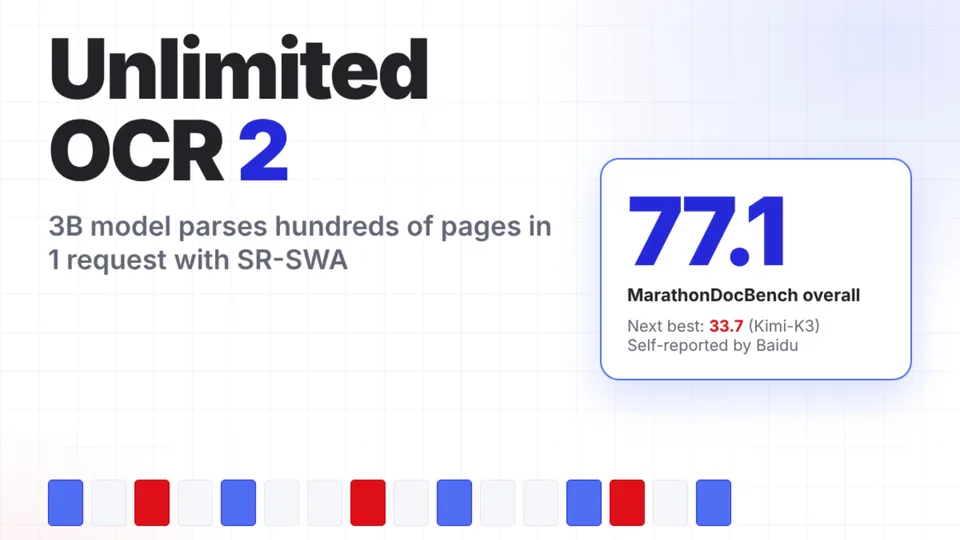
Baidu has released Unlimited OCR 2, an MIT-licensed 3B OCR model that parses hundred-page documents in one request. Its SR-SWA attention keeps per-step decoding cost nearly flat, scoring 77.1 on MarathonDocBench The post Baidu Open-Sources Unlimited OCR 2 for Hundred-Page Document Parsing appeared first on MarkTechPost.
arXiv:2610.33012v1 Announce Type: new Abstract: Large Language Model (LLM) agents with tool use exhibit inconsistent behavior across independent runs from identical states, calling different tools, producing contradictory outputs, or pursuing divergent strategies. This variability compounds over time and undermines deployment reliability. Existing evaluation metrics primarily measure task correctness via completion-based scores and do not capture consistency in agent behavior across executions. Separately, agent behavior is analyzed either at the token level using probability distributions or at the single-response level using semantic clustering, but neither captures how inconsistency propagates across future turns of a trajectory. We introduce Recursive Semantic Divergence (RSD), an unsu
arXiv:2610.33442v1 Announce Type: new Abstract: Large language models (LLMs) are reported to be susceptible to reliability issues including hallucinations and reasoning errors. Existing quality detectors can predict unreliable outputs based on internal representations with decent accuracies. However, training these detectors often requires substantial domain-specific labeled data, which limits their applicability to new domains. We propose to address this challenge by transferring representational signatures across related domains. More specifically, we build a statistical framework that first extracts low-dimensional signatures for each domain, then uses cross-fitting to learn composition weights of domain-specific predictors. The weights adapt to each source domain's predictive relevance
arXiv:2610.32305v1 Announce Type: new Abstract: Multi-stage analytical tasks require LLM agents to use intermediate evidence to decide whether to continue, redirect or stop. Self-reflection, in which an agent critiques its output, is widely studied, yet a critique does not show whether evidence changed the next action. We call that capability self-restraint. Existing agent benchmarks largely measure task completion or output quality and leave it untested. DMAIC-Bench evaluates it with 97 seeded tasks across 15 industrial cases in four sectors, built around Lean Six Sigma's explicit statistical prerequisites. Paired counterfactual variants require opposite actions at the same workflow position, distinguishing warranted restraint from indiscriminate stopping. We assess execution traces with
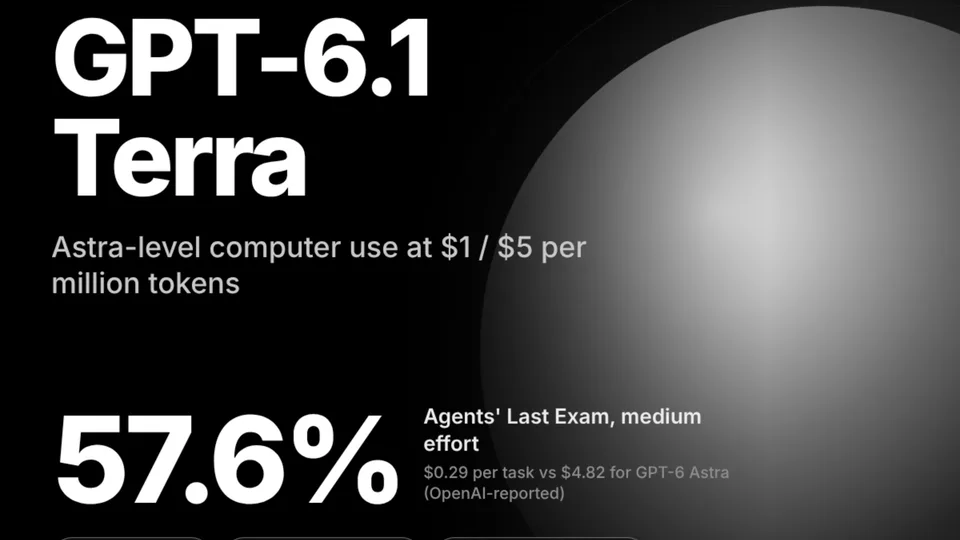
OpenAI released GPT-6.1 Terra, a fast computer-use and vision model priced at $1/$5 per million tokens. It matches GPT-6 Astra’s medium-effort Agents’ Last Exam score at $0.29 per task versus $4.82. The post OpenAI Launches GPT-6.1 Terra, Halving GPT-6.1 Sol’s API Price for Agent Work appeared first on MarkTechPost.