
Strengthening the fight against online child sexual abuse with new tools and support
New tools, practical guidance, and partnerships will help prevent, detect and respond to online child sexual exploitation and abuse.
Search headlines, summaries and articles to connect the dots.
New tools, practical guidance, and partnerships will help prevent, detect and respond to online child sexual exploitation and abuse.
arXiv:2611.17733v1 Announce Type: new Abstract: Natural language-guided, mask-free scene text editing aims to modify text in real-world images using only textual instructions, yet remains challenged by unreliable pseudo-GT supervision, over-smoothed text generation, and the absence of GT-free evaluation. Existing methods often rely on imperfect pseudo-targets with background discrepancies, while standard MSE-based velocity regression tends to suppress high-frequency details, leading to blurred text boundaries and weakened local textures. To address these issues, we propose HarmonyText, a mask-free scene text editing framework with region- and frequency-aware supervision. HarmonyText introduces Region-Decoupling Optimization (RDO), which aligns edited text regions with pseudo-targets while anchoring preserved regions to the source image, and Cascaded High-Frequency Texture Guidance (CHFTG), which applies cascaded wavelet-domain constraints to preserve sharp boundaries and fine-grained textures of textual content. We further propose Reverse-to-Refined Pair Synthesis (RePair) to construct STE25K, a high-quality 25K paired dataset, and introduce a GT-free evaluation protocol with Color Distribution Divergence and a Harmony Assessment Model. Extensive experiments show that HarmonyText outperforms existing methods in text editing accuracy, background fidelity, color consistency, and perceptual harmony.
Ling 3.2 Flash is a hybrid reasoning model from inclusionAI that accepts text and image input, with a 1M-token context window and up to 200 images per request. Thinking can...
arXiv:2611.12903v1 Announce Type: new Abstract: Context compression is now routine for language models with long inputs, but a compressed context is useful only if it keeps the evidence for the answer. Existing checks compare the reader model's answer or its most likely words, and thus miss a frequent failure, silent evidence loss: key evidence is removed while the answer stays the same, leaving the answer unsupported and risky for other models that reuse the context. To address this challenge, we propose SELD (Silent Evidence Loss Detector), which needs no training and no labels. Its principle is that when evidence is lost, a reader model's preferences among the answers it leaves unsaid shift even if its answer does not, so comparing these preferences before and after compression reveals losses that answer checks cannot see. We also build SEL-Pairs, a benchmark of length-matched evidence and control deletions from three question-answering datasets. Quantitative and qualitative experiments with five reader models on it show that SELD consistently outperforms strong and recent baselines across compressors, compression rates and models, identifying the evidence-removing edit in 83% of matched pairs with unchanged answers, against 70% for the strongest baseline. These results show that evidence loss in compressed contexts can be detected even when the answer is unchanged.
arXiv:2611.10044v1 Announce Type: new Abstract: When several answers fit a riddle, exact-match scoring can penalise a valid response. CulturalCrosswords tests how answer constraints affect large language models (LLMs) solving cultural riddles, whose solutions draw on knowledge specific to a community. We constructed 53 crosswords from crowdsourced riddles in 42 languages and evaluated 11 LLM configurations on five versions of each clue set: plain batches, batches with lengths, batches with lengths and partial-answer hints, and crosswords requesting an answer list or a completed grid. On 962 clues with alternative answers, lengths improve agreement with the reference by 22.8 percentage points, compared with 8.4 points when accepted alternatives also receive credit. Part of the gain therefore appears to come from selecting a required answer form. Crossword input increases the share of all crossings with compatible answers by 9.7 points; requiring a completed grid reveals large differences between models. The benchmark distinguishes agreement with a reference from the ability to produce answers that fit together and occupy the correct cells.
Our most capable models for daunting technical work, Claude Fable 5.2 and Claude Mythos 5.2 set a new bar in coding, finance, and the sciences.
Learn how OpenAI’s Control Room tracks model workloads across our research infrastructure and can rapidly stop them when safety or security concerns arise.
arXiv:2611.08730v1 Announce Type: new Abstract: LLM-based digital twins aim to predict how individuals would respond in new settings from representations of their prior responses. Existing evidence that compression of survey histories need not reduce predictive accuracy suggests that representation structure, rather than information volume alone, may be an important design choice. We study BDE, a fixed representation that organizes each respondent's survey history into Background, Decision procedure, and Evaluation. We evaluate it on Twin-2K-500 (Toubia et al., 2025) by predicting each respondent's held-out answers on 17 tasks. In a paired evaluation with 100 respondents, a fully inferred BDE profile improves overall accuracy over the raw survey transcript by 1.27 percentage points (pp) on gpt-5.4-nano (p < 0.01) and 1.19 pp on gpt-5.4-mini (p < 0.001). Three analyses then examine the schema, extraction depth, and component composition. Against a length-matched free-form profile written from the same transcript by the same extractor, BDE improves pricing accuracy on both simulators (2.15 pp on nano, p < 0.01; 1.38 pp on mini, p < 0.05), while its overall advantage is significant only on nano (1.05 pp, p < 0.05). Allowing deeper inference during extraction yields no statistically significant gain on either simulator. By contrast, adding Evaluation to a Background--Decision procedure profile improves overall accuracy by 1.44 pp on nano (p < 0.001) and 1.22 pp on mini (p < 0.001). These results indicate that the advantage over raw transcripts is not explained by compression or length alone, and attribute it primarily to profile composition rather than deeper extraction.
HOPE, a second-order expert pruning method for Mixture-of-Experts (MoE) language models, accounts for pairwise expert interactions by optimizing a quadratic program based on an interaction matrix derived from calibration data. Unlike first-order methods that prune experts independently, HOPE preserves cooperative expert groups, leading to better performance—especially at high pruning rates like 50%. On benchmarks such as SWE-Bench Pro, HOPE outperforms state-of-the-art first-order methods like REAP by up to +6.1%, maintaining model quality while significantly reducing memory footprint. The method requires only a single calibration pass and efficient quadratic programming, with negligible overhead. It has been validated on Qwen3.5 and GLM-4.5 models, showing consistent improvements across diverse tasks and calibration sets.
arXiv:2611.05991v1 Announce Type: new Abstract: Multi-agent LLM applications repeat most of their prompt tokens across requests, and serving engines reuse the cached state of shared prefixes. vLLM and SGLang reuse it at different granularities, and benchmarks of their default deployments report large performance gaps, usually credited to the cache. Such comparisons rarely control for other configuration differences. One of them, whether a long prompt is prefilled in chunks, is set by each engine's defaults from the hardware and the release, and it confounds the comparison. We built a reproducible testbed on Kubernetes and a seeded multi-agent workload generator, and compared the two engines under vendor defaults and with chunked prefill matched. SGLang's configuration is the same in both arms, which makes it an internal control across independently provisioned deployments. Under defaults, vLLM's median time to first token is up to 64x SGLang's. Matching one setting removes 78% of the capacity gap where that gap is largest and 30 to 67% of the latency gap. Near saturation the remaining latency gap reflects queue growth. A fluid queue model driven only by a 4.4% throughput shortfall reproduces it, and shows that such a gap scales with the length of the benchmark run. What survives matching is a tail-latency advantage of 2.4 to 6.4x at equal throughput, consistent with cache-aware ordering of waiting requests. We derive six recommendations for comparing serving engines.
arXiv:2611.05720v1 Announce Type: new Abstract: Search can help LLM agents correct mistakes, but their starting conditions may shape which evidence they find and use. Drawing on cognitive-bias paradigms, we develop a controlled search harness to examine result order, records of prior work, and initial hypotheses while holding each question and document collection fixed. Matched controls distinguish order effects from differences in document composition and the effects of failed work from context length. Across 10 models and 1,000 synthetic search worlds, we track queries, retrieved documents, document openings, and final answers. Our comparisons suggest that final answers are more sensitive to initial evidence order during active search than when all evidence is supplied in full. Dead-end histories can reduce strategy switching relative to matched neutral histories, indicating an effect beyond context length. Under wrong hypotheses, stage measurements distinguish reduced retrieval or opening from errors that persist after counter-evidence is opened. Exploratory interventions show that opening counter-evidence more often can coincide with lower accuracy, while accuracy can improve with little change in opening.
arXiv:2611.04107v1 Announce Type: new Abstract: Large language models (LLMs) often generate responses longer than necessary, increasing inference latency and computational cost. While prompting can encourage conciseness, controlling output length without compromising response completeness remains challenging. Aggressive early stopping can reduce generation costs but risks terminating responses prematurely. We introduce MinimalLM, a training-free framework for reliable verbosity control that combines uncertainty-aware, length-dependent stop-token adjustment with structural completeness guardrails. MinimalLM separates the decision of when to stop from whether stopping is structurally appropriate, coordinating response-level instructions, decoding-time intervention, and completion checks without modifying model parameters or requiring auxiliary models. We evaluate MinimalLM across three open-source LLMs and 330 questions, producing 5,940 responses across baseline and ablation configurations. MinimalLM reduces generated tokens by 47.6%, accelerates individual responses by 19-68%, and eliminates structurally truncated outputs in the primary evaluation. Despite substantial token savings, it achieves an average quality score of 8.04/10, compared with 8.42/10 for unmodified models and 6.46/10 for length-matched truncation. Evaluations across diverse subject domains (such as healthcare, programming, law, and science) demonstrate robust efficiency gains, while ablations establish the complementary roles of decoding control and completeness constraints. Our findings highlight that efficient generation requires more than producing fewer tokens: it requires controlling when generation ends while preserving response integrity. MinimalLM offers a lightweight, training-free approach toward this goal.
arXiv:2611.04090v1 Announce Type: new Abstract: Practitioners who compare systems with an LLM judge and have no human labels often check a conclusion by repeating it with a judge from another provider. We test how far that check can be trusted. In a preregistered study (with a disclosed post-registration reduction of the judge set), five judge models from three providers re-judged 4,000 Chatbot Arena battles (nine systems, 33 system pairs) that carry human votes, each in both response orders. Agreement with the human vote was low at the verdict level (median Cohen's kappa = 0.22), and system rankings did not survive a change of judge: Kendall's tau with the human ranking ranged from 0.17 to 0.89 (median 0.67), so the preregistered hypothesis that rankings remain stable was not supported. Conclusions replicated by two low-cost judges from different providers matched the human conclusion more often than single-judge conclusions (+0.10 precision), but the gain came from filtering out one poorly aligned judge, and replication involving that judge left a conclusion for only 35% of comparisons. Judges that agreed with humans reached a stable conclusion with no more verdicts than human votes required; the others failed to converge on 26-70% of system pairs at the sample sizes tested (up to 100 verdicts per pair). Disagreements with the human vote co-occurred across judges far more often than independence predicts, although a single human vote per battle cannot separate shared judge bias from voter noise.
DeepSeek, Google, and NVIDIA build the agent stack
FlashMap is a speculative decoding drafter from Polymathic AI, Princeton and USC ISI researchers. It drafts 16 tokens jointly in one pass and reaches up to 6.14x lossless speedup on Qwen3-8B. The post Polymathic AI and Princeton Researchers Release FlashMap, a Flow Map Drafter for 6.14x Faster LLM Decoding appeared first on MarkTechPost.

Google DeepMind released Genie 4 as a research preview. The real-time world model adds native audio, live dialogue and text steering, with Gemini 3.8 Flash planning events inside the simulation loop. The post Meet Google DeepMind’s Genie 4: Real-Time World Model With Native Audio appeared first on MarkTechPost.

arXiv:2610.36191v1 Announce Type: new Abstract: Large language models (LLMs) frequently generate fluent yet factually incorrect responses, raising concerns about their reliability. Recent hallucination detectors increasingly exploit internal representations, but extracting informative signals from high-dimensional hidden states remains challenging. Existing approaches often rely on selected activations or pooling-based compression, potentially overlooking discriminative information distributed across Transformer layers, feature modes, and tokens. We propose LOTUS (Low-rank Order-statistic TUcker-based Subspace learning), a multilinear low-rank decomposition framework for hallucination detection that extracts compact representations from LLM hidden states while reducing dependence on labele
Mirendil released Fern 0.1, its first model, pretrained from scratch with a 10M-token context window. It targets agentic AI R&D work, scores 100% on RULER single needle at 10M, but trails frontier models on agentic coding. The post Mirendil Launches Fern 0.1, Its First Model, With 10M-Token Context appeared first on MarkTechPost.
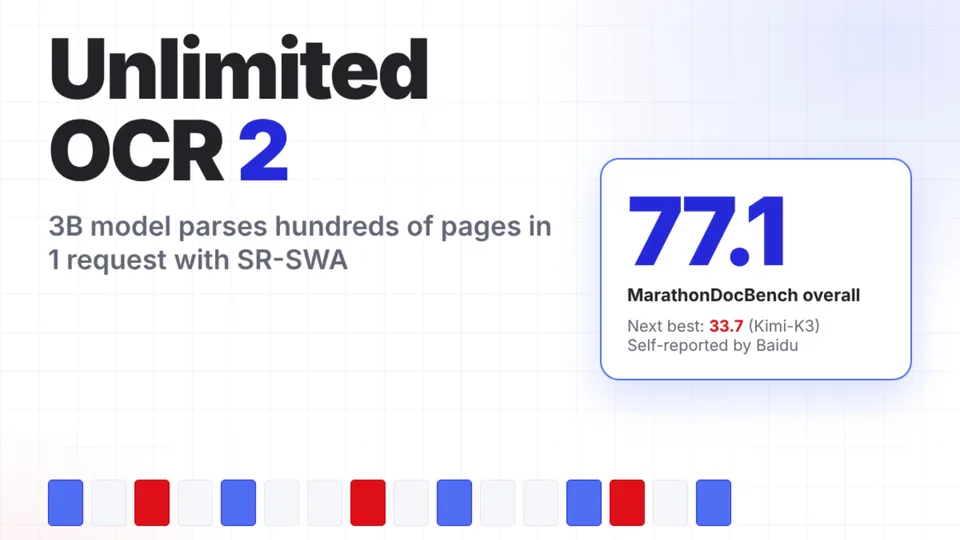
Baidu has released Unlimited OCR 2, an MIT-licensed 3B OCR model that parses hundred-page documents in one request. Its SR-SWA attention keeps per-step decoding cost nearly flat, scoring 77.1 on MarathonDocBench The post Baidu Open-Sources Unlimited OCR 2 for Hundred-Page Document Parsing appeared first on MarkTechPost.
arXiv:2610.33441v1 Announce Type: new Abstract: Automated semantic complexity estimation remains underexplored in NLP, despite important applications in linguistics and interpretability. This paper defines semantic complexity as the code length required to uniquely specify a text's semantic meaning, and operationalises it via SCAPE-T, an attention-derived metric based on encoder-only transformers. Existing measures either model reader effort (readability, lexical difficulty), which correlates with surface features (word length, syntax), or quantify surface features directly (type-token ratio, word frequency). SCAPE-T targets semantic integration directly by combining three submetrics: (i) inverse-weighted self-focus (token-to-self), (ii) CLS focus (token-to-CLS), and (iii) inter-head redun