
Clearing up a robot’s fuzzy memory
A new system identifies and corrects unreliable object descriptions stored in a robot’s memory, improving the robot’s ability to interact with its environment.
Search headlines, summaries and articles to connect the dots.
A new system identifies and corrects unreliable object descriptions stored in a robot’s memory, improving the robot’s ability to interact with its environment.
Flipsnack focused its ChatGPT Ads campaigns on getting people to try its product, growing registrations while lowering the cost per signup.
API credits benefit for eligible ChatGPT subscriptions. Earlier this month Anthropic announced a generous new benefit for their Max and Team subscriptions: $100, $200, and $500 per month subscribers would get the equivalent quantity of (expiring) credits to use with the Anthropic API.
A new developer platform will let businesses bring their services to Google's AI experiences, potentially changing how consumers discover and use apps.

1. GPT-6.1 Terra, better suited for workers, has launched, with API prices cut in half and faster computer operations On October 26, OpenAI released GPT-6.1 Terra, focusing on enhancing visual comprehension, computer operations, factual accuracy, and programming capabilities, ....
Author | Cynthia Editor | Zheng Xuan In 2026, the AI 3D landscape stands at a delicate crossroads. Momentum in the primary market continues to surge, with new models and startups emerging one after another, and single-image-to-3D generation now delivers photorealistic results that are almost indistinguishable from real-world objects. Yet beneath the dazzling demo façade, most generated outputs remain stuck at the “turntable showcase” stage: a meticulously crafted character or mechanical model slowly rotates under lighting, its scales, fabric folds, and metallic engravings rendered with lifelike detail. But as soon as these details enter real‑world production workflows—such as game engine rigging, industrial simulation, or 3D printing—their limitations quickly surface: structural fractures, backside collapses, fused details, and uneditable meshes begin to erupt, swallowing up the efficiency gains brought by AI through costly manual post‑processing. Fidelity in frontal views no longer equates to overall 3D quality—a consensus that’s taking hold across the industry. The race for AI‑driven 3D has shifted from the first half—“Can we generate?”—to the second half—“Can we deliver in real‑world applications?” It is precisely at this juncture that leading player Hi3D has made two strategic moves: officially open‑sourcing its production‑proven Hi3D V1.0 platform, while simultaneously launching the creator‑centric Hi3D Agent, which bridges the industry’s foundational layers and deeply embeds itself within the full creative workflow. Prior to this, the company—founded less than three years ago—had already delivered a solid track record: securing two consecutive rounds of funding within six months, totaling nearly $50 million, with top-tier investors like Sequoia China, IDG Capital, and Meituan Longzhu all participating; its Hi3D platform now serves over 120 countries and regions, supporting more than 2 million creators, and enjoys deep integrations with leading hardware manufacturers such as Tuzhu Technology and xTool. From academic breakthroughs in sparse geometry to open‑source, production‑ready models, and end‑to‑end connectivity via its Agent creation system, Hi3D has secured its ticket to the next phase of 3D generation. 01 3D Generation: Overhyped Demos, Underestimated Production Gaps The underlying logic of single‑image‑to‑3D generation inherently carries a perspective bias. As metrics like ULIP and Uni3D have repeatedly set new benchmarks, the industry’s past few years have been marked by an emphasis on front-facing views at the expense of holistic understanding, and on outward appearance rather than internal structure. However, the essence of a 3D asset lies in its ability to be rotated, edited, and manufactured as a three‑dimensional object. In a single character image, the vertical…
OpenAI has once again raised the bar for the cost-effectiveness of large models. #Follow iFanr’s official WeChat account: iFanr (WeChat ID: ifanr) for more exciting content delivered to you第一时间.
OpenAI released GPT-6.1 Terra, a fast computer-use and vision model priced at $1/$5 per million tokens. It matches GPT-6 Astra’s medium-effort Agents’ Last Exam score at $0.29 per task versus $4.82. The post OpenAI Launches GPT-6.1 Terra, Halving GPT-6.1 Sol’s API Price for Agent Work appeared first on MarkTechPost.
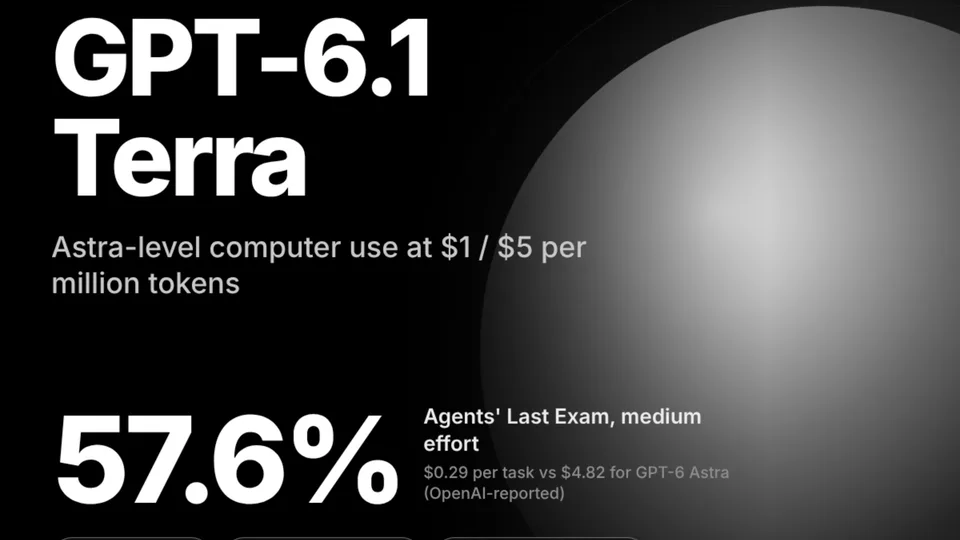
The biggest highlight is that the price has been cut in half.
An AI model said it wouldn’t use any tools, then tried to send something to a server in Beijing anyway, and while researchers say it’s probably a training quirk and not espionage, the whole thing has people asking how much to trust free Chinese AI.

OpenAI Group PBC today released GPT-6.1 Terra, an upgrade to the middle tier model in its lineup of frontier artificial intelligence systems. The new model, the successor to GTP-5.6 Terra, costs around 50% less while handling computer use tasks faster and with greater accuracy. Terra is positioned as the everyday model in OpenAI’s lineup, designed […] The post OpenAI launches GPT-6.1 Terra for faster, better-performing AI agents at half the price appeared first on SiliconANGLE.
On October 22, 2026, 1Password launched a new platform called “1Password for Agents,” which allows users to authorize AI agents—such as Claude Duet, ChatGPT Work, Grok Bot, and others—to log into their personal accounts on their behalf. The agents themselves cannot access, store, or view the original passwords; the entire process relies on digital identity verification, real-time user confirmation, and automatic password filling by the password manager.
Walmart has officially launched Agent Gateway (an AI agent gateway) along with its accompanying Agent Profiles feature, enabling authorized AI agents—such as ChatGPT, Gemini, Meta Muse, and others—to perform searches and place orders on behalf of users across Walmart and Sam’s Club platforms. User control over agent activities is ensured through mechanisms like independent account configuration, transaction approvals, and spending limits. This move stands in stark contrast to Amazon’s recent ban on AI‑powered shopping agents.
Claude Mods is Anthropic’s programmable plugin system for Claude Code, representing an early form of the “Attention Interface”—it shifts the traditional machine-oriented agent harness toward a customizable interaction layer centered on human attention. Users can write Mods in TypeScript/JS or have Claude generate them automatically using natural language, thereby determining when to be interrupted, what content to see, and what decisions to make.
Claude Mods is a programmable plugin system for developers launched by Anthropic, marking a shift of the ‘agent harness’ from a machine-side interface to a human-side interface—namely, the ‘Attention Interface’. It enables users to customize Claude Code’s behavior, rendering, and interaction logic via TypeScript/JavaScript, thereby facilitating co-design workflows between humans and AI. This mechanism has already been applied to built-in features (such as You Should Know) and supports users in building plugins themselves or having them generated with Claude’s assistance.
Learn how OpenAI built ChatGPT’s LLM-powered ad stack to understand conversational intent, keep ads separate from answers, and deliver relevant ads at scale.
Learn how OpenAI is improving ChatGPT across low-resource programming languages, with new evaluations for software engineering, SQLite, and COBOL migration.
See how Amp pushes the frontier of what agents can do with GPT-6 Astra, Ultrafast, GPT-Live-1, and Sign in with ChatGPT.
GPT‑6 is rolling out globally in ChatGPT with Intelligent UI, delivering faster responses with visuals and interactive experiences you can explore and use directly.
Introducing ChatGPT for Financial Services, combining built-in financial data and GPT-6 Astra for research, modeling, and client-ready materials.