
How Anthropic ships Claude with Claude: Separating the Brain from the Hands
Katelyn Lesse and Angela Jiang on Opus 5.5, the Claude Platform, and the engineering behind AI agents.
Search headlines, summaries and articles to connect the dots.
Katelyn Lesse and Angela Jiang on Opus 5.5, the Claude Platform, and the engineering behind AI agents.
Katelyn Lesse and Angela Jiang join Latent Space to explain the engineering behind the Claude Platform: launching Opus 5.5, separating the model’s “brain” from the agent’s “hands,” scaling APIs, and building reliable managed agents. A new introduction ...
Property Finder found that 96.8% of their vision-AI evaluation labels were inherited from the incumbent model, hiding its true accuracy. See how they built unbiased ground truth, applied evolutionary prompt optimization, and selected a more accurate, cost-effective model on Amazon Bedrock, cutting cost by 86% across 11 image-quality attributes.
Old benchmarks approach perfect scores, yet new benchmarks consistently fall short in real-world performance. As large-model evaluation itself has become a business, companies are shifting their selection criteria from ranking-based assessments to cost‑benefit analyses.
The champion on the AI rankings may change, but the products users rely on every day don’t necessarily. The next round of competition in large models will hinge not just on whose model is stronger, but on turning a single use into a habit.
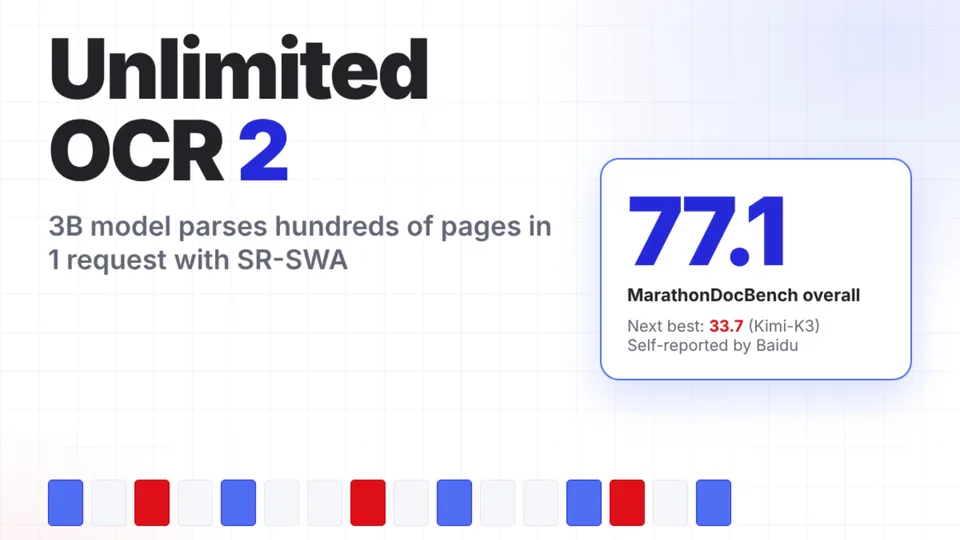
Baidu has released Unlimited OCR 2, an MIT-licensed 3B OCR model that parses hundred-page documents in one request. Its SR-SWA attention keeps per-step decoding cost nearly flat, scoring 77.1 on MarathonDocBench The post Baidu Open-Sources Unlimited OCR 2 for Hundred-Page Document Parsing appeared first on MarkTechPost.
arXiv:2610.32429v1 Announce Type: new Abstract: Large language model (LLM) agents increasingly execute tasks asynchronously: a main agent continues working while its subagents run, and the task state may change before their results arrive. The main agent must decide which work to update or preserve and which checks to repeat, while avoiding prohibited changes. Final task success alone does not reveal whether these results were handled correctly, and natural asynchronous arrivals are hard to reproduce. We introduce Async-RBench, a benchmark for asynchronous task execution in LLM agents, with 200 executable tasks covering eight scenarios. A scenario controller regulates result delivery using predefined task-state conditions, while an Event Response Contract (ERC) specifies what each response
arXiv:2610.33014v1 Announce Type: new Abstract: A negotiation assistant can reach a good deal without accurately predicting the other person's response. We ask whether evaluations of social world models test that prediction directly. We audit 113 works published from 1999 to 2026. 9 primary evaluations measure a real person's response to an action selected by the system or experimenter. Only 2 also compare an explicit response forecast with that response. Their predictors use information available when the action is chosen, and the evaluated responses were excluded from fitting; both randomize the intervention. A separate full-text check of 25 language-model works finds no experiment meeting these conditions. The other evaluations test current-state inference, task success, or prediction f
arXiv:2610.32308v1 Announce Type: new Abstract: Multi-step retrosynthesis requires recursively transforming a target molecule through successive reaction steps into purchasable building blocks, and recent work has begun to draw on large language model (LLM) reasoning to tackle the task. In its latest evolution, LLM reasoning has entered the long-horizon regime: models pursue objectives across interdependent steps, interact with environments, and adapt to feedback. This shift has markedly advanced LLM capabilities, as illustrated by breakthroughs in AI-driven mathematical research. At this frontier, we introduce Solvent, an 8B LLM that successfully extends long-horizon reasoning to multi-step retrosynthesis. Through a two-round post-training curriculum, Solvent learns to interleave iterativ
arXiv:2610.32305v1 Announce Type: new Abstract: Multi-stage analytical tasks require LLM agents to use intermediate evidence to decide whether to continue, redirect or stop. Self-reflection, in which an agent critiques its output, is widely studied, yet a critique does not show whether evidence changed the next action. We call that capability self-restraint. Existing agent benchmarks largely measure task completion or output quality and leave it untested. DMAIC-Bench evaluates it with 97 seeded tasks across 15 industrial cases in four sectors, built around Lean Six Sigma's explicit statistical prerequisites. Paired counterfactual variants require opposite actions at the same workflow position, distinguishing warranted restraint from indiscriminate stopping. We assess execution traces with
arXiv:2610.35564v1 Announce Type: new Abstract: Serverless computing platforms must preserve quality of service (QoS) while adapting to highly bursty and unpredictable workloads. To cope with workload fluctuations while satisfying QoS requirements and service-level agreements (SLAs), these platforms rely on automatic resource scaling. Commercial function-as-a-service (FaaS) platforms employ different autoscaling strategies to dynamically adjust the number of active function instances and the available processing capacity. In this work, three representative autoscaling strategies are modeled and compared: scale-per-request (SPR), concurrencylevel scaling (CLS), and metric-based scaling (MBS). To enable systematic evaluation independent of proprietary platform-specific implementations, we de
OpenAI Group PBC today released GPT-6.1 Terra, an upgrade to the middle tier model in its lineup of frontier artificial intelligence systems. The new model, the successor to GTP-5.6 Terra, costs around 50% less while handling computer use tasks faster and with greater accuracy. Terra is positioned as the everyday model in OpenAI’s lineup, designed […] The post OpenAI launches GPT-6.1 Terra for faster, better-performing AI agents at half the price appeared first on SiliconANGLE.
We're at the start of a major effort to speed up drug development with Claude. Over the past several months, our scientists have engaged in deep research partnerships with six organizations developing new medicines.
Build specialized multimodal models with LFM3
Can we trust LLMs to judge whether a research idea is novel?
Data Culture built a 3-step evaluation framework that took one AI analytics deployment from 0% accuracy to 94.7%.

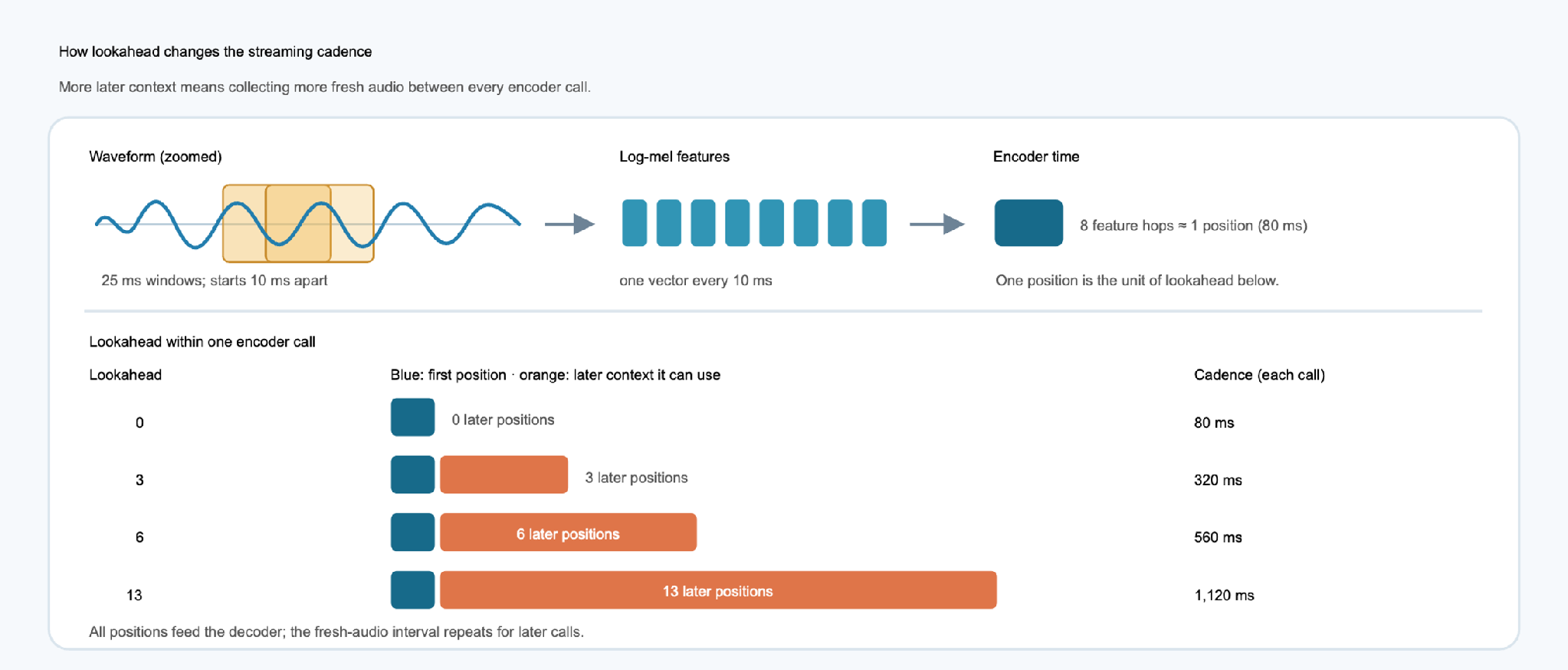
When you’re speaking to a device, you expect text to appear as you talk. That makes streaming automatic speech recognition (ASR) a different challenge from batch transcription, where the model... The post Optimizing Streaming Speech Recognition on Arm® Edge Devices with ExecuTorch appeared first on PyTorch.

arXiv:2610.31946v1 Announce Type: new Abstract: Three students answered the same exam prompt by hand: "What is happiness? Are you happy?" Their ages, recorded at collection, are 17, 28, and 45. The 17-year-old's answer is hedged and formally phrased. Asked to match each answer to an age and gender label, most frontier language models confidently assign it to an adult. This paper reports a structured case study of that failure across six models: Claude Fable 5, Gemini 3.1 Pro, GPT-5.6 Sol, Grok 4.5, GPT-4o (2024), and DeepSeek V4. We ran 1,081 API sessions and scored 3,225 responses across six experimental conditions that manipulate framing, disclosure format, and audience-awareness instruction. Three of six models perform at or near chance (1/3) on the matching task while reporting 73-88%
arXiv:2610.32024v1 Announce Type: new Abstract: Task instructions from users for agents are inherently underspecified, especially regarding safety boundaries--creating behavioral risks. To study these risks, we introduce BARC-Bench, a collection of 110 tasks across nine simulated workspace environments where benign requests leave openings for unsafe actions. In this benchmark, we evaluate agent behavior against safety boundaries established by workspace records, implicit environmental context, and unstated social norms. For example, an agent asked to schedule off-boarding discussions must arrange the meeting without prematurely revealing an employee's resignation through a shared calendar invitation. Evaluating four frontier model configurations across five attempts per task reveals that m

arXiv:2610.31971v1 Announce Type: new Abstract: Large language model (LLM) agents increasingly participate in negotiations on behalf of individuals and organizations, yet they remain vulnerable to manipulation, particularly in repeated multi-party interactions. Classical multi-agent systems address this challenge through explicit trust and reputation models, whereas existing work on LLM negotiation largely treats trust as an emergent phenomenon. We investigate whether LLM agents can form useful trust estimates from prior interactions and leverage them to improve future negotiation outcomes. We introduce a repeated, multi-party, multi-issue negotiation framework in which recurring agents participate in a sequence of negotiation games while one participant covertly attempts to prevent agreem