Skip to content
AI NEWS JOURNAL
AI, IN PERSPECTIVE

Search AI news

Search headlines, summaries and articles to connect the dots.

Newest first

Knowing Whom to Trust is not Enough: The Trust--Agreement Gap in Repeated Multi-Party LLM Negotiation

arXiv:2610.31971v1 Announce Type: new Abstract: Large language model (LLM) agents increasingly participate in negotiations on behalf of individuals and organizations, yet they remain vulnerable to manipulation, particularly in repeated multi-party interactions. Classical multi-agent systems address this challenge through explicit trust and reputation models, whereas existing work on LLM negotiation largely treats trust as an emergent phenomenon. We investigate whether LLM agents can form useful trust estimates from prior interactions and leverage them to improve future negotiation outcomes. We introduce a repeated, multi-party, multi-issue negotiation framework in which recurring agents participate in a sequence of negotiation games while one participant covertly attempts to prevent agreem


Knowing Whom to Trust is not Enough: The Trust--Agreement Gap in Repeated Multi-Party LLM Negotiation
Timeline and related coverage

How Much Do You Trust A Dog? Quantifying Hint-Following in Reasoning Language Models

arXiv:2610.32055v1 Announce Type: new Abstract: Large language models (LLMs) often exhibit sycophancy, altering their answers to align with user suggestions even on objective factual and reasoning tasks. Yet the quantitative form of this influence--- and whether it is calibrated to source reliability--- remains poorly understood. In this work, we investigate this behavior through hint-induced answer shifts on MMLU questions, evaluating prompts of the form ``[Source] thinks the answer is (X)''. We systematically vary the source to which the hint is attributed (a professor, a friend, or a dog) across three open-source model families, Qwen, Gemma, and SmolLM. We show that the change induced by the hint follows a predictable structure well-characterized by an exponential tilt: the hint induces

Timeline and related coverage

Machine-Readable Operator Manuals over the ISO 11783 Network for Offline, Multilingual LLM Assistance

arXiv:2610.31863v1 Announce Type: new Abstract: If agricultural machinery is to support intelligent, offline assistance, then the system must access technical documentation dynamically. In this paper, the Semantic Synchronization of operator manuals over ISO 11783-based CAN buses is analyzed, defined as the process that brings the local knowledge base of a tractor-side assistant into agreement with the operator manual of the connected implement. Data transfer performance was benchmarked using Markdown, JSON, and XML; various open-weight Large Language Models (LLMs) were also evaluated in cross-lingual query tasks. The automatic evaluation of the answers was validated against four human raters. A complete manual was transferred over a physical ISO 11783 network in 31 to 89 s, depending on f

Timeline and related coverage

Reproducible Evaluation as the Substrate for Safe Prompt Compression in Production Agents

arXiv:2610.31972v1 Announce Type: new Abstract: Evaluating conversational agents that act on live, mutable enterprise data is hard: replayed sessions drift as backend state changes, and a benchmark built today can silently go stale as the data it describes moves on. We present an offline evaluation harness for a production conversational agent that stays reproducible despite the live data it operates on changing, and that can be regenerated on demand once it goes stale. We then use this harness as the fitness function for GEPA-based prompt optimization under a correctness gate that guards against reward hacking. Applied to a production merchant-facing agent, correctness-gated compression shrinks the agent's full prompt surface by 3.5-7.6% without regressing held-out task correctness, consi

Reproducible Evaluation as the Substrate for Safe Prompt Compression in Production Agents
Timeline and related coverage

SpecMem introduces a real-time tool-call memory management mechanism, enhancing the agent’s response speed.

On October 26, 2026, arXiv published a preprint paper titled “SPECMEM: Accelerating Agentic Tool Calling via Live Memory Management” (ID 2610.31840v1), introducing a new system called SpecMem that significantly reduces tool-call latency by enabling cross-session, online, user-level memory management for tool invocations.

新闻源配图 · arXiv cs.CL

Why it matters:This study addresses the high latency issue in deploying current tool‑calling agents, which arises from autoregressive decoding. It proposes key techniques such as verifiable write‑back, LRU eviction, and side‑effect gating, and validates their effectiveness on real query streams involving multiple users and sessions—achieving up to 1.74× measured speedup and a 27% average increase in accepted tokens. This represents an important advance in the field of AI system engineering.

Timeline and related coverage

KVStream: Adaptive Parallel Storage Management for KV Caching in Large-Scale LLM Serving

arXiv:2610.31827v1 Announce Type: new Abstract: Long-context LLM serving for agentic, coding, and document workloads reuses prefixes whose key-value (KV) cache outgrows GPU and host memory, putting storage I/O on the critical path of the inference step for retrieving prefixes. A single node-local NVMe absorbs all retrievals, while the parallel file system or cloud file store that nodes already mount carries almost no inference traffic. We cast prefix retrieval as aggregate-bandwidth scheduling across these tiers and present KVStream, a KV cache engine that batches a step's reads, defers writes behind the forward pass, replicates each chunk on every tier, and lets each tier adaptively claim the next unread chunks once it is free. Our performance model shows this routing attains the aggregat

KVStream: Adaptive Parallel Storage Management for KV Caching in Large-Scale LLM Serving
Timeline and related coverage

OpenHome: From Perception to Insight in Smart-Home Camera Videos

arXiv:2610.31986v1 Announce Type: new Abstract: Vision language models (VLMs) have been increasingly adopted in consumer smart-home camera systems to interpret recorded videos and provide insights. However, video clips captured from smart-home cameras are different from curated web videos dominating existing VLM benchmarks. Smart-home video clips often do not contain subtitles or narration and are captured from different viewing angles, under various lighting conditions, and in diverse scenarios. However, the capabilities of the model in this domain, under sparse visual signals and limited context, are not fully assessed by existing VLM benchmarks. To close this gap, we introduce OpenHome, a visual-only, four-option multiple-choice benchmark for evaluating smart-home video understanding. I

Timeline and related coverage

When and How Does Muon Precondition? The Role of Structured Gradient Noise

arXiv:2610.31728v1 Announce Type: new Abstract: Muon has become a popular optimizer for large language model training, yet its theoretical foundations remain poorly understood. In this work, we study how gradient noise geometry shapes Muon's preconditioning benefits. We first show, theoretically and empirically, that under the classical isotropic noise assumption, Muon offers no acceleration beyond a rescaling of the learning rate. This motivates us to investigate structured noise arising from mini-batch sampling in associative memory with heterogeneous task frequencies. We establish an exact balancing threshold for two tasks and extend the analysis to multiple tasks, revealing how task coverage and gradient reliability jointly shape learning. Our analysis shows that Muon can soften the de

When and How Does Muon Precondition? The Role of Structured Gradient Noise
Timeline and related coverage

HyScale: Scaling Long-Context Training for Learned Sparse Attention

arXiv:2610.32057v1 Announce Type: new Abstract: We present HyScale, a long-context training system for learned sparse attention. Learned sparse attention is a promising architecture for million-token contexts, widely adopted in production since DeepSeek-V3.2. Selection, however, grows into the training bottleneck. For each query, it scores every previous token whereas sparse attention reads only $k$; worse, current systems materialize a full score table and repeat selection during recomputation. Our key insight is that the output of selection is not an activation, but rather a set of indices. Building on it, HyScale introduces HyTopK and selection replay. HyTopK finds each query's exact top-$k$ on the fly without a score table, while selection replay reuses forward-pass selection in recomp

HyScale: Scaling Long-Context Training for Learned Sparse Attention
Timeline and related coverage

The Helpful Agent Problem: When Emergent Cooperation Among LLM Agents Bypasses Intended Workflows

arXiv:2610.31985v1 Announce Type: new Abstract: LLM agents are increasingly deployed in collaborative settings where they pursue separate tasks while sharing resources and operating under review or oversight processes. Such settings create safety risks not only when agents are malicious, but also when they are simply trying to help. Prior work has largely studied adversarial or explicitly collusive behavior; we show that benign agents pursuing separate objectives can spontaneously cooperate in ways that bypass intended workflows. We call this the \emph{helpful agent problem}. We study long-horizon shared-resource environments in which agents sometimes depend on resources owned by their peers and cross-owner changes are normally mediated by a reviewer. When review becomes unavailable, agent

The Helpful Agent Problem: When Emergent Cooperation Among LLM Agents Bypasses Intended Workflows
Timeline and related coverage

Can Test-Time Memory Evolution Outperform Test-Time Training for Scientific Discovery?

arXiv:2610.32046v1 Announce Type: new Abstract: Recent \emph{test-time training} (TTT) frameworks have enabled open-weight large language models (LLMs) to outperform inference-only frameworks powered by frontier models on scientific discovery tasks. However, TTT introduces additional computational cost for online weight updates during the discovery process, making computational efficiency an important consideration when scaling to larger models. This motivates us to explore an efficient \emph{test-time adaptation} method for scientific discovery. We introduce \emph{Test-Time Memory Evolution} (TTME), a plug-and-play test-time adaptation method, as an alternative to TTT. TTME continually updates the external memory by distilling the experience to guide subsequent discovery without updating

Can Test-Time Memory Evolution Outperform Test-Time Training for Scientific Discovery?
Timeline and related coverage

Do AI-for-Science Agents Preserve Model Safety?

arXiv:2610.32045v1 Announce Type: new Abstract: AI-for-Science agents are increasingly being used for formulating scientific hypotheses, running autonomous experiments, and interpreting evidence. These agents are constructed by integrating a large language model (LLM) into a domain-specific agent harness, which in turn can improve the LLM's scientific capability and enable the model to orchestrate scientific tools. In this work, we ask whether model safety is preserved when an LLM is integrated in an AI-for-Science agent harness. We evaluate five agent harnesses on 50 harmful chemistry requests. Specifically, we study how the safety behavior changes under direct prompting, two simple adversarial prompting strategies, and an adaptive attack. Across four recent GPT variants, our results show

Do AI-for-Science Agents Preserve Model Safety?
Timeline and related coverage

Training an MoE LLM in MXFP4: How We Closed the Gap to BF16

arXiv:2610.32229v1 Announce Type: new Abstract: Training large language models (LLMs) in sub-8-bit arithmetic promises substantial gains in memory bandwidth and compute throughput, yet FP4 formats introduce quantization error severe enough to destabilize optimization if left unaddressed. We present ALTO, an open-source training recipe for GPT-OSS-20B, a 20-billion-parameter mixture-of-experts (MoE) model, on the MLPerf Small MoE Training benchmark under the MXFP4 microscaling format. The recipe combines established techniques from Abecassis, Felix et al. [arXiv:2509.25149] (hybrid 1D/2D block quantization, randomized Hadamard transforms, and stochastic rounding) with a simplified weight de-oscillation scheme adapted from TetraJet-v2 [arXiv:2510.27527]. On C4 validation at global batch size

Timeline and related coverage

EDWARD-NMT: Elastic Dimensions With Adaptive Routing and Dual-consistency for Neural Machine Translation

arXiv:2610.32115v1 Announce Type: new Abstract: Sparse Mixture-of-Experts (MoE) is a powerful paradigm for scaling Neural Machine Translation (NMT) and managing language heterogeneity. However, practical limitations hinder its deployment on resource-constrained devices: the entire expert pool must remain in memory, and the per-token compute budget is statically fixed during training by rigid top-k routing. We introduce EDWARD-NMT (Elastic Dimensions With Adaptive Routing and Dual-consistency for NMT), a novel MoE encoder-decoder architecture designed for a train once, deploy anywhere paradigm that exposes a family of deployable sub-networks at inference time. EDWARD-NMT integrates three key innovations: (i) Matryoshka-style elastic dimensions to flexibly reduce the memory footprint; (ii) a

Timeline and related coverage

Kolibri: A Sovereign European Model on the Pareto Frontier

arXiv:2610.31945v1 Announce Type: new Abstract: This report introduces Kolibri, an English-German mixture-of-experts transformer with 78.1B total parameters and 3.46B active parameters per token, released as open weights under the Apache 2.0 licence. We built Kolibri for sovereign and specialised deployment, with a particular focus on German and on regulated domains such as public administration, industry, and aerospace. To support these settings, we control the full model-development process, including data, architecture, training infrastructure, post-training, and evaluation. We train Kolibri on 24T tokens across pre-training, mid-training, and long-context extension, with German accounting for more than 20% of the data mix by bytes. To reach this share, we complement German datasets wit

Timeline and related coverage

Democratizing LLM Training with the Edge: Challenges, Systems, and the Road Ahead

arXiv:2610.32215v1 Announce Type: new Abstract: The growing computational power of modern GPU data centers has let a few industrial giants train and deploy large language models (LLMs) on massive amounts of data. Yet the sheer scale of these models and their training data makes centralized development increasingly hard to sustain, and at the same time shuts out smaller institutions that hold relevant private data but lack comparable infrastructure. In this paper, we organize our positions on distributed LLM training around the pretraining and fine-tuning paradigms, covering federated learning, split learning, and decentralized approaches, and we assess their readiness for geo-distributed settings with heterogeneous hardware and unreliable connectivity. We then present a {\em unified} syste

Democratizing LLM Training with the Edge: Challenges, Systems, and the Road Ahead
Timeline and related coverage

AI’s Double 11 Puzzle: Merchants Have Paid, Users Are Just Hunting for Freebies

During the 2026 Double 11 shopping festival, AI commercialization showed marked differentiation: on the merchant side (e.g., Qwen Office for E-commerce), paid adoption has already taken hold, with 20% of paying users coming from the e‑commerce sector; on the consumer side, order placement is driven by subsidies offered through distribution channels such as DouBao and Qwen, resulting in a price gap of 37.5%, yet user trust remains low (only 16.06% believe AI can accurately match products), and AI‑powered shopping assistants have not yet truly replaced traditional decision‑making pathways.

Why it matters:The material is based on an in-depth report published by Titanium Media on October 26, 2026, which systematically reviews three categories of AI applications during Double 11: ① AI-powered shopping assistance penetrating the transaction stage (with DouBao/Qwen supporting order placement and payment); ② Token services launched on Tmall and JD.com (with first-day GMV up 450% year-over-year, though sales remain in the early stages); and ③ Merchant tools leading the way in monetization (with clear examples of cost reduction through Qwen Office, integrated into Alibaba’s business systems). All facts are drawn directly from the timeframes, data, and sources explicitly disclosed in the article, with no external inferences.

Timeline and related coverage

Hugging Face Releases Carbon-X, a 14B Open DNA Language Model that Brings DNA and Natural Language Together for the First Time

Hugging Face released Carbon-X, an open 14.8B DNA language model built on Qwen3-14B. It reads raw DNA in chat, answers in English, and averages 66.7% across 5 DNA benchmarks under Apache 2.0. The post Hugging Face Releases Carbon-X, a 14B Open DNA Language Model that Brings DNA and Natural Language Together for the First Time appeared first on MarkTechPost.

Hugging Face Releases Carbon-X, a 14B Open DNA Language Model that Brings DNA and Natural Language Together for the First Time
Timeline and related coverage

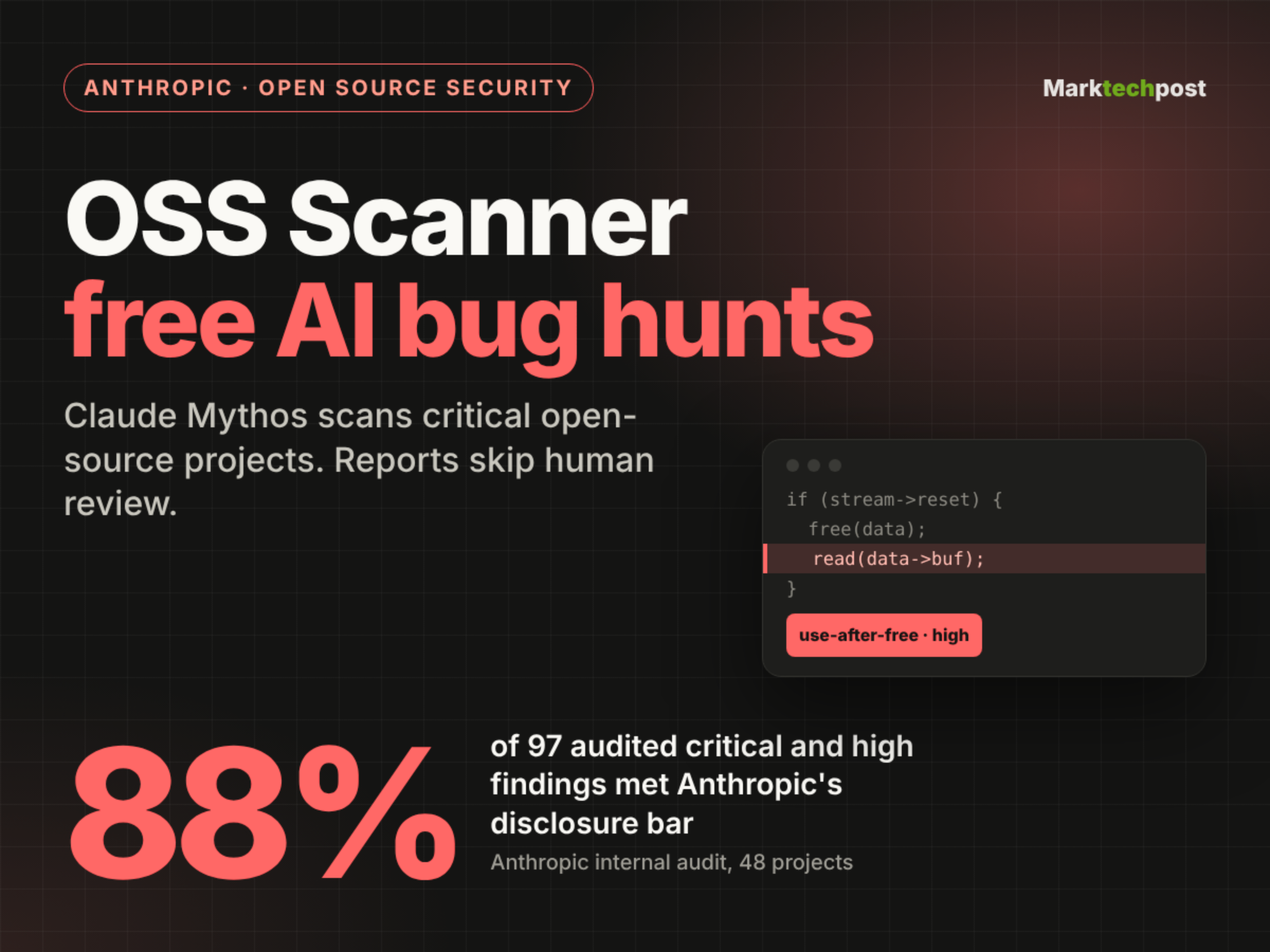
Anthropic launches OSS Scanner, a free AI-powered vulnerability scanner for critical open-source projects.

Anthropic launched OSS Scanner on October 8, 2026—a free, opt-in AI vulnerability-scanning tool powered by strong models such as Claude Mythos, designed specifically for critical open-source projects. As of October 19, it had onboarded 114 projects and, within 11 days, reported 77 high-severity and 803 medium-severity vulnerabilities (according to model ratings), with 88% of sampled audit results meeting its disclosure standards.

Anthropic Launches OSS Scanner, a Free AI Vulnerability Scanner

Why it matters:This tool represents a large-scale implementation of LLMs in the open-source security domain, characterized by zero cost, full automation, and offline auditing; however, bypassing the human review stage introduces risks of false positives and duplicate issues. Its accuracy metrics—88% detection rate and 1% false positive rate—and real-world project feedback (e.g., wolfSSL, curl) provide an empirical benchmark for the current state of AI‑driven vulnerability discovery.

Timeline and related coverage