Skip to content
AI NEWS JOURNAL
AI, IN PERSPECTIVE

Search AI news

Search headlines, summaries and articles to connect the dots.

Newest first

Nvidia releases all-in-one adaptable Nemotron 3.5 audio transcription and translation model

Nvidia Corp. today released a leaderboard-winning open artificial intelligence model for multilingual audio transcription and translation, along with an open data pipeline for fine-tuning Nemotron 3.5 Transcribe. Traditional transcription AI models follow a workflow that detects speech, transcribes it, identifies and labels different speakers, then answers questions about the transcription. Transcribe does all of this […] The post Nvidia releases all-in-one adaptable Nemotron 3.5 audio transcription and translation model appeared first on SiliconANGLE.

Timeline and related coverage

AdaptTok-Indic: Script-Aware Adaptive Tokenization for Indic Languages

arXiv:2610.33017v1 Announce Type: new Abstract: Multilingual tokenizers trained on English-dominated corpora often over-segment Indic languages, resulting in longer token sequences and increased tokenization disparity across scripts. We present AdaptTok-Indic, an Indic-specialized extension of adaptive tokenization that combines Unicode-normalized preprocessing with explicit Indic conjunct handling, script-aware routing, and learned byte-level boundary prediction jointly trained with a small Transformer language model. Evaluated on Bengali and Hindi, with additional evaluation on Gujarati, Tamil, and Telugu, AdaptTok-Indic achieves lower token fertility than SentencePiece BPE, an Indic-oriented tokenizer baseline, and an independently implemented MAGNET-style baseline. Across five recorded

Timeline and related coverage

Nemotron 3.5 Bolt 74B-A9B 24GB: A Hybrid Vision-Language Model for Local AI

arXiv:2610.33039v1 Announce Type: new Abstract: We introduce Nemotron 3.5 Bolt 74B-A9B 24GB, a hybrid Mamba-Transformer vision-language model that optimizes speed and intelligence per GB of memory used for local agentic workloads. Derived from the Nemotron 3.5 Super VL 120B-A12B model family, Nemotron 3.5 Bolt 74B-A9B 24GB combines Star Elastic compression with 2-bit Quantization-Aware Distillation for memory-constrained deployment. The model is optimized for reasoning, agentic tool use, and web & terminal interactions. We also trained a LiLiCorr speculative drafter that is released alongside the model to reach our target inference speed. The resulting model achieves a higher accuracy than leading models with similar memory footprints and speed across many benchmarks for general agentic ca

新闻源配图 · arXiv cs.CV
Timeline and related coverage

Entity-Aware Evaluation of OCR Systems for Historical Document Transcription

arXiv:2610.33004v1 Announce Type: new Abstract: Optical Character Recognition (OCR) is essential for digitizing historical archives, yet standard evaluation metrics such as Character Error Rate (CER) do not necessarily reflect whether meaningful information, such as names, dates, and identifiers, is preserved. In this work, we investigate entitylevel analysis of OCR errors as a complementary perspective for evaluating OCR quality in historical documents. Using a publicly available benchmark of 175 documents from the Berrutti Archive, augmented with 5,209 manually annotated entity mentions that will be released upon acceptance, we compare sequence-recognition OCR systems, OCR-specialized vision-language models, and general-purpose vision-language models. Beyond global transcription accuracy

Timeline and related coverage

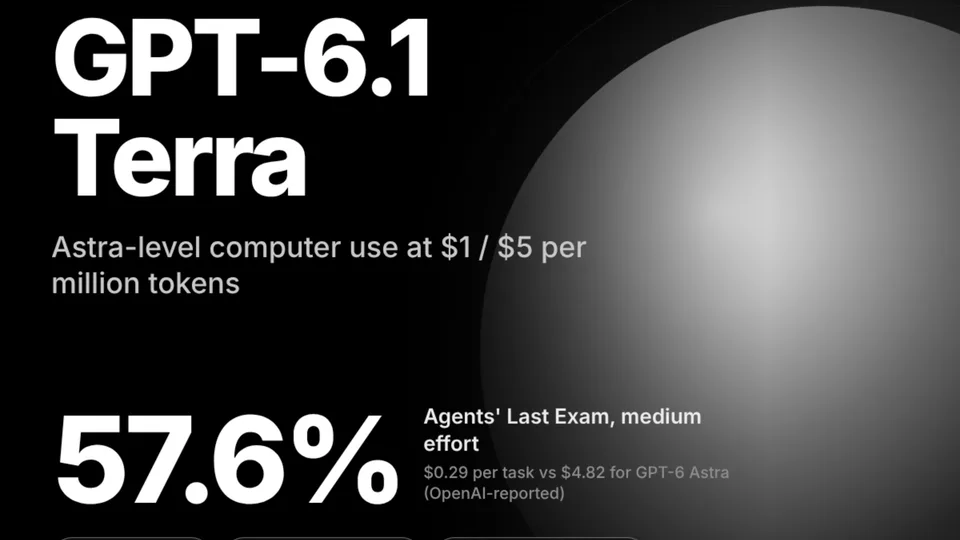
OpenAI launches GPT-6.1 Terra for faster, better-performing AI agents at half the price

OpenAI Group PBC today released GPT-6.1 Terra, an upgrade to the middle tier model in its lineup of frontier artificial intelligence systems. The new model, the successor to GTP-5.6 Terra, costs around 50% less while handling computer use tasks faster and with greater accuracy. Terra is positioned as the everyday model in OpenAI’s lineup, designed […] The post OpenAI launches GPT-6.1 Terra for faster, better-performing AI agents at half the price appeared first on SiliconANGLE.
Timeline and related coverage

Which Answer Did the Seventeen-Year-Old Write? A Behavioral Case Study of Author-Age Misattribution, Miscalibrated Confidence, and Non-Corrective Self-Explanation in Six Frontier Language Models

arXiv:2610.31946v1 Announce Type: new Abstract: Three students answered the same exam prompt by hand: "What is happiness? Are you happy?" Their ages, recorded at collection, are 17, 28, and 45. The 17-year-old's answer is hedged and formally phrased. Asked to match each answer to an age and gender label, most frontier language models confidently assign it to an adult. This paper reports a structured case study of that failure across six models: Claude Fable 5, Gemini 3.1 Pro, GPT-5.6 Sol, Grok 4.5, GPT-4o (2024), and DeepSeek V4. We ran 1,081 API sessions and scored 3,225 responses across six experimental conditions that manipulate framing, disclosure format, and audience-awareness instruction. Three of six models perform at or near chance (1/3) on the matching task while reporting 73-88%

Timeline and related coverage

Kolibri: A Sovereign European Model on the Pareto Frontier

arXiv:2610.31945v1 Announce Type: new Abstract: This report introduces Kolibri, an English-German mixture-of-experts transformer with 78.1B total parameters and 3.46B active parameters per token, released as open weights under the Apache 2.0 licence. We built Kolibri for sovereign and specialised deployment, with a particular focus on German and on regulated domains such as public administration, industry, and aerospace. To support these settings, we control the full model-development process, including data, architecture, training infrastructure, post-training, and evaluation. We train Kolibri on 24T tokens across pre-training, mid-training, and long-context extension, with German accounting for more than 20% of the data mix by bytes. To reach this share, we complement German datasets wit

Timeline and related coverage

Hugging Face Releases Carbon-X, a 14B Open DNA Language Model that Brings DNA and Natural Language Together for the First Time

Hugging Face released Carbon-X, an open 14.8B DNA language model built on Qwen3-14B. It reads raw DNA in chat, answers in English, and averages 66.7% across 5 DNA benchmarks under Apache 2.0. The post Hugging Face Releases Carbon-X, a 14B Open DNA Language Model that Brings DNA and Natural Language Together for the First Time appeared first on MarkTechPost.

Hugging Face Releases Carbon-X, a 14B Open DNA Language Model that Brings DNA and Natural Language Together for the First Time
Timeline and related coverage

llm-meta-ai 0.2

Release: llm-meta-ai 0.2 Meta AI release Muse Wonder (and Muse Wonder Full), their new "most capable models". These look like they may be Meta's first Fable class models - Artificial Analysis scores Muse Wonder (Max) as equivalent to GPT-6.1 Sol. I updated my llm-meta-ai plugin for the new model. Here are pelicans for Muse Wonder for the six reasoning levels: minimal, low, medium, high, xhigh, max. This is the max one: For comparison, here are pelicans for Muse 1.3 (released September 2nd) and Muse 1.2 (released August 5th). Meta AI are putting out a new model a month, and the improvements between each model (at least in terms of drawing pelicans) are material. Tags: ai, generative-ai, llms, meta, pelican-riding-a-bicycle, llm-release

Timeline and related coverage