
Flipsnack grows product signups with conversion optimization
Flipsnack focused its ChatGPT Ads campaigns on getting people to try its product, growing registrations while lowering the cost per signup.
Search headlines, summaries and articles to connect the dots.
Flipsnack focused its ChatGPT Ads campaigns on getting people to try its product, growing registrations while lowering the cost per signup.
Build and deploy enterprise agents, workflows and apps faster with Mistral Studio and Le Chonk full control over your models, data and infrastructure.
arXiv:2611.05539v1 Announce Type: new Abstract: LLMs can repair noisy OCR transcripts of historical documents, but they also change text that was already correct. We propose EditVeto, a veto gate placed after a full-context LLM rewrite. The rewrite is character-aligned to the OCR input, its differences are split into blocks, and a 0.6B-parameter gate keeps or reverts each block. An oracle analysis motivates the design: given the true error locations, per-span generation is worse than no correction, whereas vetoing a full rewrite's edits helps. Trained on rewrites by two Qwen3 models and evaluated, frozen, on the eight HIPE-OCRepair-2026 test sets, the gate improves all five rewriters tested, two of them unseen in training: weighted cMER falls by 0.0026-0.0044 and the preference score rises by 0.15-0.25 (paired bootstrap, p ~ 0.0002 each). On published competition outputs it lowers cMER for three of four teams but raises it for the winning run (0.0050 to 0.0065). In a second, disclosed test look, a retrained gate still improves LoRA-tuned rewriters (cMER -0.0011 to -0.0021), and an ensemble of their gated edits reaches a cMER of 0.0069 and a preference score of 0.928, mostly through fine-tuning and pooling rather than gating. Built only on public models and data, it is behind the winner (0.0050) and tied with the second-ranked run (0.0071), both from the only team using domain pre-training, and ahead of all other published runs. A third, secondary look shows the unchanged gate improving zero-shot Qwen3.8-27B (cMER 0.0114 to 0.0108) but only the preference score of its LoRA-tuned version.
arXiv:2611.05590v1 Announce Type: new Abstract: What should ``verified'' mean when evaluating LLM-generated code? Many existing pipelines report a single verification number. We argue this collapses three distinct properties measured in a conditional audit sequence: verifier acceptance (Surface A), \emph{syntactic specification binding (Surface B: does the proof obligation bind to the spec?), and \emph{semantic specification fidelity} (Surface C: does the spec capture the informal requirement?). Two empirical demonstrations show the surfaces separate. \textbf{First ($A \neq B$), via Li@Opus (a same-model reproduction of \citet{li2025dafny}'s Dafny-as-intermediate-representation (IR) pipeline under Claude Opus 4.7) on three Python benchmarks}: it reaches \textbf{99.1\% verifier acceptance} on HumanEval while only \textbf{1.9\%} carry a certificate binding to a spec-defined predicate or function. \textbf{Second ($B \neq C$), via VCG on two Rust benchmarks}: we use VCG (which is our own in-house Dafny-as-intermediate pipeline) on Rust because the Rust target lets us enforce fully-verifiable output (every component ships as a Dafny certificate, ensures-binding gate passing by construction). Even inside that construction, \textbf{11.48\% (MBPP-Rust) and 14.82\% (VeriContest LC slice) of structurally-verified samples still fail hidden tests}. On the LC slice of VeriContest, \textbf{VCG's reported End2End rate is 7.79\% (535/6870).} The cited external rates are 5.51\% (GPT-5.5) and 1.88\% (single-shot Opus 4.7). These give descriptive differences of 2.3 percentage points and 4.14$\times$, respectively; task-budget, repair and harness differences prevent a matched-performance claim.
OpenAI built an autonomous pipeline that found, validated, and generated patches for 948 local privilege-escalation vulnerabilities in the Linux kernel.
arXiv:2611.04090v1 Announce Type: new Abstract: Practitioners who compare systems with an LLM judge and have no human labels often check a conclusion by repeating it with a judge from another provider. We test how far that check can be trusted. In a preregistered study (with a disclosed post-registration reduction of the judge set), five judge models from three providers re-judged 4,000 Chatbot Arena battles (nine systems, 33 system pairs) that carry human votes, each in both response orders. Agreement with the human vote was low at the verdict level (median Cohen's kappa = 0.22), and system rankings did not survive a change of judge: Kendall's tau with the human ranking ranged from 0.17 to 0.89 (median 0.67), so the preregistered hypothesis that rankings remain stable was not supported. Conclusions replicated by two low-cost judges from different providers matched the human conclusion more often than single-judge conclusions (+0.10 precision), but the gain came from filtering out one poorly aligned judge, and replication involving that judge left a conclusion for only 35% of comparisons. Judges that agreed with humans reached a stable conclusion with no more verdicts than human votes required; the others failed to converge on 26-70% of system pairs at the sample sizes tested (up to 100 verdicts per pair). Disagreements with the human vote co-occurred across judges far more often than independence predicts, although a single human vote per battle cannot separate shared judge bias from voter noise.
A new developer platform will let businesses bring their services to Google's AI experiences, potentially changing how consumers discover and use apps.

FlashMap is a speculative decoding drafter from Polymathic AI, Princeton and USC ISI researchers. It drafts 16 tokens jointly in one pass and reaches up to 6.14x lossless speedup on Qwen3-8B. The post Polymathic AI and Princeton Researchers Release FlashMap, a Flow Map Drafter for 6.14x Faster LLM Decoding appeared first on MarkTechPost.

Google DeepMind released Genie 4 as a research preview. The real-time world model adds native audio, live dialogue and text steering, with Gemini 3.8 Flash planning events inside the simulation loop. The post Meet Google DeepMind’s Genie 4: Real-Time World Model With Native Audio appeared first on MarkTechPost.

Katelyn Lesse and Angela Jiang on Opus 5.5, the Claude Platform, and the engineering behind AI agents.

arXiv:2610.33039v1 Announce Type: new Abstract: We introduce Nemotron 3.5 Bolt 74B-A9B 24GB, a hybrid Mamba-Transformer vision-language model that optimizes speed and intelligence per GB of memory used for local agentic workloads. Derived from the Nemotron 3.5 Super VL 120B-A12B model family, Nemotron 3.5 Bolt 74B-A9B 24GB combines Star Elastic compression with 2-bit Quantization-Aware Distillation for memory-constrained deployment. The model is optimized for reasoning, agentic tool use, and web & terminal interactions. We also trained a LiLiCorr speculative drafter that is released alongside the model to reach our target inference speed. The resulting model achieves a higher accuracy than leading models with similar memory footprints and speed across many benchmarks for general agentic ca

arXiv:2610.32305v1 Announce Type: new Abstract: Multi-stage analytical tasks require LLM agents to use intermediate evidence to decide whether to continue, redirect or stop. Self-reflection, in which an agent critiques its output, is widely studied, yet a critique does not show whether evidence changed the next action. We call that capability self-restraint. Existing agent benchmarks largely measure task completion or output quality and leave it untested. DMAIC-Bench evaluates it with 97 seeded tasks across 15 industrial cases in four sectors, built around Lean Six Sigma's explicit statistical prerequisites. Paired counterfactual variants require opposite actions at the same workflow position, distinguishing warranted restraint from indiscriminate stopping. We assess execution traces with
OpenAI released GPT-6.1 Terra, a fast computer-use and vision model priced at $1/$5 per million tokens. It matches GPT-6 Astra’s medium-effort Agents’ Last Exam score at $0.29 per task versus $4.82. The post OpenAI Launches GPT-6.1 Terra, Halving GPT-6.1 Sol’s API Price for Agent Work appeared first on MarkTechPost.
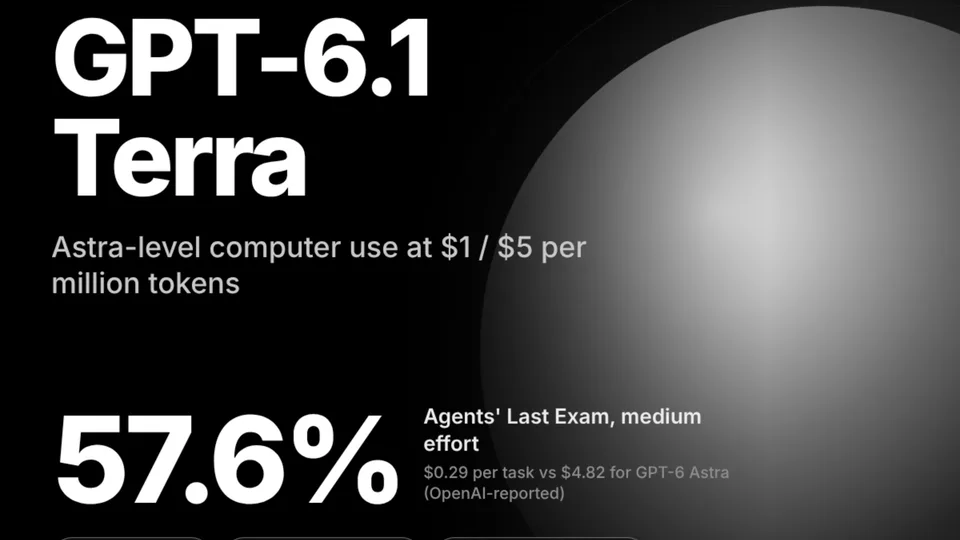
OpenAI Group PBC today released GPT-6.1 Terra, an upgrade to the middle tier model in its lineup of frontier artificial intelligence systems. The new model, the successor to GTP-5.6 Terra, costs around 50% less while handling computer use tasks faster and with greater accuracy. Terra is positioned as the everyday model in OpenAI’s lineup, designed […] The post OpenAI launches GPT-6.1 Terra for faster, better-performing AI agents at half the price appeared first on SiliconANGLE.
arXiv:2610.32638v1 Announce Type: new Abstract: LLM inference is increasingly deployed as a core service for enterprise and interactive applications, but sovereignty, compliance, latency and resource-locality requirements can limit the suitability of centralised cloud deployments. Telco operators offer geographically distributed compute and network infrastructure for addressing these constraints. However, existing LLM serving frameworks are designed for tightly coupled data centres and provide limited support for coordinating geographically distributed and heterogeneous resources. We present InferSlice, a reference architecture for Service-Level Objective (SLO)-driven LLM inference over a telco infrastructure, integrating network slicing, GPU partitioning, elastic serving and observability

Nanbeige LLM Lab released Nanbeige4.3-33B, a 33B dense Apache 2.0 model with 512K context. It reports 80.9 on Terminal-Bench 2.1 and will teach the upcoming Nanbeige4.3-3B. The post Nanbeige Releases Nanbeige4.3-33B, a 33B Open Agentic Coding Model appeared first on MarkTechPost.

GPT-6 Astra is our most capable broadly deployed model and our first to reach the Critical level of cybersecurity capability under our Preparedness Framework.
UST is bringing Claude to physical AI
GITHUB HUGGING FACE MODELSCOPE DEMO DISCORD Introduction In the past three months since Qwen2’s release, numerous developers have built new models on the Qwen2 language models, providing us with valuable feedback. During this period, we have focused on creating smarter and more knowledgeable language models. Today, we are excited to introduce the latest addition to the Qwen family: Qwen2.5. We are announcing what might be the largest opensource release in history!
DEMO PAPER GITHUB HUGGING FACE MODELSCOPE DISCORD To achieve the objective of building an AGI system, the model should be capable of understanding information from different modalities. Thanks to the rapid development of large language models, LLMs are now capable of understanding language and reasoning. Previously we have taken a step forward to extend our LLM, i.e., Qwen, to more modalities, including vision and audio, and built Qwen-VL and Qwen-Audio. Today, we release Qwen2-Audio, the next version of Qwen-Audio, which is capable of accepting audio and text inputs and generating text outputs.