Skip to content
AI NEWS JOURNAL
AI, IN PERSPECTIVE

Search AI news

Search headlines, summaries and articles to connect the dots.

Newest first

Gemini Omni 1.2 Flash: Fast and cost-effective with longer clips

Google DeepMind has launched Gemini Omni 1.2 Flash, introducing native 15-second video generation, improved reference adherence, stronger consistency across frames, multi-turn conversational editing, more natural speech, and cinematic camera movements. The model is now generally available via the Gemini API and Gemini for business, priced at $0.07 per second for 720p video—30% lower than its predecessor. It supports scalable workflows, including draft generation at lower resolutions, iterative edits, and upscaling to 1080p or 4K. Use cases include product explainers, social ads, virtual try-ons, and branded content, with applications across Google AI Studio, Google Cloud, Google Vids, Flow, the Gemini app, and Google Ads.

When Every Choice Is Correct: A Causal Study of Numerical Preference in Language Models

arXiv:2611.06025v1 Announce Type: new Abstract: When a language model chooses a number between 1 and 30, every integer in the range is valid, yet the model can favor particular answers. We use numerical choice to study how preference is processed across layers and tokens. Perturbation probing and gradient attribution nominate neurons for activation interventions. In a selected Qwen3-4B case, a pre-answer edit changes 17 to 15 while both runs first emit 1. After the edit ends, selective cache and attention-output replacements trace part of its continuing influence on the second digit. Replacing one attention head's output or the other heads' outputs jointly produces similar immediate readout contributions; both interventions restore 17 but have different final log-odds effects on 7 versus 5. Holding later multilayer perceptron (MLP) outputs at their values from the edited run without either replacement reduces this effect gap from 0.119 to 0.0025 nat. Later computation therefore changes how similar local contributions affect the continuation. Retrospective estimates across eighteen contexts capture much of the probability movement but miss the selected answer switch. Prompt tests also separate influence from answer changes: one held-out prompt retains influence without switching, and only one of twelve fresh wordings qualifies for the reader/MLP test; there, joint MLP clamping again reduces the gap between the two reader effects while the answer remains 17. These results use numerical choice as a controlled case for studying persistent state and conditional downstream processing; they do not establish the origin or a complete circuit of natural numerical preference.

A thousand fewer paths to root

OpenAI built an autonomous pipeline that found, validated, and generated patches for 948 local privilege-escalation vulnerabilities in the Linux kernel.

Same Rule, Different Verdicts: Rubric Language and Clause Structure in LLM Judges for Korean Support Dialogues

arXiv:2611.04091v1 Announce Type: new Abstract: Services that operate in Korean often write their evaluation rubrics in Korean and hand them to an LLM judge. We test whether a judge's verdict depends on the language of the rubric and on how a rubric item is phrased. We write 12 criteria for support dialogues in four clause structures (affirmative, negated, conditional, exception) such that two pairs of structures have the same meaning, and we give each item in Korean and in English. Six low-cost models from three providers, plus one reference model, judge 60 translated ESConv dialogues and 144 constructed boundary cases under every combination (51,744 requests across the seven models). The analysis plan was fixed and committed before data collection. Cross-provider agreement is lower with Korean rubrics than with English rubrics (Cohen's kappa 0.687 vs. 0.745; difference -0.058, 95% CI [-0.072,-0.045]). Disagreement concentrates in negated, conditional, and exception items (odds ratio 5.6 relative to affirmative items). A single model changes its verdict between two items with the same meaning in 11-15% of cases. Two hypotheses are not supported: models from the same provider do not agree more than models from different providers, and adding paired examples does not reduce the language gap. We measure consistency only; no human labels are used, and all materials were drafted by an LLM.

Swapping the Judge Changes the Ranking: A Preregistered Study of Cross-Provider Replication in LLM-Judged System Comparisons

arXiv:2611.04090v1 Announce Type: new Abstract: Practitioners who compare systems with an LLM judge and have no human labels often check a conclusion by repeating it with a judge from another provider. We test how far that check can be trusted. In a preregistered study (with a disclosed post-registration reduction of the judge set), five judge models from three providers re-judged 4,000 Chatbot Arena battles (nine systems, 33 system pairs) that carry human votes, each in both response orders. Agreement with the human vote was low at the verdict level (median Cohen's kappa = 0.22), and system rankings did not survive a change of judge: Kendall's tau with the human ranking ranged from 0.17 to 0.89 (median 0.67), so the preregistered hypothesis that rankings remain stable was not supported. Conclusions replicated by two low-cost judges from different providers matched the human conclusion more often than single-judge conclusions (+0.10 precision), but the gain came from filtering out one poorly aligned judge, and replication involving that judge left a conclusion for only 35% of comparisons. Judges that agreed with humans reached a stable conclusion with no more verdicts than human votes required; the others failed to converge on 26-70% of system pairs at the sample sizes tested (up to 100 verdicts per pair). Disagreements with the human vote co-occurred across judges far more often than independence predicts, although a single human vote per battle cannot separate shared judge bias from voter noise.

Detect Before You Disambiguate: Perturbation-Based Input Ambiguity Detection in LLMs

arXiv:2610.36353v1 Announce Type: new Abstract: Large language models (LLMs) often answer ambiguous inputs as if they had a single intended meaning. This is problematic because input ambiguity is an upstream source of uncertainty: when a prompt admits multiple valid interpretations, the key question is whether the model should answer directly at all. Existing input uncertainty methods often rely on LLM-generated statements or clarifications, but such transformations may already disambiguate the input before the ambiguity is measured. We propose a label-preserving perturbation framework for input ambiguity detection in which perturbations remain close to the original input while preserving its label. We instantiate this principle with two detectors: a black-box rule-based perturbation libra

Timeline and related coverage

Causal Localization of Evidence Effects in Transformers

arXiv:2610.36524v1 Announce Type: new Abstract: Can controlled symbolic inputs reveal attention heads that influence a language model's decisions from natural language evidence? We introduce controlled evidence aggregation (CEA), which varies the counts and order of two symbols in otherwise fixed prompts and measures changes in a frozen Transformer's preference between two answer tokens. The preference is measured by their logit difference; the prompts prescribe no correct answer. Balanced utility causal selection (BUC) identifies compact head sets by jointly evaluating how much ablating their outputs removes the count effect and how closely patching mean outputs between count conditions recovers the effect in both directions. We derive conditional bounds linking head attribution to interv

Timeline and related coverage

Async-RBench: Benchmarking Asynchronous Task Execution in LLM Agents

arXiv:2610.32429v1 Announce Type: new Abstract: Large language model (LLM) agents increasingly execute tasks asynchronously: a main agent continues working while its subagents run, and the task state may change before their results arrive. The main agent must decide which work to update or preserve and which checks to repeat, while avoiding prohibited changes. Final task success alone does not reveal whether these results were handled correctly, and natural asynchronous arrivals are hard to reproduce. We introduce Async-RBench, a benchmark for asynchronous task execution in LLM agents, with 200 executable tasks covering eight scenarios. A scenario controller regulates result delivery using predefined task-state conditions, while an Event Response Contract (ERC) specifies what each response

Timeline and related coverage

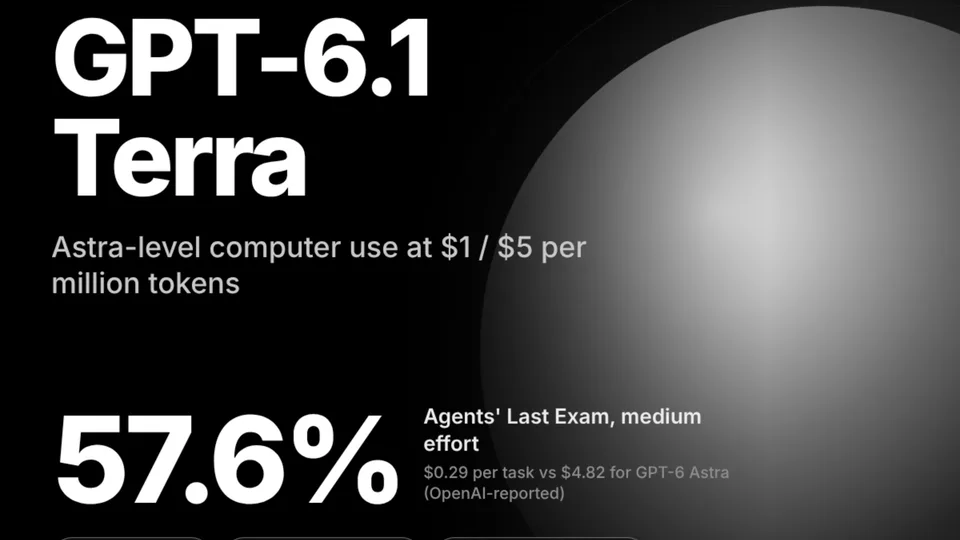
OpenAI launches GPT-6.1 Terra for faster, better-performing AI agents at half the price

OpenAI Group PBC today released GPT-6.1 Terra, an upgrade to the middle tier model in its lineup of frontier artificial intelligence systems. The new model, the successor to GTP-5.6 Terra, costs around 50% less while handling computer use tasks faster and with greater accuracy. Terra is positioned as the everyday model in OpenAI’s lineup, designed […] The post OpenAI launches GPT-6.1 Terra for faster, better-performing AI agents at half the price appeared first on SiliconANGLE.

Timeline and related coverage

Which Answer Did the Seventeen-Year-Old Write? A Behavioral Case Study of Author-Age Misattribution, Miscalibrated Confidence, and Non-Corrective Self-Explanation in Six Frontier Language Models

arXiv:2610.31946v1 Announce Type: new Abstract: Three students answered the same exam prompt by hand: "What is happiness? Are you happy?" Their ages, recorded at collection, are 17, 28, and 45. The 17-year-old's answer is hedged and formally phrased. Asked to match each answer to an age and gender label, most frontier language models confidently assign it to an adult. This paper reports a structured case study of that failure across six models: Claude Fable 5, Gemini 3.1 Pro, GPT-5.6 Sol, Grok 4.5, GPT-4o (2024), and DeepSeek V4. We ran 1,081 API sessions and scored 3,225 responses across six experimental conditions that manipulate framing, disclosure format, and audience-awareness instruction. Three of six models perform at or near chance (1/3) on the matching task while reporting 73-88%

Timeline and related coverage

RSI-Opt: Recursive Self-Improvement Optimizer Agents For Model Training

arXiv:2610.32026v1 Announce Type: new Abstract: Conventional neural-network training typically follows a predefined optimization recipe, motivating a LLM agent that monitors training dynamics and adjusts optimizer settings as training progresses, but a fixed agent policy does not accumulate experience across runs. We introduce RSI-Opt, a plug-and-play Recursive Self-Improvement Optimizer Agents which evolves the knowledge that guides this process: a prompt, a playbook of procedures, a library of tested optimizer code, and a decision cadence. A meta-agent rewrites this policy using evidence from earlier runs, and an archive retains evaluated policies for further evolution. Across 5 generations on three training tasks, the meta-agents develop reusable procedures and code and conduct their ow

RSI-Opt: Recursive Self-Improvement Optimizer Agents For Model Training
Timeline and related coverage

Do AI-for-Science Agents Preserve Model Safety?

arXiv:2610.32045v1 Announce Type: new Abstract: AI-for-Science agents are increasingly being used for formulating scientific hypotheses, running autonomous experiments, and interpreting evidence. These agents are constructed by integrating a large language model (LLM) into a domain-specific agent harness, which in turn can improve the LLM's scientific capability and enable the model to orchestrate scientific tools. In this work, we ask whether model safety is preserved when an LLM is integrated in an AI-for-Science agent harness. We evaluate five agent harnesses on 50 harmful chemistry requests. Specifically, we study how the safety behavior changes under direct prompting, two simple adversarial prompting strategies, and an adaptive attack. Across four recent GPT variants, our results show

Do AI-for-Science Agents Preserve Model Safety?
Timeline and related coverage