
AI made self-hosting fun again
Article URL: https://janlukas.blog/posts/ai-self-hosting Comments URL: https://news.ycombinator.com/item?id=50660180 Points: 72 # Comments: 54
Search headlines, summaries and articles to connect the dots.
Article URL: https://janlukas.blog/posts/ai-self-hosting Comments URL: https://news.ycombinator.com/item?id=50660180 Points: 72 # Comments: 54
arXiv:2611.33706v1 Announce Type: new Abstract: Hallucinations in multimodal large language models (MLLMs) often arise from visual assumptions that go unchecked. Self-reflection, multi-agent debate, and counterfactual verification can reinforce erroneous conclusions when they rely on the same unverified visual assumptions. External visual tools can provide verifiable evidence, but models may select the wrong tools, supply incorrect parameters, or ignore or contradict the evidence they obtain. In this work, we propose EVA, an Evidence-seeking Visual Agent that reframes multimodal reasoning as an explicit process of evidence acquisition and verification. At the core of EVA is a unified evidence-grounded execution pipeline designed to address the above challenges through two tightly coupled mechanisms. First, we introduce Iterative Tool Replanning, which dynamically refines tool selection and parameters based on intermediate observations, improving the reliability of tool usage. Second, we develop Evidence Consistency Verification, an answer validation mechanism that improves alignment between the final prediction and the collected evidence, mitigating evidence--reasoning inconsistencies. In addition, to balance robustness and efficiency, EVA incorporates Selective Evidence Routing, an adaptive fast--slow reasoning strategy that determines when external evidence is necessary. Visually straightforward queries are handled via direct reasoning, while complex or high-risk cases trigger tool-based evidence acquisition. By jointly addressing how to reliably acquire evidence and how to use it consistently, EVA transforms multimodal reasoning from passive answer validation into explicit evidence-backed decision making. Experimental results demonstrate that EVA achieves significantly improved reasoning reliability over direct VLM inference and multi-agent methods, while maintaining efficiency through selective tool invocation.
arXiv:2611.33308v1 Announce Type: new Abstract: Model merging combines fine-tuned experts into one model that serves many tasks without retraining, but merging many experts this way substantially reduces accuracy. Grouping offers a middle ground: at every layer or weight matrix, the $N$ experts are divided into $K
arXiv:2611.25407v1 Announce Type: new Abstract: Long-horizon agents rely on stored records to recover a person's state as facts change. Reliable answers depend on how facts are recorded, retrieved, and presented to the reader. We treat a long-form persona dossier as a memory representation of a known latent state, an invariant identity plus a timeline of facts, routines, and decision rules tied to life phases. We present ChronoDossier, a benchmark of 311 synthetic dossiers of 1k-10k words written by seven generators from dated timelines. Intrinsic metrics evaluate the records against their intended states; extrinsic metrics test recovery by five readers on a seeded 32-persona GPT-5.1 panel balanced across lengths (520 rated turns per condition). The linked states, records, evidence packets, and answers support tests of construction and evidence delivery. In a contextual-stress control, tag-scoped writer inputs remove detected out-of-scope anchor copying. Frozen questions authored on staged dossiers transfer less reliably to one-pass dossiers of the same states. In matched evidence controls, whole sections repair 29 of 32 GPT-5.1 and 25 of 30 Sonnet 4.6 failures labeled as packaging, compared with 2 of 8 and 1 of 8 answer-formation failures. Attribution uses separate key-based and key-free support measures, with model disagreements retained. Length remains confounded with persona and question composition; the observed between-bucket widening depends on excerpt construction. The benchmark supports offline evaluation against known facts. Memory acquisition from interaction and validation against real users remain outside its scope.
The contact center has been the low-hanging fruit for the artificial intelligence industry. Ask any information technology or business leader what they want to use agentic AI for, and they will say it’s to improve the customer experience, which starts with the contact center. However, to date, the industry has spent the past two years […] The post NiCE’s next-generation Cognigy bets the hard part of AI agents is running them, not building them appeared first on SiliconANGLE.
Article URL: https://evanxmerz.com/post/ai-usage-generates-a-fragile-codebase/ Comments URL: https://news.ycombinator.com/item?id=50438318 Points: 47 # Comments: 28
Merge uses GPT-6 Astra, ChatGPT, and Codex to review product code and support marketing. Its teams also use AI to plan executive dinners and prepare sales updates.
Meta Platforms Inc. has acquired artificial intelligence coding startup Conductor in a deal first reported today by Axios. Conductor confirmed it’s joining Meta in a post on its website. Terms were not disclosed. Conductor’s software lets a developer run several coding agents at once, each in an isolated copy of the codebase, and then review […] The post Meta acquires AI coding startup Conductor, whose app runs several coding agents at once appeared first on SiliconANGLE.
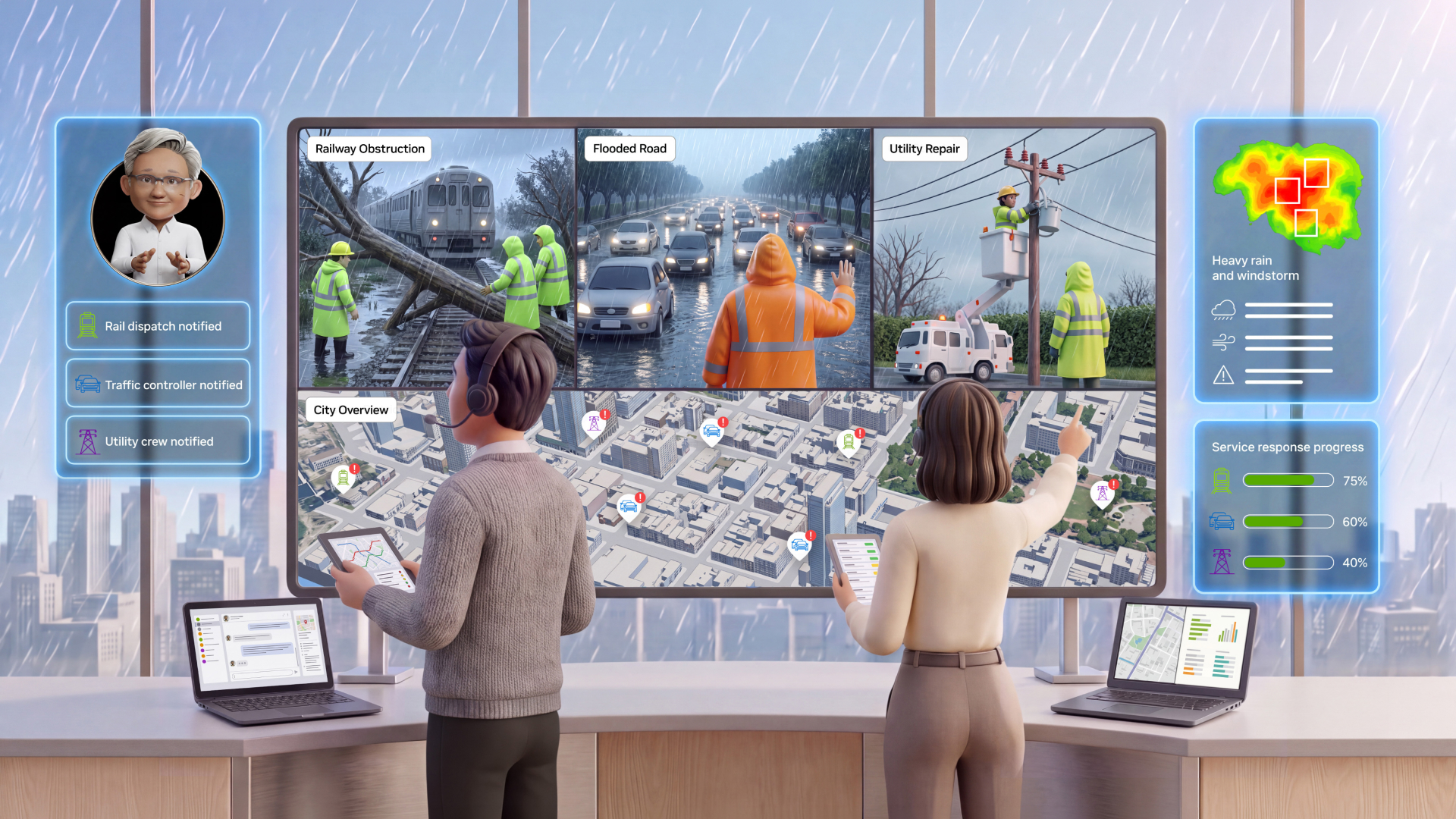
Cities generate enormous amounts of data from cameras, sensors and operational systems, but turning it into useful action — for planning, maintenance and public services — remains a challenge. Physical and agentic AI offer new ways to close that gap, from digital twins for infrastructure planning to vision and service agents, while keeping local governments […]
Massive note conversions reveal the true extent of Amazon's ownership in Anthropic.

Here's a clear explanation of Anthropic's incredibly complex governance structure.

In breathless press releases and posts, the company has touted its models’ ability to deliver scientific breakthroughs. But its IPO filing taps the brakes on just how fast its AI will lead to big discoveries.
Lots of visuals to use and learn with.
Model credits are showing up in festival promotions and carrier-style packs. Thin resellers that thrived on opaque markups face quality doubts, enforcement, and better-funded rivals. Durable intermediaries will charge for routing, trust, and integration—not for a secret price cut.
The S-1, the numbers, and the reactions.
arXiv:2610.33016v1 Announce Type: new Abstract: Llama-3, Qwen3 and many other open LLMs pre-tokenize text with a regular expression whose word class admits only Unicode letters. Devanagari vowel signs are combining marks, so this regex splits Nepali words at every vowel sign, and models that use it spend 2.6 to 5.8 times as many tokens on Nepali as on the same English text. Merge-based vocabulary extension cannot join the split pieces: for Llama-3 and Qwen3 no number of new merges brings this premium below about 2.2, and ten released extensions already end within 4% of this pre-token floor. We give a small edit to the deployed regex that provably keeps every token id of text without combining marks or Devanagari characters. With 32,000 new merges it brings Nepali to 1.01 times English, abo
In an S-1 filing today preceding what could be the largest IPO ever, Anthropic laid out extensive new details about its earnings, growth, key stakeholders and the risks it faces going forward. Clocking in at 335 pages, the document wasn’t exactly light reading. However, in a preliminary once-over, we highlight some of the more intriguing disclosures.

# Release v5.21.0 ## New Model additions ### MiniCPM-OCR MiniCPM-OCR is a document-understanding model from OpenBMB's MiniCPM-V family. It keeps the MiniCPM-V 4.6 architecture, which pairs a SigLIP vision encoder and a window-attention merger with a Qwen3.5 language model. It is specialized for reading text-dense images such as scanned pages, screenshots, receipts and tables. **Links:** [Documentation](https://huggingface.co/docs/transformers/main/en/model_doc/minicpm_ocr) | [Paper](https://huggingface.co/papers/2509.18154) * Feat test (#49920) by @guarin in [#49920](https://github.com/huggingface/transformers/pull/49920) ### Flint Flint is Recursive's mixture-of-experts language model. Compared to a standard SwiGLU MoE transformer such as Qwen3-MoE, it uses hybrid attention (sliding-windo
Fleet-wide computer vision needs a model per camera, not one model for the whole fleet. This post presents a working Amazon SageMaker SDK v3 reference architecture that trains, quality-gates, compiles per-camera models with SageMaker Neo, and versions thousands of them, with an AWS Step Functions layer pacing fleet-scale retraining within account quotas.
Anthropic’s S-1 shows more than half of its $100,000-plus customers now use both the Claude Platform and a first-party app, a cross-selling playbook reminiscent of Amazon that’s making enterprise customers stickier.