Skip to content
AI NEWS JOURNAL
AI, IN PERSPECTIVE

Search AI news

Search headlines, summaries and articles to connect the dots.

Newest first

Release: v5.21.0

# Release v5.21.0 ## New Model additions ### MiniCPM-OCR MiniCPM-OCR is a document-understanding model from OpenBMB's MiniCPM-V family. It keeps the MiniCPM-V 4.6 architecture, which pairs a SigLIP vision encoder and a window-attention merger with a Qwen3.5 language model. It is specialized for reading text-dense images such as scanned pages, screenshots, receipts and tables. **Links:** [Documentation](https://huggingface.co/docs/transformers/main/en/model_doc/minicpm_ocr) | [Paper](https://huggingface.co/papers/2509.18154) * Feat test (#49920) by @guarin in [#49920](https://github.com/huggingface/transformers/pull/49920) ### Flint Flint is Recursive's mixture-of-experts language model. Compared to a standard SwiGLU MoE transformer such as Qwen3-MoE, it uses hybrid attention (sliding-windo

Timeline and related coverage

Fleet-wide computer vision lifecycle at the edge with SageMaker SDK v3

Fleet-wide computer vision needs a model per camera, not one model for the whole fleet. This post presents a working Amazon SageMaker SDK v3 reference architecture that trains, quality-gates, compiles per-camera models with SageMaker Neo, and versions thousands of them, with an AWS Step Functions layer pacing fleet-scale retraining within account quotas.

Timeline and related coverage

Will the real Anthropic please stand up

This story originally appeared in The Algorithm, our weekly newsletter on AI. To get stories like this in your inbox first, sign up here. After weeks of frenzied speculation, Anthropic has filed its IPO prospectus. The 335-page document (100 pages or so are focused on risks) lays out the company’s unique view of the technology it…

Timeline and related coverage

Five weird details from Anthropic’s IPO filing

Anthropic has finally filed its S-1 prospectus with the SEC, a document designed to give investors a look under the hood of its business, from how much its executives are making and plans for spending its IPO billions to the risks that could derail its ambitions. At more than 300 pages, there's a lot to […]

Five weird details from Anthropic’s IPO filing
Timeline and related coverage

Anthropic files S-1 paperwork for proposed IPO

Artificial intelligence giant Anthropic PBC filed papers today for an initial public offering with the United States Securities and Exchange Commission, putting it on track for what will likely be the biggest stock market debut of an AI developer to come, amid warnings about advanced AI. In its filing, Anthropic said it plans to list […] The post Anthropic files S-1 paperwork for proposed IPO appeared first on SiliconANGLE.

Timeline and related coverage

Anthropic files S-1 paperwork for blockbuster AI IPO

Artificial intelligence giant Anthropic PBC filed papers today for an initial public offering with the U.S. Securities and Exchange Commission, putting it on track for what will likely be the biggest stock market debut of an AI developer to come, amid warnings about advanced AI. In its filing, Anthropic said it plans to list on […] The post Anthropic files S-1 paperwork for blockbuster AI IPO appeared first on SiliconANGLE.

Timeline and related coverage

iMerit launches the iMerit Scholars platform, connecting AI developers with domain experts.

Indian AI data services company iMerit launched the iMerit Scholars platform on October 26, 2026, aiming to help AI developers recruit and manage domain experts with backgrounds in fields such as medicine, agriculture, and mathematics, thereby supporting model evaluation, fine-tuning, and validation. The platform leverages its Ango Hub technology stack and integrates Trolley Technologies’ payment compliance capabilities, emphasizing experts’ proactive “challenging” of models and their ability to identify errors.

Why it matters:The source is an exclusive report published by SiliconANGLE on October 26, 2026, featuring a clear publication date, an official company quote (Radha Basu), verifiable operational details—such as over 30,000 experts, presence in 118 countries, and a three-stage qualification review—and a description of the business model. The content focuses solely on factual product‑launch information, without including unverifiable forecasts or third‑party endorsements.

Timeline and related coverage

Phronix: The Capability-Centric Learning Paradigm for Agents

arXiv:2610.31789v1 Announce Type: new Abstract: Scientific computing increasingly relies on large language model-based agents for performance engineering tasks such as instrumentation, analysis, and workflow porting. However, agent effectiveness depends heavily on the surrounding harness, which typically relies on manually written skills and curated memory. This limits autonomous learning, forcing agents to repeatedly rediscover solutions rather than retain and reuse knowledge from prior executions. We introduce Phronix, a capability-centric learning paradigm that enables agentic harnesses to acquire, validate, and refine reusable capabilities from their own executions. Phronix operates through a predictor-validator-corrector loop: MCP tools and associated skills propose solutions, tool ex

Phronix: The Capability-Centric Learning Paradigm for Agents
Timeline and related coverage

Zhen’an Technology plans to acquire, through cash, no less than 51% of the equity in Shenzhen Sanwei, marking the second step in bolstering its computing power and thermal management capabilities.

Zhen’an Technology (300767.SZ) announced on October 26, 2026, that it plans to acquire, in cash, no less than 51% of the equity interest in Shenzhen Sanwei Mechanical and Electrical Equipment Co., Ltd., a transaction expected to constitute a major asset restructuring. This marks the company’s second acquisition of an affiliated thermal‑control asset within the year; earlier, in March 2026, it had acquired a 51% stake in Dongchuang Jingyi. The deal aims to strengthen its upstream precision‑manufacturing capabilities in the computing‑power thermal‑control value chain. However, the company’s core business continues to shrink, it has posted consecutive losses over the past three years, maintains high leverage, and faces an accounts‑receivable bad‑debt ratio approaching 40%, with the effectiveness of its transformation still pending verification.

Why it matters:This information is based on an original report published by Titanium Media on October 26, 2026, covering the latest M&A announcements, the background of the target assets, the historical trajectory of related-party transactions, and financial and operational pressures—providing a comprehensive, timely, and clearly sourced analysis. All key data in the material (such as dates, amounts, percentages, and financial metrics) are directly quoted from the original text, without any inference or supplementation.

Timeline and related coverage

A roundup of the most anticipated AI-powered wearable devices in 2026: over ten new models, including Bee, Friend, Limitless, and more, make their debut.

On October 25, 2026, TechCrunch published a review summarizing more than ten AI-powered wearable devices, including Bee, Friend, Limitless, Muse Charm, Nirva, Omi, Plaud NotePin, Rabbit R1, Stream Ring, and others, covering their pricing, functional positioning, market availability, and privacy controversies.

The hottest AI wearables and gadgets you should know about

Why it matters:This report is an annual roundup of new products published by the authoritative tech media outlet TechCrunch on October 25, 2026. It covers both mainstream AI hardware manufacturers and startups, providing a comprehensive overview in terms of price, form factor, core features, release timelines, and points of contention. All statements are based solely on facts explicitly stated in the source material, with no speculation or extrapolation.

Timeline and related coverage

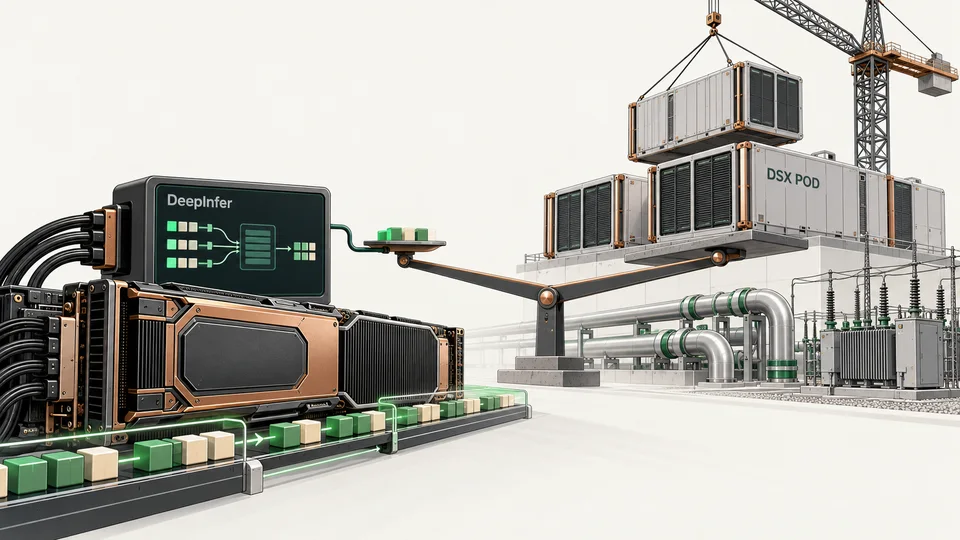
Low-Cost Intelligence vs. Expensive Ambitions: DeepInfer, DSX POD, and AI Investment Expansion

Issue 958 of “The Sequence Radar” examines inference software, modular AI factories, and enterprise AI investments side by side: cheaper per-inference does not necessarily mean lower overall industry spending. This article is compiled from the original publication and supplemented with technical scope and delivery terms based on DeepSeek and NVIDIA’s official materials.

推理软件效率与模块化AI基础设施投入的编辑示意,非实际产品照片
Timeline and related coverage

Learning What to Ask for Tomorrow: Active Preference Acquisition for Long-Term Personalized Web Agents

arXiv:2610.31107v1 Announce Type: new Abstract: Web agents increasingly serve the same user across repeated online tasks such as booking travel, shopping, and scheduling, so their long-term usefulness depends on how well they know the user's preferences. Passive memory and personalization methods cannot obtain preferences the user never reveals, and clarification methods that value a question by its benefit to the current task overlook the benefit of reusing the answer in later tasks. We study Active Preference Acquisition (APA): which missing preferences are worth the cost of asking? We define the Prospective Personalization Value (PPV) of a missing preference as its expected cumulative utility gain over future tasks minus the effort and disclosure-risk cost of asking, and select question

Learning What to Ask for Tomorrow: Active Preference Acquisition for Long-Term Personalized Web Agents
Timeline and related coverage