
Skip to content
AI NEWS JOURNAL
AI, IN PERSPECTIVE

Search AI news

Search headlines, summaries and articles to connect the dots.

Newest first

b12202

The llama.cpp v1.220.2 release introduces enhanced BF16 precision support across multiple components, aligning with reference implementations by moving specific operations like GLM4 family projections, MiMoVL vision matmuls, and Qwen3-TTS speaker encoder conv1d to BF16 where appropriate. Backends such as CUDA, Hexagon, OpenCL, WebGPU, and Vulkan now uniformly handle GGML_PREC_BF16 similarly to F32, while CPU, SpaceMIT, and ET backends extend flash attention support to BF16 with F32 accumulation. Flash attention tests now include BF16 cases, and the KQ multiplication in Llama is updated to request BF16 precision. A TODO remains in clip.cpp for future work.

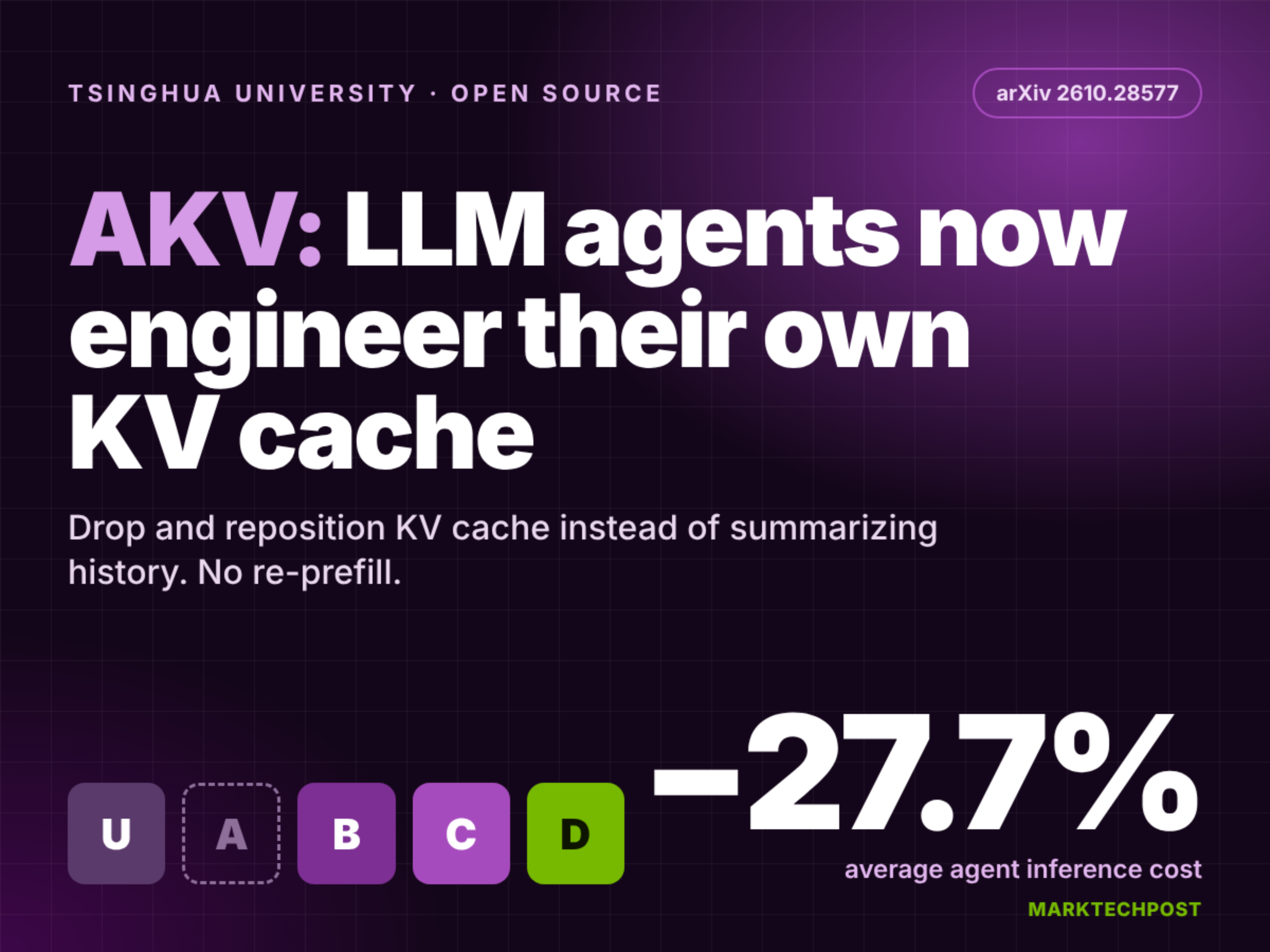
Tsinghua University and The Chinese University of Hong Kong jointly open-source AKV: an engineering service system for KV caching tailored to LLM agents.

On October 26, 2026, researchers from Tsinghua University and the Chinese University of Hong Kong open-sourced AKV—a KV cache engineering server built on SGLang and specifically designed for large language model (LLM) agents. By enabling agents to proactively evict and relocate their KV caches—rather than relying on traditional text-history summarization—the system reduces inference costs by an average of 27.7% across four agent benchmarks and improves task scores by 1.7 points on average. The code is licensed under the Apache-2.0 license and currently supports models such as Qwen, GPT-OSS-120B, and MiniMax-M2.7.

Tsinghua AI Open-Sources AKV, a Cache Engineering Server for LLM Agents on SGLang

Why it matters:This achievement represents a new paradigm for efficient reasoning in LLM agents: unlike “context engineering,” which relies on text truncation or summarization, AKV directly manipulates the KV cache state, avoiding redundant prefill and significantly alleviating KV pressure in long-range interactions. Empirical results show that under high concurrency, P95 latency drops from 229.9 seconds to 30.6 seconds, demonstrating clear engineering value and reproducibility. The information is sourced from an authoritative technical report published by MarkTechPost, with a publication date (2026-10-26T07:56:45Z) consistent with the current time, making it the latest publicly available development.

Timeline and related coverage