
Grok releases the first seven minutes of its AI-generated ‘Odyssey’
The footage looks okay, as long as you're not seeking artistry, inspiration, or human interest.

Search headlines, summaries and articles to connect the dots.
The footage looks okay, as long as you're not seeking artistry, inspiration, or human interest.
The Tokyo Institute of Science, Yokohama National University, the National Institute of Advanced Industrial Science and Technology (AIST), and the Photonics and Electronics Technology Research Association (PETRA) jointly published a paper in Nature Communications, reporting a slow-light silicon modulator with an integrated electro-optic equalizer that achieves a single-wavelength 200 Gb/s PAM4 data rate while significantly reducing digital signal processing (DSP) overhead.

Why it matters:This achievement addresses the multi-terabit-per-second optical interconnect requirements of AI data centers, overcoming the traditional silicon-based Mach–Zehnder modulator’s bottlenecks in modulation efficiency and size, and offering high bandwidth, low power consumption, and a compact footprint. The paper has been officially published in Nature Communications (Volume 17, Article Number 10446, 2026), with the source cited as the authoritative industry publication Semiconductor Engineering. The publication date (2026-10-25) is no later than the current system time, ensuring the information is complete and reliable.
tests : adjust default threads for test-llama-context (#31157) **Website:** - **Attestations:** - **macOS/iOS:** - [macOS Apple Silicon (arm64)](https://github.com/ggml-org/llama.cpp/releases/download/b11887/llama-b11887-bin-macos-arm64.tar.gz) - macOS Apple Silicon (arm64, KleidiAI enabled) [DISABLED](https://github.com/ggml-org/llama.cpp/pull/23780) - [macOS Intel (x64)](https://github.com/ggml-org/llama.cpp/releases/download/b11887/llama-b11887-bin-macos-x64.tar.gz) - [iOS XCFramework](https://github.com/ggml-org/llama.cpp/releases/download/b11887/llama-b11887-xcframework.zip) **Linux:** - [Ubuntu x64 (CPU)](https://github.com/ggml-org/llama.cpp/releases/download/b11887/llama-b11887-bin-ubuntu-x64.tar.gz) - [Ubuntu arm64 (CPU)](https://github.com/ggml-org/llama.cpp/releases/download/b11
qwen: merge tensors on convert (#31028) * qwen: merge tensors on convert * convert: use generator functions * qwen4exp: remove conts and pre-scale **Website:** - **Attestations:** - **macOS/iOS:** - [macOS Apple Silicon (arm64)](https://github.com/ggml-org/llama.cpp/releases/download/b11886/llama-b11886-bin-macos-arm64.tar.gz) - macOS Apple Silicon (arm64, KleidiAI enabled) [DISABLED](https://github.com/ggml-org/llama.cpp/pull/23780) - [macOS Intel (x64)](https://github.com/ggml-org/llama.cpp/releases/download/b11886/llama-b11886-bin-macos-x64.tar.gz) - [iOS XCFramework](https://github.com/ggml-org/llama.cpp/releases/download/b11886/llama-b11886-xcframework.zip) **Linux:** - [Ubuntu x64 (CPU)](https://github.com/ggml-org/llama.cpp/releases/download/b11886/llama-b11886-bin-ubuntu-x64.tar.gz
llama: fix exhausting CPU and MEM caused by dry sequence breaker (#31035) **Website:** - **Attestations:** - **macOS/iOS:** - [macOS Apple Silicon (arm64)](https://github.com/ggml-org/llama.cpp/releases/download/b11884/llama-b11884-bin-macos-arm64.tar.gz) - macOS Apple Silicon (arm64, KleidiAI enabled) [DISABLED](https://github.com/ggml-org/llama.cpp/pull/23780) - [macOS Intel (x64)](https://github.com/ggml-org/llama.cpp/releases/download/b11884/llama-b11884-bin-macos-x64.tar.gz) - [iOS XCFramework](https://github.com/ggml-org/llama.cpp/releases/download/b11884/llama-b11884-xcframework.zip) **Linux:** - [Ubuntu x64 (CPU)](https://github.com/ggml-org/llama.cpp/releases/download/b11884/llama-b11884-bin-ubuntu-x64.tar.gz) - [Ubuntu arm64 (CPU)](https://github.com/ggml-org/llama.cpp/releases/d
llama-quant : fix 4D tensor quantization using ggml_nrows() and name-based expert detection (#30820) * llama-quant : fix quantizing 4D tensors nrows_total was ne[1]*ne[2], so for a 4D tensor only the first ne[2] slices were quantized and the rest of the rows were dropped. Use ggml_nrows(tensor) to count all rows, including ne[3]. Fixes #29916 * llama-quant : detect expert tensors by name and fix imatrix size for 4D tensors The MXFP4_MOE path used ne[2] > 1 to detect MoE expert tensors. This is wrong for non-expert tensors with 3 or more dims, e.g. MLA projections (BailingMoE3) and 4D conv kernels. Use the tensor name instead: all tensors used by GGML_OP_MUL_MAT_ID are named *_exps or *_chexps. This also removes the BailingMoE3 special case. The imatrix holds one vector of ne[0] values per
grammar: limit recursion depth to prevent stack overflow (#29495) (#29755) **Website:** - **Attestations:** - **macOS/iOS:** - [macOS Apple Silicon (arm64)](https://github.com/ggml-org/llama.cpp/releases/download/b11882/llama-b11882-bin-macos-arm64.tar.gz) - macOS Apple Silicon (arm64, KleidiAI enabled) [DISABLED](https://github.com/ggml-org/llama.cpp/pull/23780) - [macOS Intel (x64)](https://github.com/ggml-org/llama.cpp/releases/download/b11882/llama-b11882-bin-macos-x64.tar.gz) - [iOS XCFramework](https://github.com/ggml-org/llama.cpp/releases/download/b11882/llama-b11882-xcframework.zip) **Linux:** - [Ubuntu x64 (CPU)](https://github.com/ggml-org/llama.cpp/releases/download/b11882/llama-b11882-bin-ubuntu-x64.tar.gz) - [Ubuntu arm64 (CPU)](https://github.com/ggml-org/llama.cpp/releases/
llama : respect no_alloc in all memory caches (#31087) * llama : respect no_alloc in memory caches Assisted-by: dsh:llama.cpp/ggml-org/DeepSeek-V4-Flash-Vision-Exp-GGUF (Mac Studio, M2 Ultra, 192GB) * llama : TODO: move no_alloc out of llama_hparams Assisted-by: dsh:llama.cpp/ggml-org/DeepSeek-V4-Flash-Vision-Exp-GGUF (Mac Studio, M2 Ultra, 192GB) * llama : TODO: move no_alloc out of llama_hparams Assisted-by: dsh:llama.cpp/ggml-org/DeepSeek-V4-Flash-Vision-Exp-GGUF (Mac Studio, M2 Ultra, 192GB) **Website:** - **Attestations:** - **macOS/iOS:** - [macOS Apple Silicon (arm64)](https://github.com/ggml-org/llama.cpp/releases/download/b11881/llama-b11881-bin-macos-arm64.tar.gz) - macOS Apple Silicon (arm64, KleidiAI enabled) [DISABLED](https://github.com/ggml-org/llama.cpp/pull/23780) - [macOS
tools : reject truncated GGUF tensor data in merge (#31044) Co-authored-by: Shreya Agrawal **Website:** - **Attestations:** - **macOS/iOS:** - [macOS Apple Silicon (arm64)](https://github.com/ggml-org/llama.cpp/releases/download/b11880/llama-b11880-bin-macos-arm64.tar.gz) - macOS Apple Silicon (arm64, KleidiAI enabled) [DISABLED](https://github.com/ggml-org/llama.cpp/pull/23780) - [macOS Intel (x64)](https://github.com/ggml-org/llama.cpp/releases/download/b11880/llama-b11880-bin-macos-x64.tar.gz) - [iOS XCFramework](https://github.com/ggml-org/llama.cpp/releases/download/b11880/llama-b11880-xcframework.zip) **Linux:** - [Ubuntu x64 (CPU)](https://github.com/ggml-org/llama.cpp/releases/download/b11880/llama-b11880-bin-ubuntu-x64.tar.gz) - [Ubuntu arm64 (CPU)](https://github.com/ggml-org/lla
CUDA: fuse FFN gate/up matmuls and GLU in MMQ with interleaved gate/up rows (#29948) * cuda: fuse FFN gate/up and GLU in MMQ with interleaved gate/up rows For prompt processing, run the gate and up matmuls of a dense FFN as one mul_mat_q launch and apply the GLU in the write-back. - The loaders take the gate weights as a second pointer and fill the weight tile with up and gate rows interleaved in chunks of 8, so each thread holds an up value and the matching gate value (rows r and r + 8 of an MMA tile). - The MMA loop is unchanged: same tile, warp layout, vec_dot and one sum[] per thread. The fused write-back computes the GLU from registers and writes half the rows. - The fused path uses the regular tiling (no stream-k) with the column tiles innermost so that neighbouring blocks share weig
ggml-cuda: fuse qwen MRoPE + set-rows (#31025) **Website:** - **Attestations:** - **macOS/iOS:** - [macOS Apple Silicon (arm64)](https://github.com/ggml-org/llama.cpp/releases/download/b11878/llama-b11878-bin-macos-arm64.tar.gz) - macOS Apple Silicon (arm64, KleidiAI enabled) [DISABLED](https://github.com/ggml-org/llama.cpp/pull/23780) - [macOS Intel (x64)](https://github.com/ggml-org/llama.cpp/releases/download/b11878/llama-b11878-bin-macos-x64.tar.gz) - [iOS XCFramework](https://github.com/ggml-org/llama.cpp/releases/download/b11878/llama-b11878-xcframework.zip) **Linux:** - [Ubuntu x64 (CPU)](https://github.com/ggml-org/llama.cpp/releases/download/b11878/llama-b11878-bin-ubuntu-x64.tar.gz) - [Ubuntu arm64 (CPU)](https://github.com/ggml-org/llama.cpp/releases/download/b11878/llama-b11878
vulkan: Add a larger tile size for conv3d (coopmat2 only) (#29920) * vulkan: Add a larger tile size for conv3d (coopmat2 only) This adds a larger tile size, in practice it is only for coopmat2 where we don't need shared memory to store the output (would use more than 64KB). Add some additional representative backend tests. At least, this is what codex came up with from looking at sd.cpp Wan VAE. * only apply large tile size for newer driver versions **Website:** - **Attestations:** - **macOS/iOS:** - [macOS Apple Silicon (arm64)](https://github.com/ggml-org/llama.cpp/releases/download/b11877/llama-b11877-bin-macos-arm64.tar.gz) - macOS Apple Silicon (arm64, KleidiAI enabled) [DISABLED](https://github.com/ggml-org/llama.cpp/pull/23780) - [macOS Intel (x64)](https://github.com/ggml-org/llama
Starting in September 2026, panel manufacturers such as TCL CSOT, BOE, and HKC have issued price‑increase notices one after another. The primary reason is the rapid growth of AI large models, which has led to a sharp surge in demand for HBM, squeezing capacity for mature‑process chips and driving up the prices of key components like driver ICs, PCBs, and glass substrates. Upstream suppliers, including Corning, have also raised their prices in tandem. Despite clear cost pressures, downstream TV and monitor brands have yet to broadly increase purchase prices, while end users continue to report frequent quality‑control issues such as overheating and black spots. As a result, these price hikes have not yet translated into actual sales or improved user experiences.

Why it matters:The materials system reveals the cross‑chain transmission mechanism through which the AI industry impacts indirectly related hardware sectors—rather than driving panel demand directly, it triggers a full‑chain cost repricing via the reallocation of wafer‑fabrication capacity. At the same time, it highlights a significant gap between price‑increase behavior and actual market feedback (price rigidity, declining shipments, and user complaints), underscoring the deep‑seated contradiction between industry bargaining power and product competitiveness.
In his book “Hyper-Scale,” Paris Marx traces the history of resistance within global data centers, noting that Ireland imposed a ban due to grid capacity saturation, prompting companies to build their own gas-fired power plants; meanwhile, New Zealand is exploring a non-exploitative AI pathway by leveraging local cloud services to support Māori-language speech recognition; and the wave of opposition currently sweeping the United States is, in fact, a reenactment of long‑foreseen global tensions.
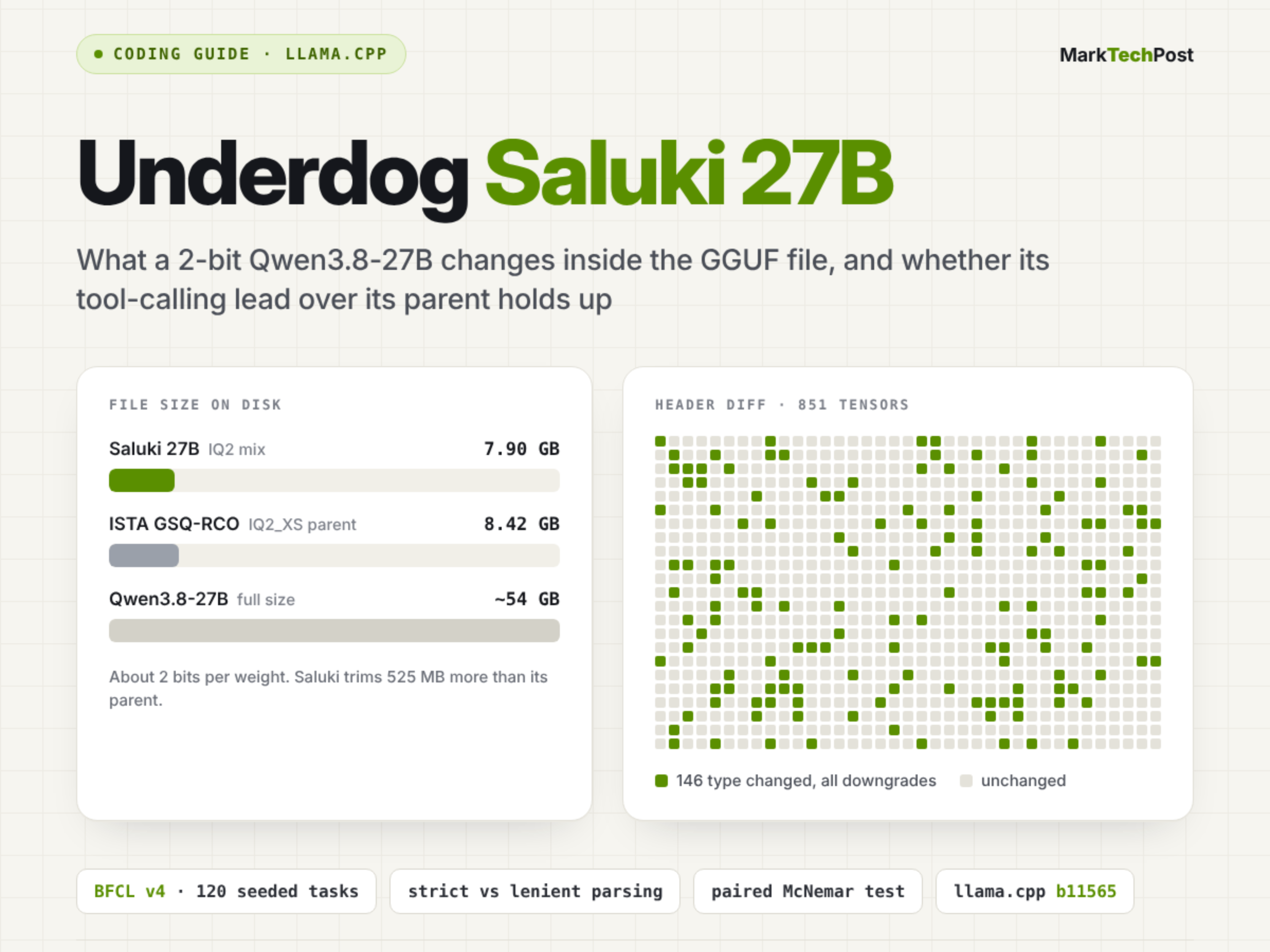
This article introduces Saluki 27B, a model released by Underdog—a 7.9 GB, 2-bit quantized variant of Qwen3.8-27B—built using the GSQ-RCO method from ISTA-DASLab. It claims to outperform the original 54 GB full-precision model on the BFCL v4 benchmark across 120 tasks; however, all performance conclusions are based solely on the developers’ assertions and have not been independently verified.
The llama.cpp project has released build version b11869, which primarily fixes the parameter-parsing logic for the select and selectattr functions in Jinja templates and provides precompiled binaries that support dozens of hardware–backend combinations across macOS, Linux, Windows, Android, iOS, and openEuler.
llama.cpp v2.45.0 (tag b11868) has been officially released, with the core update being the introduction of a KV-head splitting mechanism in the Hexagon backend to optimize multi-core HMX Flash Attention performance and unify the FA splitting control flag. Binary packages are simultaneously available for all major platforms, including macOS, Linux, Windows, Android, iOS, and openEuler, supporting multiple backends such as CUDA 12/13, Vulkan, ROCm, OpenVINO, SYCL, and Snapdragon (Adreno + Hexagon).
llama.cpp has officially released version b11867 on GitHub. Key changes include a refactored server entry point (PR #31113) and the addition of the server_role mechanism. Additionally, more than 40 precompiled binaries are now available, covering macOS, Linux, Windows, Android, iOS, and openEuler, with support for diverse hardware backends such as CPU, CUDA (12.4/12.8/13.4), Vulkan, ROCm 10.0, OpenVINO, SYCL (FP16/FP32), and Snapdragon (Adreno + Hexagon).
The llama.cpp project has released build version b11865, with core changes including the addition of memory-boundary checks in the RDMA receive logic (PR #30399) and a significant expansion of hardware-acceleration support, covering CUDA 13.4, ROCm 10.0, Vulkan, OpenVINO, SYCL, and Qualcomm Snapdragon—providing full-stack heterogeneous computing backends for CPU, Adreno, and Hexagon. macOS KleidiAI support and openEuler builds have been explicitly marked as DISABLED.
llama.cpp v.b11861 fixes the weight distortion issue in the minimax-m3 model that occurred under NVFP4/MXFP8 quantization due to the scale tensor not being injected into the computation graph, thereby preventing “token soup” and residual vanishing; it also provides multi-platform binary builds covering macOS, Linux, Windows, Android, iOS, and openEuler.