
Skip to content
AI NEWS JOURNAL
AI, IN PERSPECTIVE

Search AI news

Search headlines, summaries and articles to connect the dots.

Newest first

GitHub Copilot Fusion Launches with Dual Capabilities: Intelligent Model Orchestration and Local Model Routing

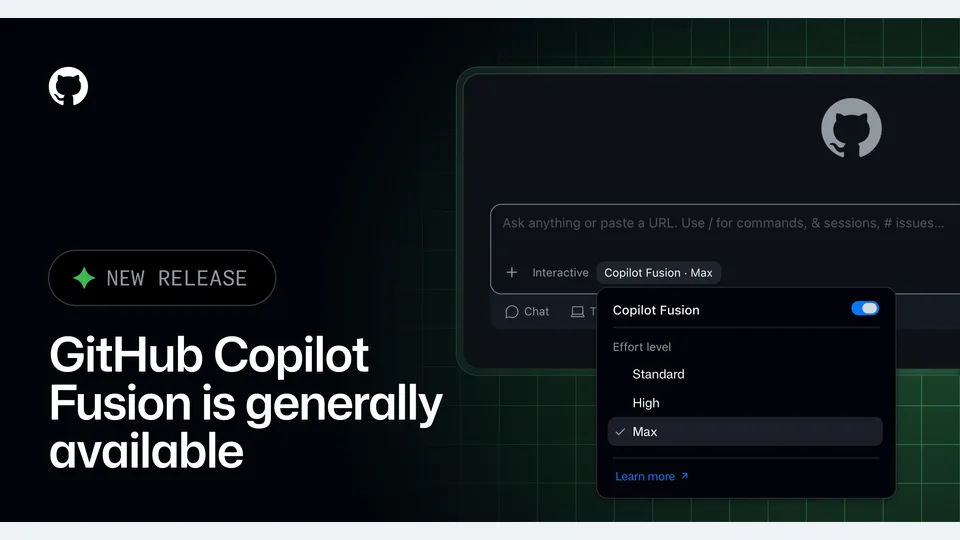
On October 28, 2026, GitHub released the official version of Copilot Fusion, simultaneously introducing an experimental local model routing feature. This capability enables automatic invocation of local models such as MAI Code 1.1 Flash on Windows devices and activates intelligent routing within VS Code, the CLI, and the Copilot App. The system automatically selects and combines cloud models—like those from OpenAI, Anthropic, and Google—based on three effort levels: Standard, High, and Max, achieving performance close to Claude Code while cutting costs in half during coding evaluations.

Timeline and related coverage

GitHub releases Copilot Fusion, an automated multi-model orchestration tool that boosts coding efficiency and cost-effectiveness.

At Universe 2026, GitHub unveiled Copilot Fusion, an intelligent orchestration layer that automatically routes and combines models from OpenAI, Anthropic, Google, and others to complete coding tasks—eliminating the need for developers to manually select models. It integrates existing automatic model-selection technologies with Project HydraFusion, previewed in September. Once the model selector is enabled, the system automatically adopts execution modes such as single-model, cascading, or critique, based on task complexity.

QQ20261029-155714.jpg
Timeline and related coverage

Quoting Addy Osmani, Morgan Westlee Lunt, and Qing Wang

We think "did a human read the code?" is an imprecise proxy for "what could go wrong with this change, and which check—automated or human—is the right one to catch it?" Asking that question also changed when review happens. Before, review was a gate at the end of the road: write the code, open a PR, wait for your colleague. Now, review runs continuously, more like spellcheck while you write. Most changes have been reviewed and fixed by Claude at least once before a human is asked to look. This catches most routine mistakes, and saves team attention for higher-level questions and scrutiny. — Addy Osmani, Morgan Westlee Lunt, and Qing Wang, How the Claude Code team does code review Tags: anthropic, claude, ai, claude-code, llms, addy-osmani, coding-agents, generative-ai, agentic-engineering,

Timeline and related coverage

sparqlite: SPARQL 1.1 inside SQLite, written in Rust

Research: sparqlite: SPARQL 1.1 inside SQLite, written in Rust This research task is really an experiment in running Claude Code for web in "Ultracode" mode, as described in Orchestrate subagents at scale with dynamic workflows in the Claude Code documentation. With Ultracode turned on, Claude Code makes aggressive use of dynamic workflows - it generates JavaScript that defines and coordinates a network of subagents to take on complex problems. My initial prompt was this - I meant "hit the rows directly", the word "delete" was an accidental typo on my phone: Write a SQLite extension in Rust that implants SPARQL and runs really fast because it can hit the delete rows directly This caused Claude Code for web to churn for over 12 hours. I checked in on its progress the next day and sent a sin

Timeline and related coverage

Chirp Pong

Tool: Chirp Pong Another game experiment - I wanted to see if it was feasible to have a two player game on two separate phones running in static HTML where the networking code uses chirps sent via the microphone. It seems to work! Build a two player competitive pong like game where two players use their phones close to each other and the game state is sent via audio noises which the web microphone API can interpret - but add graphical and gameplay twists to make it a lot more fun and intertwine than pong Claude Opus 5.5 Extra in Claude Code. Tags: game-design, ai, generative-ai, llms, claude-code

Timeline and related coverage

LaTeX renderer

Tool: LaTeX renderer Inspired by Paul Ford and Aboard Foundary's new web app Tiny Little Office, which provides a suite of web app content editors (a Word Processor, Outliner, Presentation Builder, Spreadsheet, Calculator, Drawing Tool, Diagram Maker, Animator, Calendar, and Trip Planner). Tiny Little Office's signature trick is to store all of the document data in the #fragment section of the URL, so every document created using it becomes a bookmarkable and shareable link. It also has an llms.txt file telling agents how to construct URLs that will render as documents. Claude used that file to generate this link to a deck that explains how the URL format works: Tiny Little Office inspired me to have Claude Code (Opus 5.5 Extra) build a similar tool that works with LaTeX. Here's the sequen

Timeline and related coverage

Tree Appreciator

Tool: Tree Appreciator Another game experiment with Claude. This one used the default Claude iPhone app (chat mode, not Claude Code mode), where I prompted Claude Opus 5.5 Max with: Build a three js game called "Tree appreciator" - it shows you two algorithmically generated trees and the game mechanics is about appreciating the differences between them. Think hard about how to make sure it is both fun and beautiful. Somewhat embarrassingly given my recent talk, I've found that telling Opus 5.5 "make sure it is fun" works uncomfortably well. In this case Claude crunched for 3 hours and 7 minutes before retuning a cosy little spot-the-difference game with music and animation and achievements that's quite compelling to play. Tags: game-design, javascript, ai, generative-ai, llms, claude, vibe

Timeline and related coverage