
How I Fight AI Brain Fry
Article URL: https://sergeykuhne.com/blog/fighting-ai-brain-fry Comments URL: https://news.ycombinator.com/item?id=50416363 Points: 83 # Comments: 56
Search headlines, summaries and articles to connect the dots.
Article URL: https://sergeykuhne.com/blog/fighting-ai-brain-fry Comments URL: https://news.ycombinator.com/item?id=50416363 Points: 83 # Comments: 56
Turn conversations into code with @GitHub in Slack and Teams! Investigate bugs, create issues, implement changes, and open pull requests—all without leaving your conversation. What’s new Build and review together… The post @GitHub in Slack and Teams is generally available and more appeared first on The GitHub Blog.
The enterprise and organization repository-level Copilot usage metrics reports now show what happens to Copilot code review feedback. A new copilot_code_review object on each repos-1-day row reports how many Copilot-reviewed… The post Usage metrics API adds code review details and addressed rate appeared first on The GitHub Blog.
What does old me think
Images 2.6 brings faster image generation, GIF creation, more precise editing, and new API controls across ChatGPT, Codex, and the API.
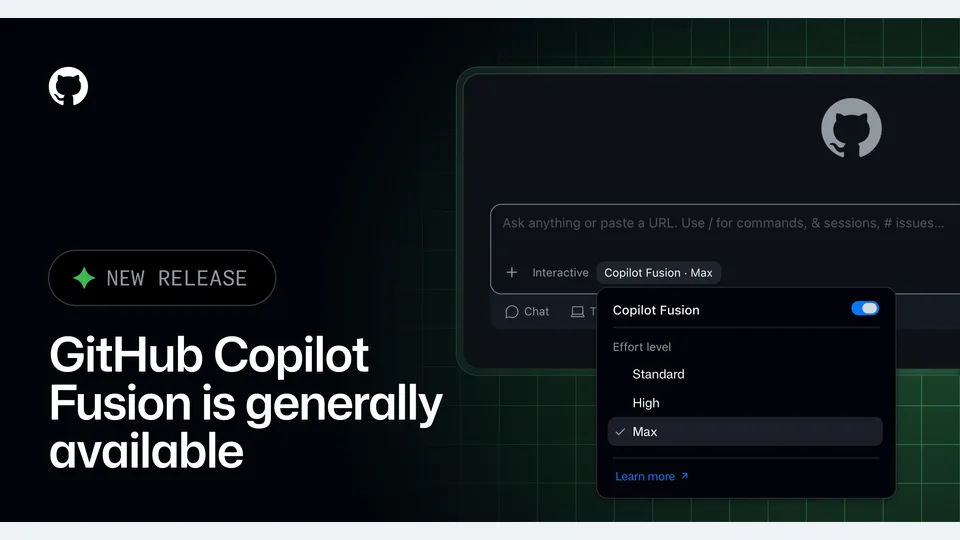
GitHub Copilot Fusion is generally available. Instead of picking a model for each task, choose Copilot Fusion and let Copilot intelligently route and orchestrate which models it uses for you.… The post Route and orchestrate models with GitHub Copilot Fusion appeared first on The GitHub Blog.
Enterprises working with a GitHub or Microsoft account team can now get Copilot included with GitHub Enterprise for every licensed user. Previously, you had to manage two things: how many… The post GitHub Enterprise now includes access to GitHub Copilot appeared first on The GitHub Blog.

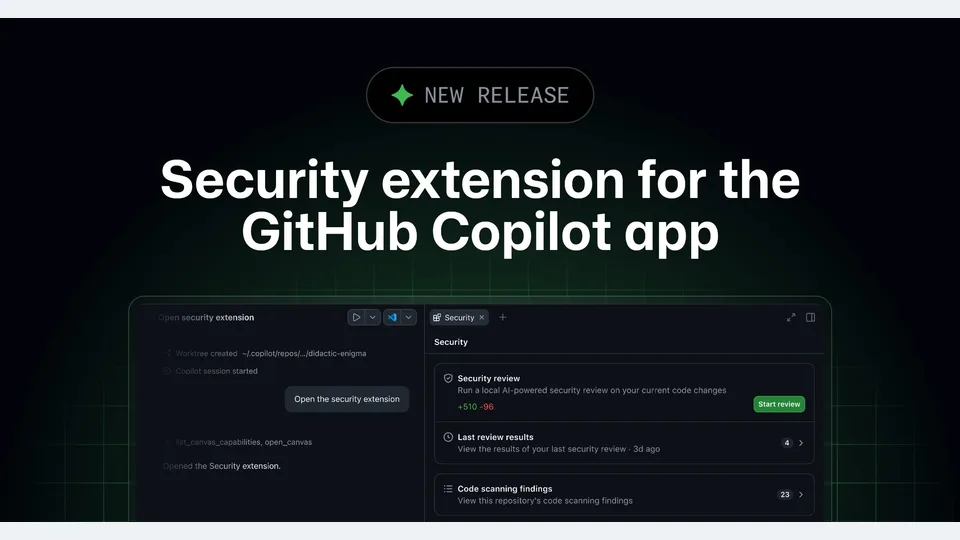
You can now work through your repository’s GitHub code scanning alerts without leaving the GitHub Copilot app. The new GitHub security extension, now in public preview, lets you find the… The post Security extension for the GitHub Copilot app appeared first on The GitHub Blog.
Agents should understand more than your codebase—they should understand how your team works. Your preferences, repository conventions, skills, and custom instructions guide how changes should be made, while code in… The post GitHub intelligence puts your code, context, and history to work appeared first on The GitHub Blog.

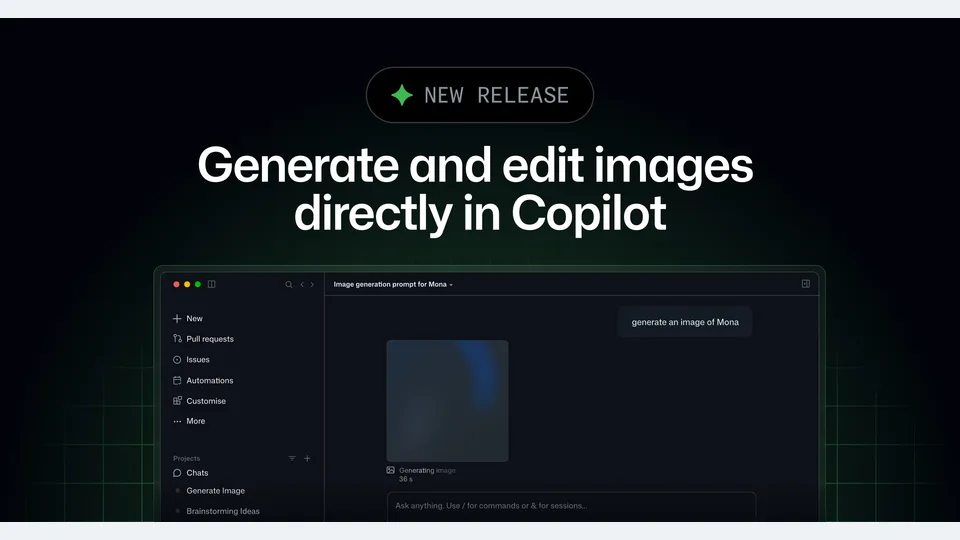
You can now generate and edit images using natural language in GitHub Copilot. When you ask for an image, your selected reasoning model calls a dedicated image-generation tool powered by… The post Generate and edit images directly in Copilot appeared first on The GitHub Blog.
How to set up and run an offline coding agent using OpenCode, Ollama and Qwen.
arXiv:2610.31882v1 Announce Type: new Abstract: We present the framework of TACS-RF - a Tool-driven Agentic Circuit Synthesis of RF and mmWave modules. In this framework, a large-language-model (LLM) coding agent (Claude Opus 4.8) directly drives industry-standard electronic-design-automation (EDA) tools such as Cadence Virtuoso/Spectre, Calibre, Cadence EMX, and Ansys HFSS to design RF and mmWave modules. We validate the framework through the agentic design of a 240-251 GHz sub-THz transmitter in a 90 nm SiGe BiCMOS process. The agent semi-autonomously designed the sub-blocks including a 60 GHz push-push Colpitts VCO with second-harmonic extraction, multistage differential cascode power drivers, a push-push frequency doubler, a differential bowtie antenna, and all the interstage matching

We think "did a human read the code?" is an imprecise proxy for "what could go wrong with this change, and which check—automated or human—is the right one to catch it?" Asking that question also changed when review happens. Before, review was a gate at the end of the road: write the code, open a PR, wait for your colleague. Now, review runs continuously, more like spellcheck while you write. Most changes have been reviewed and fixed by Claude at least once before a human is asked to look. This catches most routine mistakes, and saves team attention for higher-level questions and scrutiny. — Addy Osmani, Morgan Westlee Lunt, and Qing Wang, How the Claude Code team does code review Tags: anthropic, claude, ai, claude-code, llms, addy-osmani, coding-agents, generative-ai, agentic-engineering,
Tool: Chirp Pong Another game experiment - I wanted to see if it was feasible to have a two player game on two separate phones running in static HTML where the networking code uses chirps sent via the microphone. It seems to work! Build a two player competitive pong like game where two players use their phones close to each other and the game state is sent via audio noises which the web microphone API can interpret - but add graphical and gameplay twists to make it a lot more fun and intertwine than pong Claude Opus 5.5 Extra in Claude Code. Tags: game-design, ai, generative-ai, llms, claude-code
Release: web-edit 0.1a0 I was working on a project from my phone using Codex Remote when I found myself wanting to edit a credentials file without round-tripping those credentials through the LLM itself. So... I had Codex and GPT-6 Astra Extra High build this Python web app which provides a web UI for viewing and editing files in a folder. It's intended to be run over Tailscale, so I can have an agent start this running and then edit files via my Tailscale network directly from my phone. Here's the interface for browsing files in a folder: Editing uses CodeMirror 6 - I was going to use Monaco but that still doesn't have a great mobile experience yet. Tags: projects, python, ai, tailscale, generative-ai, llms, codex