Skip to content
AI NEWS JOURNAL
AI, IN PERSPECTIVE

Search AI news

Search headlines, summaries and articles to connect the dots.

Newest first

Data Cache is moving to Runtime Cache

Data Cache is being phased out and replaced by Runtime Cache in Next.js, with automatic migration for all versions. Pro teams receive 8x more storage per project, while Enterprise projects get 10x their previous allocation. Post-migration, previously unbilled reads and writes will be charged at $0.40 per million read units and $4.00 per million write units, varying by region. Hobby teams receive 1 million free read and 200,000 free write units monthly. Pro teams use a $20 infrastructure credit before billing applies. Teams created on or after October 30, 2026, will default to Runtime Cache. Migration dates: November 29, 2026 for Hobby; Pro and Enterprise teams will be notified separately. Early opt-in is available starting October 30, 2026, with immediate pricing application. Teams can disable caching in CDN settings without affecting migration. Optimization guidance is available via Observability and the Vercel Agent.
Introducing Geist Serif

Vercel has launched Geist Serif, a high-contrast display serif typeface designed as part of the Geist family, which includes Geist Sans, Geist Mono, and Geist Pixel. Built on the same foundational principles as its predecessors, Geist Serif features fine serifs, sharp hairlines, and a variable axis called Element Shape (ELSH) offering four dot variants: Regular, Square, Triangle, and Heart. It maintains consistent x-height and cap height with Geist Sans for seamless integration across layouts. The font supports 352 Latin-script languages, includes 894 glyphs, and is available via npm and Vercel’s font platform. Future updates will include additional weights, an italic variant, Cyrillic support, and availability on Google Fonts. The release marks a shift toward editorial and fashion-inspired design, honoring print traditions while leveraging modern screen capabilities.

Simplifying runtime caching on Vercel

Vercel is merging its Data Cache service into Runtime Cache, unifying data caching across frameworks like Next.js, SvelteKit, and Nuxt. Developers using fetch caching or unstable_cache in Next.js won’t need to change their code. Pro and Enterprise projects receive increased storage allocations, with Pro getting 8x more space and Enterprise 10x. Runtime Cache now handles regional storage, authentication, and tag-based invalidation across Vercel’s global infrastructure. Improvements include faster reads during traffic bursts via circuit breakers, higher storage budgets reducing evictions, and enhanced observability with deployment markers, revalidation causes, and write utilization metrics. The migration simplifies billing and usage tools, with existing teams receiving advance notice and pricing details.

Vercel Flags starts 7x faster and no longer extends function duration

The Vercel Flags SDK has been updated to initialize 7x faster on cold starts by loading and parsing the flags datafile at client creation and checking for updates without a network request. Usage reporting now no longer extends function duration, as events are passed directly to the Vercel runtime. Update to version 1.5.3 or later to benefit from these improvements.

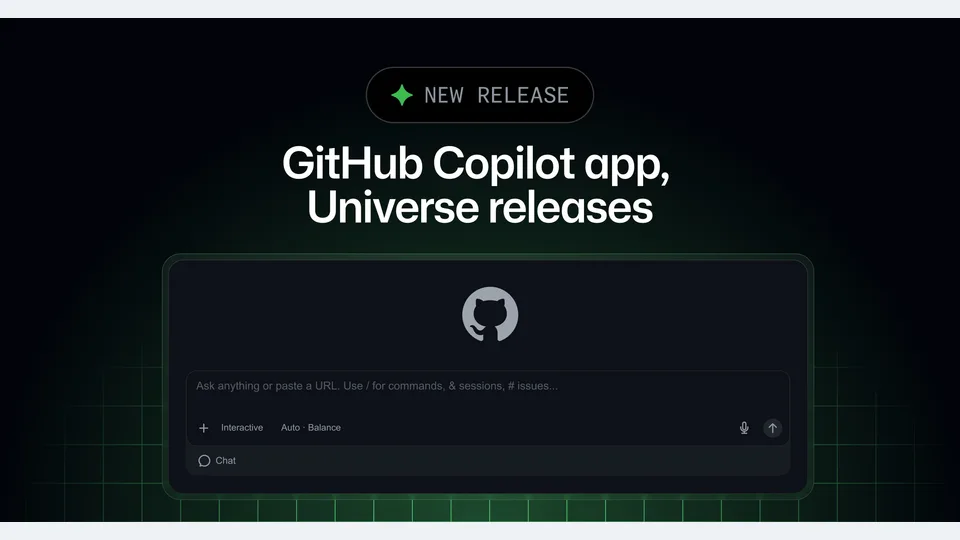
GitHub Copilot app, Universe releases

Work doesn’t always fit in a single repository or session. A feature can span several repositories. A launch plan can pull in specs, designs, and assets without touching a repository… The post GitHub Copilot app, Universe releases appeared first on The GitHub Blog.

新闻源配图 · GitHub Copilot changelog
Timeline and related coverage

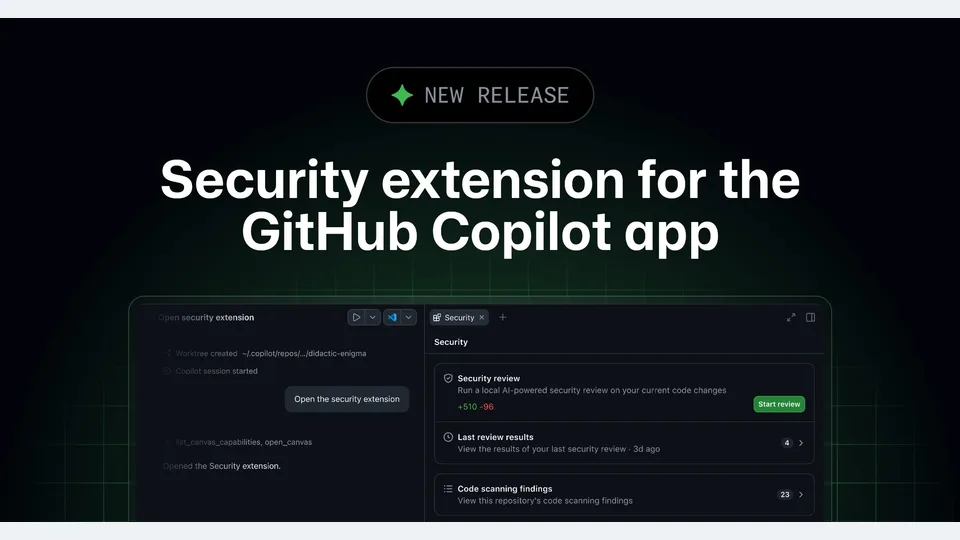
Security extension for the GitHub Copilot app

You can now work through your repository’s GitHub code scanning alerts without leaving the GitHub Copilot app. The new GitHub security extension, now in public preview, lets you find the… The post Security extension for the GitHub Copilot app appeared first on The GitHub Blog.

新闻源配图 · GitHub Copilot changelog
Timeline and related coverage

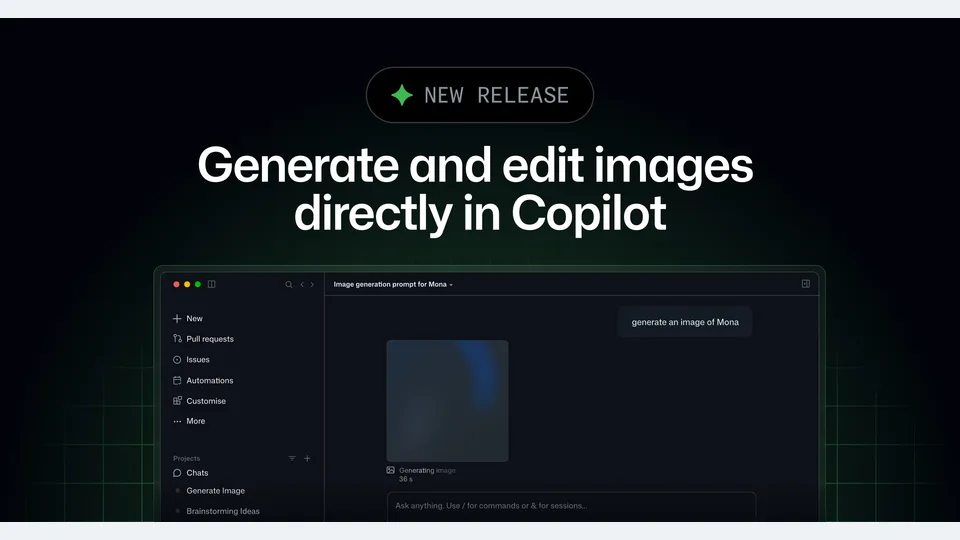
Generate and edit images directly in Copilot

You can now generate and edit images using natural language in GitHub Copilot. When you ask for an image, your selected reasoning model calls a dedicated image-generation tool powered by… The post Generate and edit images directly in Copilot appeared first on The GitHub Blog.

新闻源配图 · GitHub Copilot changelog
Timeline and related coverage

GitHub Copilot supports server-to-server authentication

GitHub Copilot now supports server-to-server authentication for GitHub Apps installed on organizations, available in public preview. Services and agents built with the GitHub Copilot SDK can now make requests on… The post GitHub Copilot supports server-to-server authentication appeared first on The GitHub Blog.

新闻源配图 · GitHub Copilot changelog
Timeline and related coverage

Microsoft offers buyouts to 60,000 employees

Microsoft is offering voluntary buyouts to up to 60,000 employees across the US, UK, Canada, and India. In a message to employees, Microsoft chief people officer Amy Coleman writes that this gives staff members "the opportunity to leave Microsoft with financial support and career planning resources" as the company looks to trim staff without another […]

Microsoft offers buyouts to 60,000 employees
Timeline and related coverage

How Three Java Champions Leverage GitHub Copilot to Boost Development Efficiency: Focusing on Human-AI Collaboration and Shared Responsibility

Vlad Mihalcea, Patrick Baumgartner, and Frank Delporte, three seasoned Java Champions, shared their experiences using GitHub Copilot in production environments and open-source projects, emphasizing human-led problem definition, context anchoring, iterative validation, and ultimate accountability—rather than relying on AI to automatically generate code.

Timeline and related coverage

Quoting Addy Osmani, Morgan Westlee Lunt, and Qing Wang

We think "did a human read the code?" is an imprecise proxy for "what could go wrong with this change, and which check—automated or human—is the right one to catch it?" Asking that question also changed when review happens. Before, review was a gate at the end of the road: write the code, open a PR, wait for your colleague. Now, review runs continuously, more like spellcheck while you write. Most changes have been reviewed and fixed by Claude at least once before a human is asked to look. This catches most routine mistakes, and saves team attention for higher-level questions and scrutiny. — Addy Osmani, Morgan Westlee Lunt, and Qing Wang, How the Claude Code team does code review Tags: anthropic, claude, ai, claude-code, llms, addy-osmani, coding-agents, generative-ai, agentic-engineering,

Timeline and related coverage