
AI Test Case Generation for Production QA Pipelines
Learn how AI test case generation improves test coverage and speeds testing across systems. Discover how orchestration enhances QA processes.
Search headlines, summaries and articles to connect the dots.
Learn how AI test case generation improves test coverage and speeds testing across systems. Discover how orchestration enhances QA processes.
arXiv:2611.23572v1 Announce Type: new Abstract: Food insecurity creates a pressing need for guidance that helps households find usable food resources and assess food choices in light of their circumstances. Such guidance must connect eligibility requirements, practical access constraints, and dietary needs rather than return isolated listings or generic nutritional advice. Multi-agent food assistants can coordinate these tasks, with uncertainty indicating when clarification or verification is needed before a recommendation. However, uncertainty can be lost across agent handoffs, allowing tentative interpretations to propagate as facts and obscuring opportunities for correction. Moreover, confidence that a service requirement has been interpreted correctly is not confidence that a recommendation satisfies the user's needs; local confidence cannot simply be reused as downstream reliability. We introduce an inference-time, receiver-conditioned clarification framework that preserves shared premise identities and replays consistent interpretations across dependent agents. Each receiver exposes admissible decisions and remaining evidence obligations, so question relevance reflects both decision changes and missing support. Information questions and user-confirmable fallback adjustments are evaluated together with their anticipated follow-up interactions under shared budgets. This structure connects clarification to jointly supported plans for resource navigation, nutritional reasoning, and supply-side planning.
LangChain CEO and Co-founder Harrison Chase shares how we're moving from task-specific agents to goal-focused agents. Learn more.
Discover microservices best practices to build resilient systems. Learn what the best patterns look like and how workflow automation fits into the process.
Adobe Inc. today announced an expansion of its CX Enterprise Coworker agentic artificial intelligence platform into its GenStudio content supply chain platform. The company said the integration move allows creative professionals to bring AI agents into production workflows to develop, manage and deliver personalized marketing content at large scale. The announcement, made at its Adobe […] The post Adobe expands AI assistant into creative workflows appeared first on SiliconANGLE.
arXiv:2611.05551v1 Announce Type: new Abstract: Virtual trials use routinely collected clinical data to evaluate treatment strategies, but translating a study protocol into an executable analysis requires determining how clinical concepts and study requirements should be represented in the available data and applied consistently across the workflow. These decisions depend on local data representations and operational conventions and can involve source selection, patient and encounter identity, linkage, and temporal interpretation. Here we introduce VirtualTrialHarness (VTHarness), an agent framework that coordinates virtual-trial operationalization by selecting reusable procedural skills for each workflow stage and uses explicit contracts to maintain consistent study decisions across stages. We also introduce VTBenchmark for evaluating source selection and cohort construction. Across three complex synthetic environments, VTHarness successfully produced all required cohort outputs matching the references in 95.1% of workflows after requirement clarification, compared with 60.4% using retrieval from the same procedural corpus. Procedural skills improved source recovery across three language models and increased source overlap with analyst code in 13 Mayo Clinic cases. Site-specific adaptation enabled reference-matched cohort execution across eight MIMIC-IV tasks. Within the Mayo Clinic Virtual Trials Program, the framework supported investigator review of cohort construction and endpoint analysis. These findings support coordinating procedural guidance with workflow decisions to improve virtual-trial implementation across complex clinical schemas.
How LangChain built Content Studio, an open-source design agent in Slack that makes on-brand videos, graphics and decks, and the harness that powers it.
Every time an agent takes a step, it re-reads its entire context before acting. Here is how prompt caching for OpenAI models on Amazon Bedrock lets your agent remember, cutting input cost and latency without resending the same tools, instructions, and history every turn.
On October 25, 2026, Microsoft Research open-sourced Agensh, a multi-agent runtime framework that operates without a central coordinator, enabling 1 to 1,024 LLM-powered coding agents to self-organize and collaborate on ProgramBench. The system achieves decentralized coordination through shared dashboards inspired by Gitea, Mattermost, and DeLM, with all agents following the same prompt-driven five-step loop; its scalability has been validated in a Linux + Docker environment.
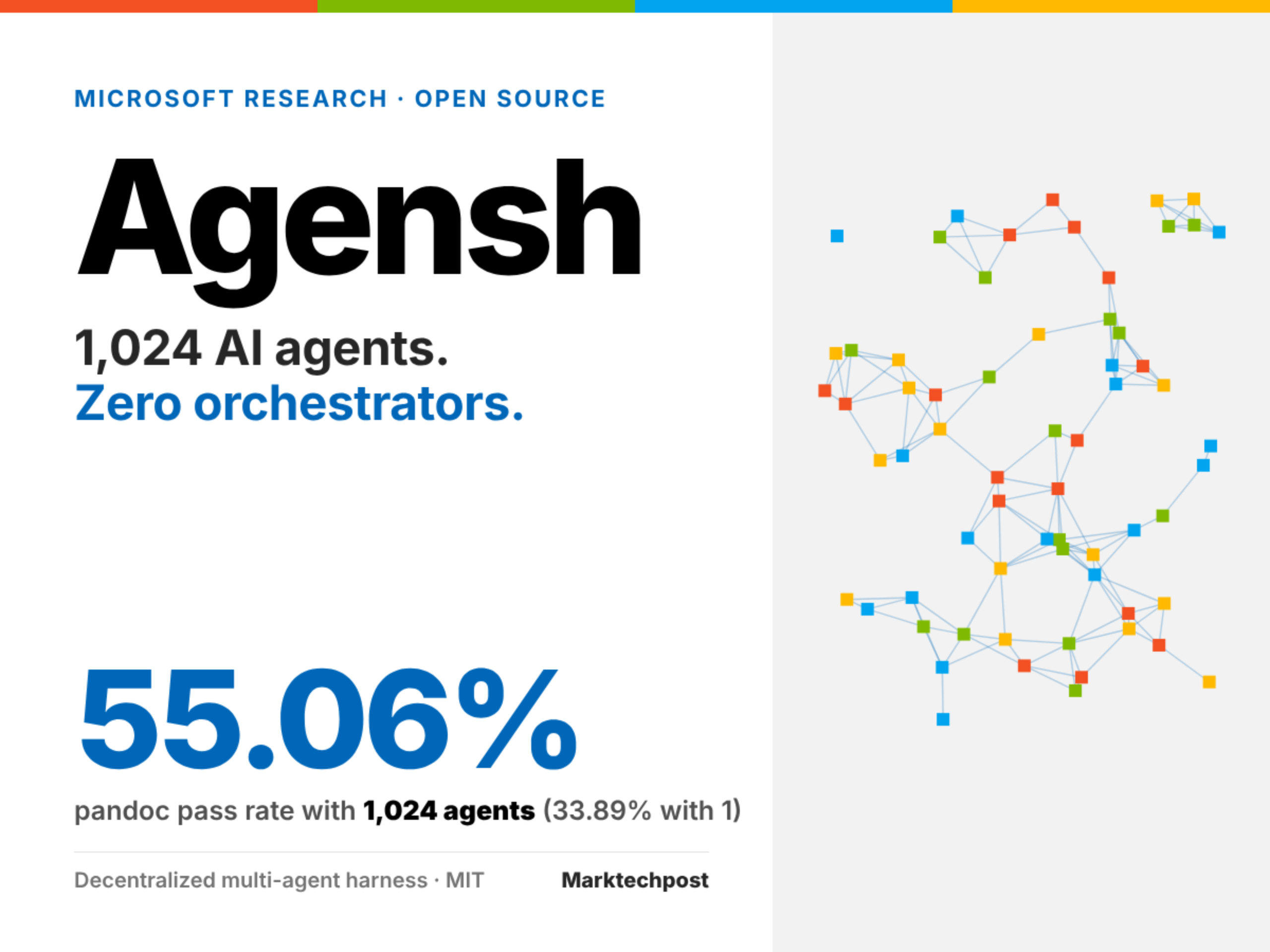
Why it matters:This achievement represents a significant evolution in multi-agent system architectures—abandoning the traditional “master‑agent” paradigm and enabling large‑scale self‑organization through prompt engineering and lightweight service composition. Empirical results on ProgramBench (e.g., 128 agents achieving a 49% improvement in task load balancing across five tasks) establish a new benchmark for distributed AI engineering. Released under the MIT License and compatible with mainstream single‑agent tools such as Copilot CLI, it offers valuable guidance for practical development.
AWS Solutions Architecture Team has launched Deep Insight, an open-source multi-agent system designed for automated CSV data analysis and natural-language report generation. It systematically addresses five common challenges in production environments—agent orchestration, role-based model selection, stable operation, secure code execution, and observability—and has been validated in real-world scenarios such as LG Electronics and the re:Invent 2025 TechRecon.