
Skip to content
AI NEWS JOURNAL
AI, IN PERSPECTIVE

Search AI news

Search headlines, summaries and articles to connect the dots.

Newest first

The Two-Ledger Model: Transaction-Grain Cost Accounting for Multi-Agent AI Systems Across Clouds, Models, and Systems of Record

arXiv:2611.06989v1 Announce Type: new Abstract: Enterprises run business transactions through multi-agent AI systems spanning clouds, large language models (LLMs), orchestration harnesses, and systems of record. Finance receives AI cost only at settlement grain, aggregated by SKU and charge period. The business question (what did this order, claim, or case cost in AI?) cannot be answered from billing data, because providers never see enterprise transaction boundaries. The FinOps Open Cost and Usage Specification (FOCUS) gives billing data one schema across providers but remains settlement-grain even as it adds AI token and requester attribution. We formalize this grain mismatch, derive seven requirements, and propose the Two-Ledger Model: a settlement ledger of FOCUS-conformant billing data joined to an attribution ledger of invocation-grain usage records built on OpenTelemetry GenAI telemetry. A layered correlation spine (trace context, A2A/MCP metadata, business-key correlation, probabilistic matching) assigns each record to its business transaction with recorded method and confidence; a versioned rate card prices usage in near real time; period reconciliation ties both ledgers to the invoice, and the unexplained residual identifies shadow AI. Costs are reported per order, claim, or outcome with agentic cost metrics. A simulation with known ground truth shows the spine sustaining cost coverage above 99% as trace propagation falls to zero, the reconciliation residual recovering planted unmetered spend within 0.24 percentage points while flagging provider billing errors, and mid-flight gating cutting p99 transaction cost by up to 61% at a 2-4% false-pause rate. We propose the attribution ledger as an invocation-grain FOCUS profile for standardization.
Understanding Communication Failures in Multi-Agent LLM Systems

arXiv:2610.32060v1 Announce Type: new Abstract: Multi-agent LLM systems aim to improve reasoning through debate, evidence sharing, and mutual correction, but interaction can also introduce failures that final accuracy alone cannot explain. Agents may converge too early, ignore dissent, suppress correct minority answers, or preserve a wrong framing across rounds. We present a corpus-grounded taxonomy of communication failures, built from 3,211 failed multi-round trajectories across medical QA, coding, finance, multi-hop reasoning, ethics, and embodied text tasks. Using this taxonomy, we analyze failure distributions across datasets and system designs, round-level error dynamics, recovery hardness, majority transitions, minority-signal suppression, and self-reported confidence. We find that

Timeline and related coverage

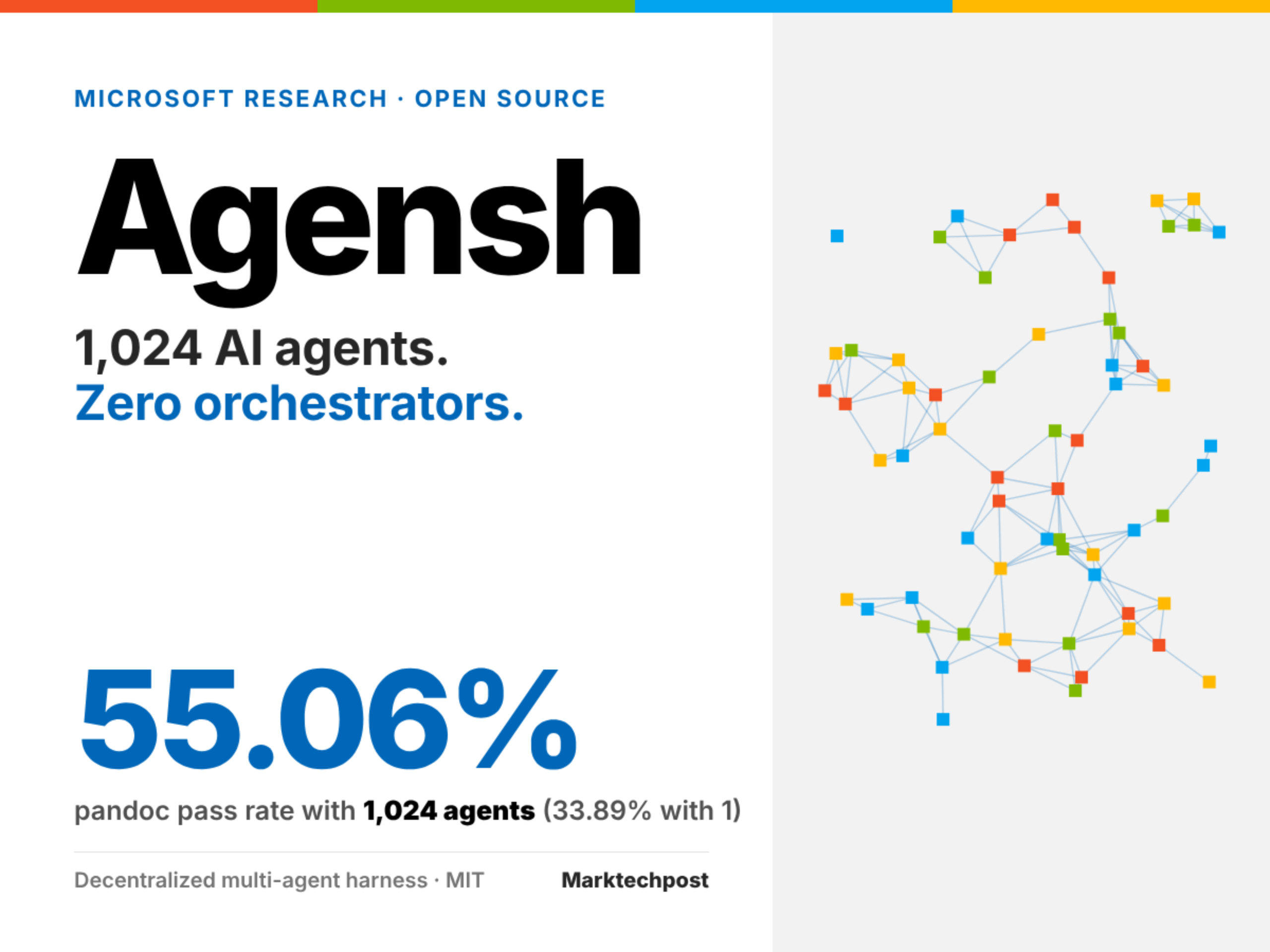
Microsoft open-sources Agensh: a decentralized framework that supports 1024 autonomous, collaboratively operating AI coding agents.

On October 25, 2026, Microsoft Research open-sourced Agensh, a multi-agent runtime framework that operates without a central coordinator, enabling 1 to 1,024 LLM-powered coding agents to self-organize and collaborate on ProgramBench. The system achieves decentralized coordination through shared dashboards inspired by Gitea, Mattermost, and DeLM, with all agents following the same prompt-driven five-step loop; its scalability has been validated in a Linux + Docker environment.

Microsoft Open-Sources Agensh: A Multi-Agent Harness for 1,024 Agents

Why it matters:This achievement represents a significant evolution in multi-agent system architectures—abandoning the traditional “master‑agent” paradigm and enabling large‑scale self‑organization through prompt engineering and lightweight service composition. Empirical results on ProgramBench (e.g., 128 agents achieving a 49% improvement in task load balancing across five tasks) establish a new benchmark for distributed AI engineering. Released under the MIT License and compatible with mainstream single‑agent tools such as Copilot CLI, it offers valuable guidance for practical development.

Timeline and related coverage