
Skip to content
AI NEWS JOURNAL
AI, IN PERSPECTIVE

Search AI news

Search headlines, summaries and articles to connect the dots.

Newest first

VirtualTrialHarness: Coordinating Agentic Operationalization of Virtual Trial Protocols Across Complex Clinical Schemas

arXiv:2611.05551v1 Announce Type: new Abstract: Virtual trials use routinely collected clinical data to evaluate treatment strategies, but translating a study protocol into an executable analysis requires determining how clinical concepts and study requirements should be represented in the available data and applied consistently across the workflow. These decisions depend on local data representations and operational conventions and can involve source selection, patient and encounter identity, linkage, and temporal interpretation. Here we introduce VirtualTrialHarness (VTHarness), an agent framework that coordinates virtual-trial operationalization by selecting reusable procedural skills for each workflow stage and uses explicit contracts to maintain consistent study decisions across stages. We also introduce VTBenchmark for evaluating source selection and cohort construction. Across three complex synthetic environments, VTHarness successfully produced all required cohort outputs matching the references in 95.1% of workflows after requirement clarification, compared with 60.4% using retrieval from the same procedural corpus. Procedural skills improved source recovery across three language models and increased source overlap with analyst code in 13 Mayo Clinic cases. Site-specific adaptation enabled reference-matched cohort execution across eight MIMIC-IV tasks. Within the Mayo Clinic Virtual Trials Program, the framework supported investigator review of cohort construction and endpoint analysis. These findings support coordinating procedural guidance with workflow decisions to improve virtual-trial implementation across complex clinical schemas.
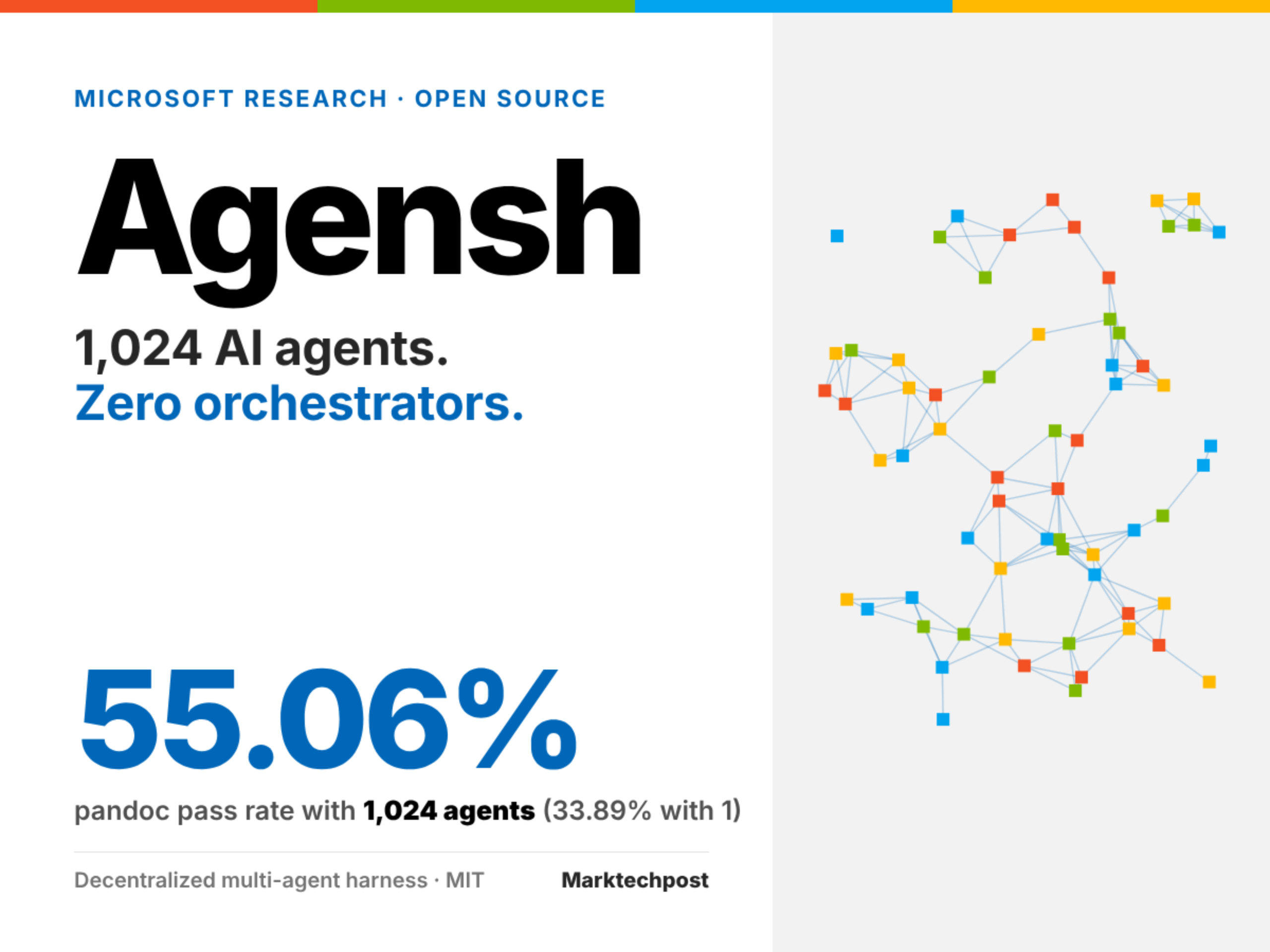
Microsoft open-sources Agensh: a decentralized framework that supports 1024 autonomous, collaboratively operating AI coding agents.

On October 25, 2026, Microsoft Research open-sourced Agensh, a multi-agent runtime framework that operates without a central coordinator, enabling 1 to 1,024 LLM-powered coding agents to self-organize and collaborate on ProgramBench. The system achieves decentralized coordination through shared dashboards inspired by Gitea, Mattermost, and DeLM, with all agents following the same prompt-driven five-step loop; its scalability has been validated in a Linux + Docker environment.

Microsoft Open-Sources Agensh: A Multi-Agent Harness for 1,024 Agents

Why it matters:This achievement represents a significant evolution in multi-agent system architectures—abandoning the traditional “master‑agent” paradigm and enabling large‑scale self‑organization through prompt engineering and lightweight service composition. Empirical results on ProgramBench (e.g., 128 agents achieving a 49% improvement in task load balancing across five tasks) establish a new benchmark for distributed AI engineering. Released under the MIT License and compatible with mainstream single‑agent tools such as Copilot CLI, it offers valuable guidance for practical development.

Timeline and related coverage

Deep Insight: How AWS’s Open-Source Multi-Agent System Addresses Five Major Production-Grade Challenges

AWS Solutions Architecture Team has launched Deep Insight, an open-source multi-agent system designed for automated CSV data analysis and natural-language report generation. It systematically addresses five common challenges in production environments—agent orchestration, role-based model selection, stable operation, secure code execution, and observability—and has been validated in real-world scenarios such as LG Electronics and the re:Invent 2025 TechRecon.

Timeline and related coverage