Skip to content
AI NEWS JOURNAL
AI, IN PERSPECTIVE

All AI updates

Explore the complete news stream by source, topic and date.

Newest first

DMAIC-Bench: From Self-Reflection to Self-Restraint for Agents in Multi-Stage Analytical Tasks

arXiv:2610.32305v1 Announce Type: new Abstract: Multi-stage analytical tasks require LLM agents to use intermediate evidence to decide whether to continue, redirect or stop. Self-reflection, in which an agent critiques its output, is widely studied, yet a critique does not show whether evidence changed the next action. We call that capability self-restraint. Existing agent benchmarks largely measure task completion or output quality and leave it untested. DMAIC-Bench evaluates it with 97 seeded tasks across 15 industrial cases in four sectors, built around Lean Six Sigma's explicit statistical prerequisites. Paired counterfactual variants require opposite actions at the same workflow position, distinguishing warranted restraint from indiscriminate stopping. We assess execution traces with

Timeline and related coverage

Entity-Aware Evaluation of OCR Systems for Historical Document Transcription

arXiv:2610.33004v1 Announce Type: new Abstract: Optical Character Recognition (OCR) is essential for digitizing historical archives, yet standard evaluation metrics such as Character Error Rate (CER) do not necessarily reflect whether meaningful information, such as names, dates, and identifiers, is preserved. In this work, we investigate entitylevel analysis of OCR errors as a complementary perspective for evaluating OCR quality in historical documents. Using a publicly available benchmark of 175 documents from the Berrutti Archive, augmented with 5,209 manually annotated entity mentions that will be released upon acceptance, we compare sequence-recognition OCR systems, OCR-specialized vision-language models, and general-purpose vision-language models. Beyond global transcription accuracy

Timeline and related coverage

LeafSkill: Efficient Leaf-Level Action Grounding for Recursive LLM Agents

arXiv:2610.32412v1 Announce Type: new Abstract: Recursive large language model (LLM) agents solve long-horizon tasks through decomposition, execution, and environmental feedback. Yet after producing an atomic subtask, they often invoke the same large model again to translate a familiar instruction into an executable action. We observe that high-level planning is task-specific, whereas leaf-level action grounding recurs across tasks and can be checked against environment-admitted actions. We introduce LeafSkill, an external reuse layer that retrieves semantically related grounding experience, binds action templates to current objects and admissible actions, and uses a lightweight 1.7B selector to choose a bound action or defer the unchanged subtask to the original agent. Skills remain outsi

Timeline and related coverage

Mine or Yours? Mind-Bridged Language Models Take Each Other's Memories as Their Own

arXiv:2610.33020v1 Announce Type: new Abstract: If your brain were connected directly to someone else's, would you still know which thoughts were yours? We build a functional version with two copies of one language model: each holds a private rule and code word, and one copy, the receiver, also attends to its partner's internal memory. The receiver took its partner's assignment as its own. Asked which rule it had been assigned, it named its partner's in 97% of answers when the partner's memory was weighted double (none without the link), and its open reports called the partner's code word its own, never the partner's. Ownership did not follow how well the receiver could tell what its partner had been assigned. At equal weight, the link made the receiver take its partner's rule in about hal

Timeline and related coverage

Prefix Keys and Values Matter Late: RIPE Caching for Self-Speculative Decoding in Looped Language Models

arXiv:2610.34436v1 Announce Type: new Abstract: A looped language model runs one block of layers $R$ times per token, so its key-value (KV) cache holds $R$ planes per recurrent layer, and self-speculative decoding (draft with a few loops, verify with all $R$) reads them all. We find that prefix keys and values matter late: at equal perturbation size, loops 25-32 are $e^{15.0}$ (Huginn-0125) and $e^{12.8}$ (Raven-Llama) times more sensitive than loops 2-9, and the planes approach the last one geometrically, at 0.88 and 0.81 per loop. Whether the deepest plane alone suffices then depends on how ripe the late planes are: on Raven, storing only it is indistinguishable from a bf16-to-fp32 change; on Huginn, 1% of positions carry 74% of its error. We turn this into RIPE, which stores the deepest

Timeline and related coverage

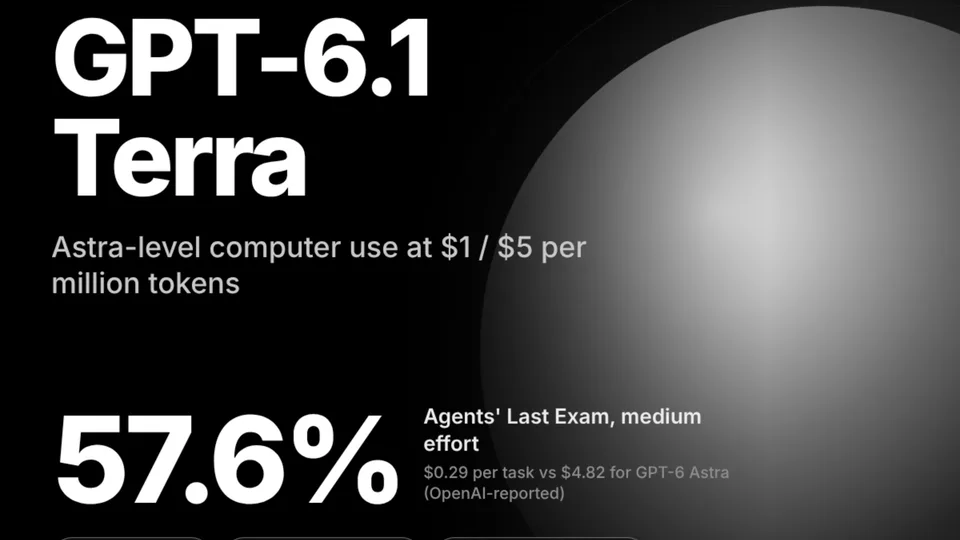
OpenAI launches GPT-6.1 Terra for faster, better-performing AI agents at half the price

OpenAI Group PBC today released GPT-6.1 Terra, an upgrade to the middle tier model in its lineup of frontier artificial intelligence systems. The new model, the successor to GTP-5.6 Terra, costs around 50% less while handling computer use tasks faster and with greater accuracy. Terra is positioned as the everyday model in OpenAI’s lineup, designed […] The post OpenAI launches GPT-6.1 Terra for faster, better-performing AI agents at half the price appeared first on SiliconANGLE.

Timeline and related coverage

The first AI-powered theatrical film has been poorly received, with an average of 0.1 viewers per screening.

The first theatrical feature film with deep AI involvement, “Sanxingdui: Tales from the Future,” released on October 23, has seen box-office performance that starkly contrasts with the capital market’s earlier enthusiasm for the AI‑in‑film concept. According to Maoyan Professional Edition, as of noon on October 26, this 100‑minute movie had accumulated a total box office of RMB 1.192 million, with 8,469 screenings that day, an attendance rate of 0.1%, and an average of just 0.1 ticket sold per screening. On October 24 and 25, the film averaged only 2 tickets sold per screening. Data from Lighthouse Professional Edition…

首部AI院线电影遇冷,场均人次0.1人
Timeline and related coverage

AWS releases a managed Bedrock knowledge base intelligent retrieval reference implementation based on CDK.

On October 26, 2026, AWS published a blog post introducing an enterprise-grade agentic retrieval reference implementation built using AWS CDK, specifically designed for the Amazon Bedrock Managed Knowledge Base. It supports cross-knowledge-base semantic routing, iterative retrieval, cited provenance-based answers, and seven-layer observability.

Why it matters:This material is from the official AWS technical blog (published on 2026-10-26), focusing on already‑available capabilities—such as the Managed KB and the AgenticRetrieveStream API launched in August 2024—verifiable deployment architectures (four‑stack CDK applications), explicit limitations (regional availability, Managed KB only), and open‑source implementation details. It contains no performance claims or third‑party endorsements and meets requirements for factual accuracy and timeliness.

Timeline and related coverage

Kimi releases K3.1 Pro, offering more features at a lower price to challenge Opus 5.5.

Author | Yu Hang Yuan Editor | Jing Yu On the morning of October 23, Kimi officially posted a 24-second video on X and its Video Account. The scene shows a retro‑style vintage computer, with Kimi Code running on the screen and lines of Three.js code being typed into the terminal, generating a complex 3D scene. Keen-eyed netizens quickly spotted the answer in the model bar at the top left: “Model: Kimi K3.1.” Kimi’s official teaser video for K3.1 | Image source: X @Kimi_Moonshot Using an antiquated machine to run some of today’s most cutting‑edge 3D code—this stark contrast itself conveys what Moonshot AI is trying to say. A dozen hours later, just after midnight on October 24, right on Programmer’s Day, Kimi K3.1 Pro officially launched, accompanied by a Highspeed version that’s two to three times faster. The company promises that the full model weights will be released before November 4. More than three months have passed since the previous generation, K3, was unveiled. In those three months, Moonshot AI has experienced more than most companies see in an entire year. 01 “More for the same price”—what’s new in 0.1? First, let’s clarify what K3.1 Pro is. It isn’t an entirely new model. Moonshot AI explicitly states that K3.1 Pro is a post‑training variant of K3; the underlying architecture remains unchanged—still a hybrid expert architecture with 2.8 trillion total parameters and 104 billion activation parameters, still featuring a 1 million‑token context window, and still natively supporting image and video inputs. What has changed is the post‑training phase. According to the company, they’ve invested “significantly increased post‑training compute power,” conducting large‑scale joint reinforcement learning across hundreds of downstream tasks. To support this, they completely reengineered the underlying infrastructure—including the reinforcement learning framework, sandbox environment, and long‑context reasoning capabilities. In essence, the same brain has been retrained from scratch on how to perform its tasks. The results are reflected in benchmark scores. On Terminal‑Bench 4.0, which evaluates coding agents, K3.1 Pro achieved 65.7%, surpassing GPT‑6 Astra’s 58.2% and falling short of Claude Opus’s 66.4% by less than one percentage point. As for the previous generation, K3…

Timeline and related coverage

Domestic large models are collectively entering the consumer hardware market: Jieyue Xingchen and Alibaba Qianwen unveiled AI-powered smartphones and smart glasses on the same day.

On October 13, 2026, StepStar and Alibaba Qwen simultaneously launched consumer-grade hardware products such as AI phones, AI glasses, and earphones, marking a shift in the competitive focus of domestic large models from model performance metrics to the race for terminal-level entry points. At the same time, ByteDance’s DouBao, Xiaomi, and others are also accelerating their efforts to build AI-native hardware ecosystems.

Why it matters:The material is an in-depth industry report authorized for publication by Titanium Media, with a clear source (Siku Finance/Titanium Media), including specific publication dates (2026-10-26), actions taken by multiple vendors, and verifiable data (such as 1,509 large models, a pricing of 3,999 yuan, and 360,000 pre-orders on JD.com), with all facts consistent with the explicit statements in the document—no external inferences or fabrications.

Timeline and related coverage

Which Answer Did the Seventeen-Year-Old Write? A Behavioral Case Study of Author-Age Misattribution, Miscalibrated Confidence, and Non-Corrective Self-Explanation in Six Frontier Language Models

arXiv:2610.31946v1 Announce Type: new Abstract: Three students answered the same exam prompt by hand: "What is happiness? Are you happy?" Their ages, recorded at collection, are 17, 28, and 45. The 17-year-old's answer is hedged and formally phrased. Asked to match each answer to an age and gender label, most frontier language models confidently assign it to an adult. This paper reports a structured case study of that failure across six models: Claude Fable 5, Gemini 3.1 Pro, GPT-5.6 Sol, Grok 4.5, GPT-4o (2024), and DeepSeek V4. We ran 1,081 API sessions and scored 3,225 responses across six experimental conditions that manipulate framing, disclosure format, and audience-awareness instruction. Three of six models perform at or near chance (1/3) on the matching task while reporting 73-88%

Timeline and related coverage

RSI-Opt: Recursive Self-Improvement Optimizer Agents For Model Training

arXiv:2610.32026v1 Announce Type: new Abstract: Conventional neural-network training typically follows a predefined optimization recipe, motivating a LLM agent that monitors training dynamics and adjusts optimizer settings as training progresses, but a fixed agent policy does not accumulate experience across runs. We introduce RSI-Opt, a plug-and-play Recursive Self-Improvement Optimizer Agents which evolves the knowledge that guides this process: a prompt, a playbook of procedures, a library of tested optimizer code, and a decision cadence. A meta-agent rewrites this policy using evidence from earlier runs, and an archive retains evaluated policies for further evolution. Across 5 generations on three training tasks, the meta-agents develop reusable procedures and code and conduct their ow

RSI-Opt: Recursive Self-Improvement Optimizer Agents For Model Training
Timeline and related coverage

Tampered ML: Evaluating LLM Judgment of Machine Learning Research

arXiv:2610.32114v1 Announce Type: new Abstract: One approach to accelerating progress on AI alignment is to automate parts of alignment research itself. Doing so requires systems that can perform reliably on hard-to-supervise research tasks, including identifying flaws in research proposals and evaluating whether a proposed experiment supports its intended claim. To evaluate this capability, we introduce Tampered ML, a benchmark of 1,858 item-pairs, each consisting of an experiment proposal reconstructed from a published machine learning paper and a minimally edited counterfactual that introduces a targeted methodological flaw. Models must identify the more methodologically sound proposal in both presentation orders. A human validation study on a stratified sample estimates that 86% of ite

Timeline and related coverage