
Grok releases the first seven minutes of its AI-generated ‘Odyssey’
The footage looks okay, as long as you're not seeking artistry, inspiration, or human interest.

Explore the complete news stream by source, topic and date.
The footage looks okay, as long as you're not seeking artistry, inspiration, or human interest.
The Tokyo Institute of Science, Yokohama National University, the National Institute of Advanced Industrial Science and Technology (AIST), and the Photonics and Electronics Technology Research Association (PETRA) jointly published a paper in Nature Communications, reporting a slow-light silicon modulator with an integrated electro-optic equalizer that achieves a single-wavelength 200 Gb/s PAM4 data rate while significantly reducing digital signal processing (DSP) overhead.

Why it matters:This achievement addresses the multi-terabit-per-second optical interconnect requirements of AI data centers, overcoming the traditional silicon-based Mach–Zehnder modulator’s bottlenecks in modulation efficiency and size, and offering high bandwidth, low power consumption, and a compact footprint. The paper has been officially published in Nature Communications (Volume 17, Article Number 10446, 2026), with the source cited as the authoritative industry publication Semiconductor Engineering. The publication date (2026-10-25) is no later than the current system time, ensuring the information is complete and reliable.
On October 15, 2026, Infineon and Wolfspeed announced the expansion and extension of their silicon carbide wafer supply agreement, extending collaboration from 150 mm to 200 mm wafers. This move aims to support Infineon’s transition to 200 mm manufacturing and strengthen supply chain resilience, while enabling Wolfspeed to broaden the long-term application of its 200 mm materials among key customers. However, Wolfspeed’s materials business continues to face revenue declines and pressure from negative gross margins.


Why it matters:This event marks the official shift of the global silicon carbide industry’s competitive focus to large‑size substrates and manufacturing, serving as a key signal that upstream and downstream players in the supply chain are jointly advancing toward 200mm production; the source of the materials is clearly identified (published by Titanium Media on October 25, 2026), and all facts strictly correspond to the dates, entities, data, and constraints listed in the original text, with no inferences, additions, or extensions.
Starting in September 2026, panel manufacturers such as TCL CSOT, BOE, and HKC have issued price‑increase notices one after another. The primary reason is the rapid growth of AI large models, which has led to a sharp surge in demand for HBM, squeezing capacity for mature‑process chips and driving up the prices of key components like driver ICs, PCBs, and glass substrates. Upstream suppliers, including Corning, have also raised their prices in tandem. Despite clear cost pressures, downstream TV and monitor brands have yet to broadly increase purchase prices, while end users continue to report frequent quality‑control issues such as overheating and black spots. As a result, these price hikes have not yet translated into actual sales or improved user experiences.
Why it matters:The materials system reveals the cross‑chain transmission mechanism through which the AI industry impacts indirectly related hardware sectors—rather than driving panel demand directly, it triggers a full‑chain cost repricing via the reallocation of wafer‑fabrication capacity. At the same time, it highlights a significant gap between price‑increase behavior and actual market feedback (price rigidity, declining shipments, and user complaints), underscoring the deep‑seated contradiction between industry bargaining power and product competitiveness.
In his book “Hyper-Scale,” Paris Marx traces the history of resistance within global data centers, noting that Ireland imposed a ban due to grid capacity saturation, prompting companies to build their own gas-fired power plants; meanwhile, New Zealand is exploring a non-exploitative AI pathway by leveraging local cloud services to support Māori-language speech recognition; and the wave of opposition currently sweeping the United States is, in fact, a reenactment of long‑foreseen global tensions.
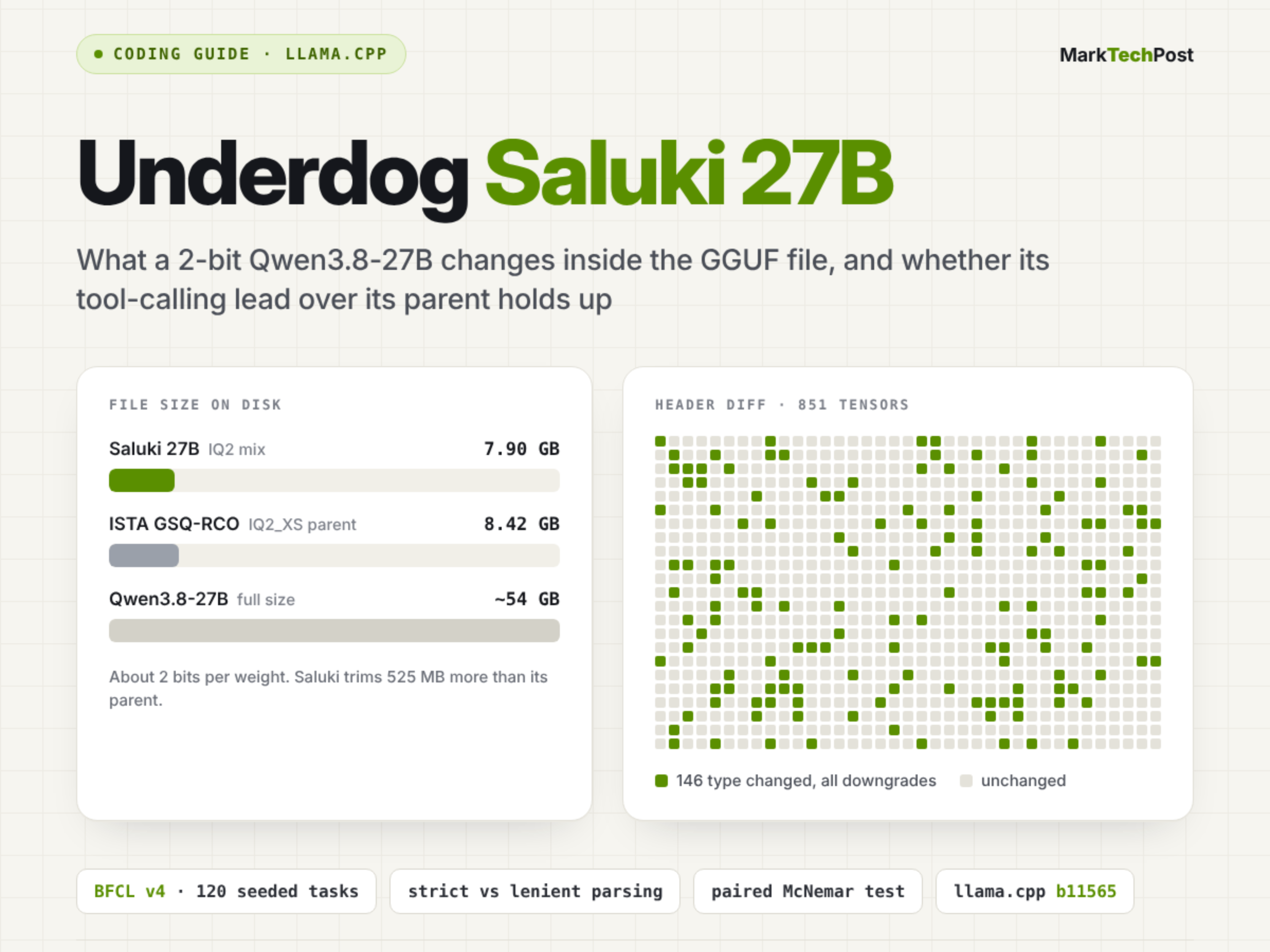
This article introduces Saluki 27B, a model released by Underdog—a 7.9 GB, 2-bit quantized variant of Qwen3.8-27B—built using the GSQ-RCO method from ISTA-DASLab. It claims to outperform the original 54 GB full-precision model on the BFCL v4 benchmark across 120 tasks; however, all performance conclusions are based solely on the developers’ assertions and have not been independently verified.
Introducing Kimi K3.1 Pro Kimi K3.1 Pro landed on the Kimi API today - it's not yet open weights, but Moonshot promise "Full model weights will be released by Nov 4, 2026". They're also offering a "Highspeed" version that's 2-3x faster, at twice the price (except for input token cache hits, which are priced the same). The US dollar pricing is $2.00/million tokens for input and $10/million for output - the same as GPT-6.1 Sol and half the price of Claude Opus 5.5. Moonshot's own benchmarks show Kimi as approximately level with Opus 5.5 and GPT-6 Astra - beating them on a few benchmarks, coming close on others. Artificial Analysis scored Kimi at 55 - ahead of Claude Fable 5.1, GPT-6 Astra, and Gemini 4 Argon (all at 53) and behind only Claude Opus 5.5 (58). This is the first time a (soon-to-
On October 22, 2026, the U.S. Federal Communications Commission (FCC) granted Intel a one-year exemption, allowing it to continue using certain foreign‑made automated guided vehicles (AGVs) at its U.S. semiconductor fabs, as the original ban’s vague wording could inadvertently affect critical semiconductor manufacturing equipment.
Kazakhstan’s AI ecosystem is transitioning from the planning phase to large-scale deployment. Firebird has obtained U.S. export licenses to build an AI factory in Kazakhstan, with the first phase deploying 45,000 NVIDIA Grace Blackwell GPUs. Kazakhtelecom has already brought online more than 1,000 H200/B300 GPUs and plans to add over 2,000 Vera Rubin and other GPUs by 2025. Multiple stakeholders are collaborating to advance computing power supply, developer access, and the local implementation of AI applications.
AWS has announced that SageMaker AI’s serverless model customization feature now includes “Training Sessions,” which are fully available starting today. Users can independently define post-training logic—such as custom loss functions, reward signals, or multi‑round reinforcement learning—while the platform automatically handles GPU allocation, distributed execution, fault tolerance, and checkpoint storage.
Amazon SageMaker has released the Training Sessions API, enabling users to implement custom large-model training workflows—such as SFT, RLHF, GRPO, and KTO—using pure Python scripts. GPU resource scheduling, fault tolerance, distributed execution, and checkpoint management are all handled by the service.
Elastic GPUs, sandbox growth, and the economics of the agent cloud
Elastic GPUs, sandbox growth, and the economics of the agent cloud
European retailers are leveraging NVIDIA-accelerated open large models and physics‑AI technologies to achieve large‑scale deployment across scenarios such as digital product discovery, intelligent warehouse simulation, virtual try‑on, and accelerated R&D. Companies including Shopify, Zooplus, L’Oréal, and the Otto Group have used tools like the Nemotron series of models, Omniverse digital twins, and ALCHEMI molecular simulations to significantly reduce inference costs, improve search accuracy, shorten R&D cycles, and validate improvements in conversion rates and sales growth.
Jas Kaira, head of Blackstone’s AI business, stated at the TechCrunch Disrupt conference that market panic over massive debt in the AI infrastructure sector has been overly amplified. His key argument is that this debt is largely backed by long-term contracts with high‑credit‑rating clients—such as Microsoft and Meta—and that the underlying assets (e.g., GPUs) possess strong collateral value, meaning the risk profile differs fundamentally from that of the 2008 banking system.
A U.S. federal judge ruled that the Trump administration lacked the authority to instruct the Environmental Protection Agency (EPA) to unilaterally dismiss an air pollution lawsuit against SpaceX AI over its operation of an unauthorized gas turbine in Memphis; the lawsuit filed by the NAACP will proceed.
On October 26, 2026 (UTC), NVIDIA announced that the cuDSS library has entered General Availability (GA). This CUDA-X library is specifically designed to efficiently solve large-scale sparse linear systems on GPUs, significantly boosting simulation throughput and iterative efficiency across fields such as chip design, aerospace, and industrial systems.
Dharma-AI has introduced the VocabX method, which reconfigures the vocabulary of language models for specific tasks—such as automated scoring of Portuguese essays—by optimizing for cost rather than word frequency. Without modifying the model architecture, parameters, or training pipeline, empirical results show a 77% reduction in inference costs, while the evaluation score (bench score) improved from 0.703 to 0.810.
This article is the first in a series of technical blog posts jointly published by Hugging Face and Amazon, systematically introducing how to use TorchNeuron on AWS Trainium AI accelerator chips for PyTorch model inference performance analysis. It covers the principles of Neuron backend integration, methods for configuring torch.profiler, the use of NeuronConfig and NeuronProfiler tools, and visualized tracing with Neuron Explorer. Additionally, using RMSNorm as an example, it compares the device‑time differences among three implementations: plain PyTorch, the built-in torch.rms_norm fusion, and torch.compile’s automatic fusion.
i14 has launched the Laplace 3B model with 3.028 billion parameters, which replaces Softmax attention with Gated Linear Attention (GLA). During inference, its per-sequence recursive state remains constant at 29.5 MB, independent of context length. The model was trained and validated on a single AWS trn2.48xlarge instance (equipped with 16 Trainium 2 chips), achieving a training throughput of 120,000 tokens per second and an inference throughput of 11,544 output tokens per second (with 1,280 concurrent sequences). All performance metrics are based on internal measurements conducted by i14 and the AWS GenAIIC team.