Skip to content
AI NEWS JOURNAL
AI, IN PERSPECTIVE

Search AI news

Search headlines, summaries and articles to connect the dots.

Newest first

LangChain releases the five core components of its “Enterprise-Level Agent Framework”

On October 25, 2026, LangChain published a blog post systematically outlining the five universal architectural principles it has distilled from deploying AI agents (GTM Agent, OpenSWE, Content Studio) within its marketing, sales, and engineering teams: native integration with the work environment (Slack), a dynamic identity model (OBO + fixed credentials), a two-tiered memory mechanism (global/user-level), sandboxed code execution, and a high proportion of scheduled operations (not manually triggered). All agents are built on the Managed Deep Agents platform.

Why it matters:This information originates from the official LangChain blog, published on 2026-10-25T18:06:32.000Z—earlier than the current system time of 2026-10-25T23:01:18.857Z. The content focuses on implemented internal agent practices, with specific details such as Slack thread isolation, GitHub account attribution logic, and tiered permissions for Notion/Twitter, without including unverified predictions or external claims, thus meeting requirements for timeliness and factual accuracy.
Timeline and related coverage

llama.cpp releases version b11871: adds a limit on JSON nesting depth to prevent service crashes

llama.cpp introduced a critical security fix in version b11871, imposing a hard limit of 128 nested JSON levels on requests to prevent HTTP thread stack overflows and service crashes caused by deep recursive parsing (triggering SIGBUS on macOS and SIGSEGV on Linux). This policy covers multiple input scenarios for the chat interface and uniformly returns an HTTP 400 error.

Timeline and related coverage

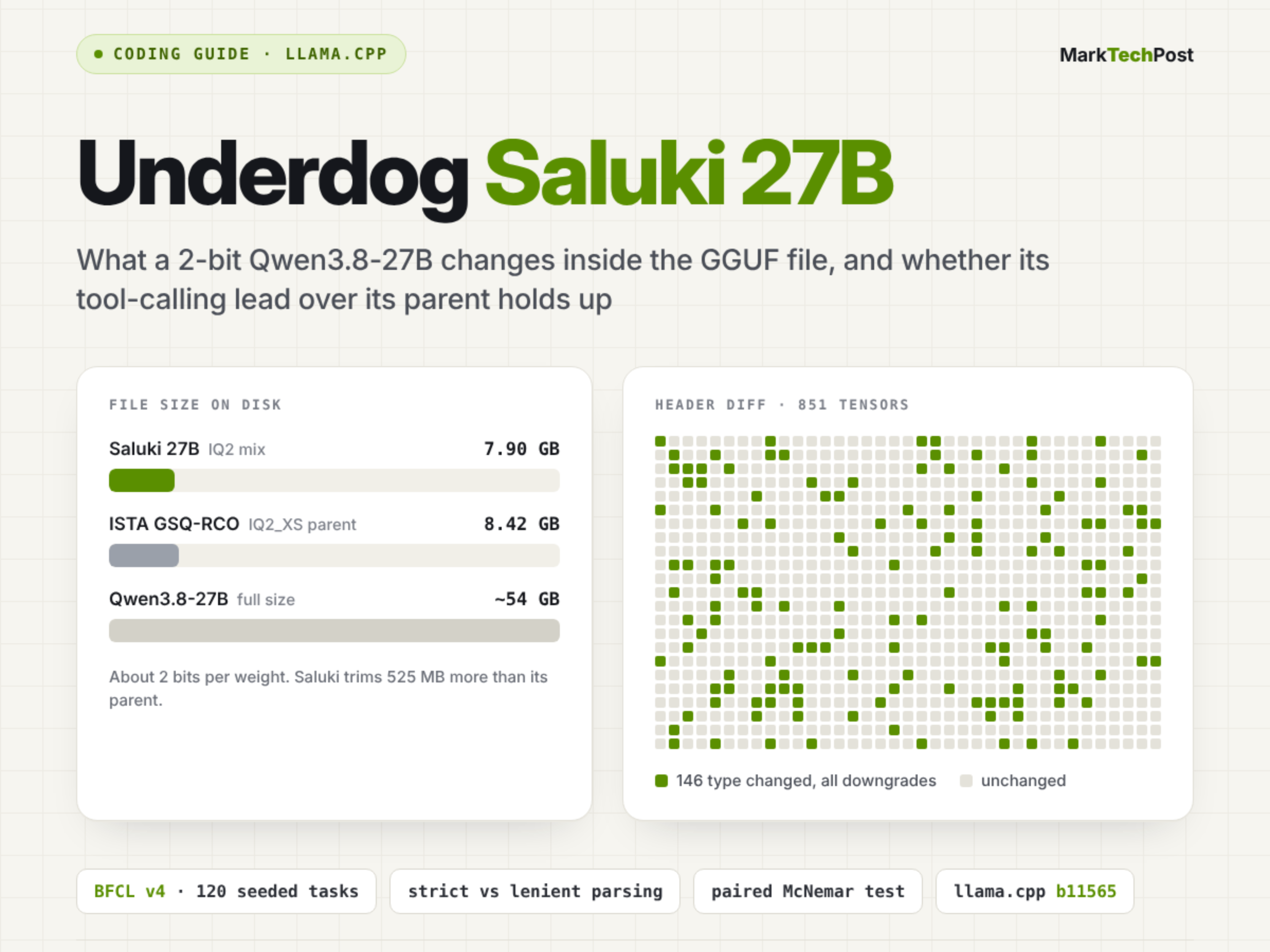
Underdog Saluki 27B: Technical Analysis of the 2-bit Qwen3.8-27B Tool-Calling Model Based on GSQ-RCO

This article introduces Saluki 27B, a model released by Underdog—a 7.9 GB, 2-bit quantized variant of Qwen3.8-27B—built using the GSQ-RCO method from ISTA-DASLab. It claims to outperform the original 54 GB full-precision model on the BFCL v4 benchmark across 120 tasks; however, all performance conclusions are based solely on the developers’ assertions and have not been independently verified.

How to Run Underdog Saluki 27B: 2-Bit Qwen3.8-27B Tool-Calling Guide
Timeline and related coverage

llama.cpp has released version b11870, officially supporting the DeepSeek-V4.1-Flash model.

llama.cpp has added support for the DeepSeek-V4.1-Flash (deepseek41) model in version b11870, and implemented several low-level optimizations tailored to its Engram architecture, including simplification of KV cache computation, replacement of MXFP8 with BF16 precision, and in-graph row gather operations; it also provides multi-platform binary builds covering macOS, Linux, Windows, Android, iOS, and openEuler.

Timeline and related coverage

llama.cpp releases version b11867: server-side entry point refactored, with full support for multiple platforms and heterogeneous acceleration backends.

llama.cpp has officially released version b11867 on GitHub. Key changes include a refactored server entry point (PR #31113) and the addition of the server_role mechanism. Additionally, more than 40 precompiled binaries are now available, covering macOS, Linux, Windows, Android, iOS, and openEuler, with support for diverse hardware backends such as CPU, CUDA (12.4/12.8/13.4), Vulkan, ROCm 10.0, OpenVINO, SYCL (FP16/FP32), and Snapdragon (Adreno + Hexagon).

Timeline and related coverage

llama.cpp releases version b11865: adds RDMA receive boundary checking and supports multiple platform backends, including CUDA 13.4, ROCm 10.0, and Snapdragon NPU.

The llama.cpp project has released build version b11865, with core changes including the addition of memory-boundary checks in the RDMA receive logic (PR #30399) and a significant expansion of hardware-acceleration support, covering CUDA 13.4, ROCm 10.0, Vulkan, OpenVINO, SYCL, and Qualcomm Snapdragon—providing full-stack heterogeneous computing backends for CPU, Adreno, and Hexagon. macOS KleidiAI support and openEuler builds have been explicitly marked as DISABLED.

Timeline and related coverage

llama.cpp releases version b11861: fixes an inference exception caused by the minimax-m3 model’s quantized scaling tensor not being propagated.

llama.cpp v.b11861 fixes the weight distortion issue in the minimax-m3 model that occurred under NVFP4/MXFP8 quantization due to the scale tensor not being injected into the computation graph, thereby preventing “token soup” and residual vanishing; it also provides multi-platform binary builds covering macOS, Linux, Windows, Android, iOS, and openEuler.

Timeline and related coverage

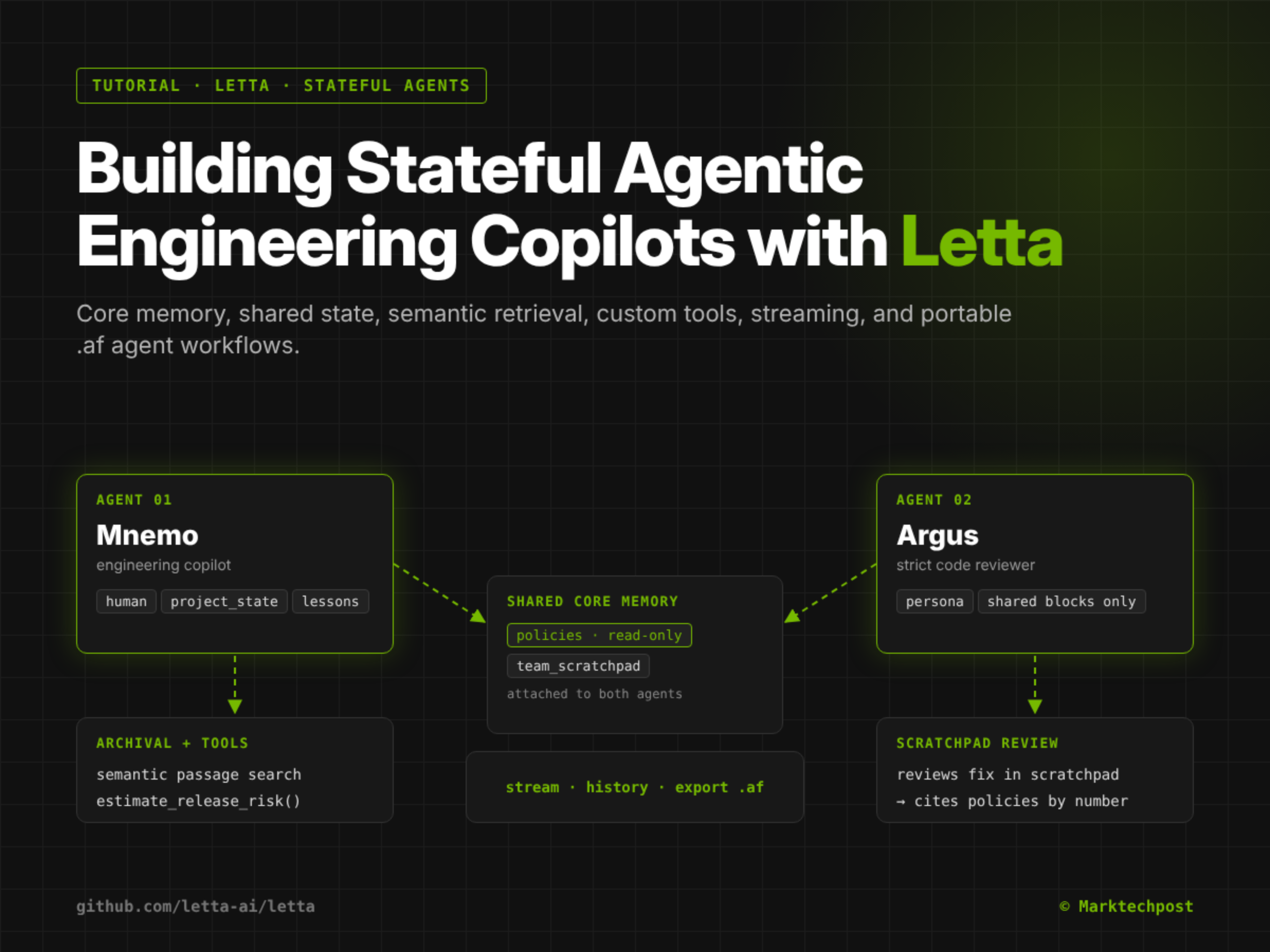
Letta platform releases a tutorial on building stateful engineering collaborators: supporting core memory, shared state, and portable workflows.

MarkTechPost published a tutorial on October 24, 2026, detailing how to build an agentic copilot with persistent state using the Letta framework. The guide covers capabilities such as verifiable core memory, multi-agent shared memory, semantic retrieval of archived knowledge, custom Python tool integration, streaming responses, and .agent format (.af) export. The content serves as a technical practice guide and does not provide performance metrics, security audits, or production‑environment validation.

Stateful Agentic Engineering Copilots with Letta: Core Memory, Shared State, Semantic Retrieval, Custom Tools, Streaming, and Portable Agent Workflows
Timeline and related coverage

ULME Framework Achieves True Unification of Text Embedding and Language Modeling: A New Paper on arXiv Proposes a Predictive Coupling Mechanism

On October 24, 2026, arXiv published the paper arXiv:2610.30705v1, introducing ULME—a post-training framework for causal-decoder–based large language models that, through a predictive coupling mechanism, achieves, for the first time, a mutually reinforcing unification of text embedding and language-generation capabilities. This approach was validated on the Qwen2.5/Qwen3 series (with 0.5B–8B parameters), yielding MTEB improvements of 3.3–4.1 points while maintaining performance on generation tasks such as MMLU.

ULME: Predictive Coupling for Mutually Reinforcing Embedding and Language Modeling

Why it matters:This paper directly addresses the core issue of fragmented multimodal LLM capabilities: embeddings and generation have long been handled either by separate models or by “pseudo-unified” models that rely solely on parameter sharing. ULME achieves a substantial architectural breakthrough by employing learnable slots and joint training with three objectives—including a stop-gradient prediction loss—enabling the generation process to actively shape the embedding representations. The study features broad experimental coverage, strong baselines, comprehensive metrics, and was published on a reputable preprint platform, balancing timeliness with technical rigor.

Timeline and related coverage

Research reveals the local geometric structure of semantic meaning in large language models

A paper published on October 24, 2026, on arXiv (ID 2610.30715v1) characterizes the local geometric properties of semantic meaning in embedding space across four decoder-only large language models—Gemma 4, Llama 3.2, Qwen 2.5, and Pythia—using cross-lingual probes and fine-grained probes.

Meaning Contracts: Local Semantic Geometry in Large Language Models

Why it matters:This study is the first to systematically characterize the invariance, variability, and refinement mechanisms within “the same semantic factor” in LLMs, proposing the “local anisotropic neighborhood” model. The approach has been validated through blind human evaluations, demonstrating rigorous methodology, broad model coverage, and cross-architecture consistency in its findings.

Timeline and related coverage

Research reveals systematic differences in evidence-location sensitivity among models with varying long-context lengths.

An empirical study published on October 24, 2026, on arXiv (paper ID 2610.31135v1) compared the positional bias of Transformer, state-space, and hybrid Mamba architectures in long-context question-answering tasks. It found that Transformer models generally exhibit an advantage in leveraging evidence from the initial positions, whereas state-space models lack this characteristic; however, both types of models tend to favor evidence from the end positions.

Mixing Matters: Evidence Position Bias Across Sequence Mixers in Long-Context Question Answering

Why it matters:This study, based on a controlled experimental design (with nine perturbed documents fixed and a single golden document slid), for the first time conducts a cross‑comparison of the positional sensitivity of three mainstream sequence‑modeling architectures within a unified evaluation framework. It reveals the strong coupling between model capabilities and architecture type, prompt engineering, and task characteristics, offering direct guidance for the design and tuning of long‑context AI systems.

Timeline and related coverage

Natural language autoencoders can effectively verbalize activation differences in large models, supporting model differentiation and interpretability research.

A paper published on October 24, 2026, on arXiv (arXiv:2610.30934v1) systematically evaluates the generalization capabilities of natural language autoencoders (NLAs) in representing differences across activation spaces, with experiments demonstrating robust performance across four dimensions: compositionality, fine-tuning model adaptation, fine-tuning target recovery, and model-difference specialization.

Verbalizing Activation Differences with Natural Language Autoencoders

Why it matters:This study is based on four reproducible experimental designs, covering four large language models from three families, and provides the most systematic evidence of generalization to date in the emerging interpretability direction of verbalization. All conclusions are strictly confined to the experimental settings and observed results reported in the paper and do not extend to untested model sizes or tasks.

Timeline and related coverage

Lighthouse: The First Trusted Digital Assistant Dedicated to the History of the U.S. Civil Rights Movement Has Been Released

The paper arXiv:2610.30158v1, published on October 24, 2026, introduces Lighthouse, the first digital assistant dedicated to exploring the history of the U.S. Civil Rights Movement, based on archival data from South Carolina. Its core innovation lies in adopting trustworthy content and user harm mitigation as design principles, employing a neuro-symbolic hybrid architecture that integrates large language models with rule-based symbolic reasoning.

Lighthouse: On Building a Trustworthy Digital Assistant for Exploring History with Civil Rights Archives

Why it matters:This study is the first to apply AI‑assisted historical exploration to the sensitive and pivotal period of the Civil Rights Movement, explicitly introducing dual constraints—“trustworthiness” and “harm modeling”—which set it apart from general‑purpose chatbots. Its methodology (neurosymbolic integration), evaluation approach (including a human‑consensus‑based gold standard for subjective questions), and data scale (over 18,000 original archival documents) all hold significant academic demonstrative value.

Timeline and related coverage

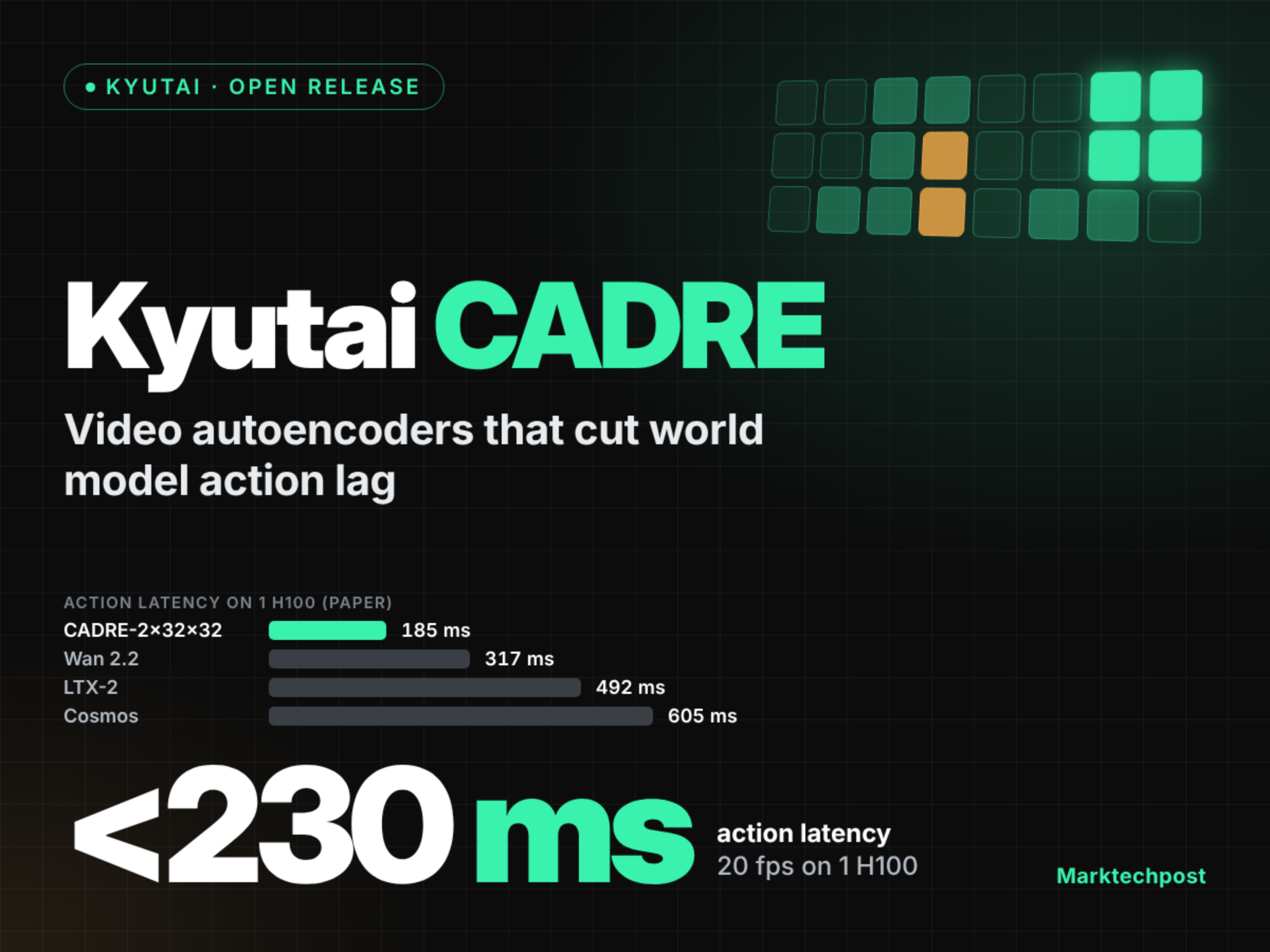
Kyutai releases the CADRE video autoencoder family: designed for interactive world models, with end-to-end action latency reduced to below 230 milliseconds.

On October 23, 2026, Kyutai unveiled CADRE—a family of seven open-source causal diffusion-based video autoencoders designed to reduce action latency in world models. On a single H100 GPU, measured response latency was as low as 185 ms, with inference throughput reaching 23.4 fps, and the scene FVD metric dropping to 162.6 (compared to 599.7 for Wan 2.2). However, in robotic manipulation tasks, its action following rate (ARR) lagged behind both Wan 2.2 and Cosmos.

Kyutai CADRE: Video Autoencoders That Cut World Model Lag Below 230 ms
Timeline and related coverage

Block releases its new voice AI model, Dessa: trained entirely on real-world conversations, with a slightly awkward conversational style.

Jack Dorsey’s company, Block, announced the launch of an end-to-end voice AI model called Dessa, claiming it was trained entirely from scratch using only human speech dialogue data. The official demonstration samples exhibited a mix of naturalness and awkwardness—for example, mistakenly addressing a user as “Ronaldo”—highlighting its anthropomorphic yet still immature conversational capabilities.

Timeline and related coverage

TechCrunch Founder Summit 2026 will be held in Boston on November 4, focusing on customer acquisition, team building, and rational expansion.

The Founder Summit 2026, co-hosted by TechCrunch and Fidelity Private Shares, is scheduled for November 4, 2026, at the SoWa Power Station in Boston. The event will focus on practical topics such as product-market fit validation, founder leadership, localized scaling strategies, and AI-native architectures. Representatives from institutions including Toast, Bessemer, and Glasswing will share their firsthand experiences.

Timeline and related coverage

Amazon QuickSight’s layered maps now support GeoJSON point and line features, enabling the visualization of locations and routes together.

Amazon QuickSight’s layered maps now support the GeoJSON formats for Point and LineString geometries, enabling users to overlay store locations, delivery routes, or flight trajectories on the same map. This capability requires no third-party services, but it does demand that GeoJSON files adhere to the proper structure, with matching keys and static updates.

Timeline and related coverage

Bayer Crop Science has built the multi-agent decision-making engine ADE based on Amazon Bedrock AgentCore.

Bayer Crop Science has built the Agentic Decision Engine (ADE) on Amazon Bedrock AgentCore—a natural-language multi-agent platform for breeding experts, analysts, and researchers—as an enhancement layer rather than a replacement for its existing Connected Decision Engine (CDE). The system is now live in production, serving over 100 R&D users and enabling approximately 80% of issues to be resolved independently through 22 domain-specific agents and about 20 API tools.

Timeline and related coverage

Canva has launched its in-house AI image-generation model, Canva Craft, which employs a two-stage design and planning architecture.

Canva has launched its first in-house AI image-generation model, Canva Craft, which employs a two-stage architecture—planning followed by generation—to enhance design accuracy, consistency, and controllability. It supports 2K resolution and over 30 aspect ratios, catering to use cases such as social media, marketing content, and digital art.

Timeline and related coverage