Skip to content
AI NEWS JOURNAL
AI, IN PERSPECTIVE

Search AI news

Search headlines, summaries and articles to connect the dots.

Newest first

Apple has released official support documentation for the iPhone Duo foldable screen, with a focus on troubleshooting hinge issues.

On October 25, 2026, Apple released official support documentation for its first foldable smartphone, the iPhone Duo, which includes a troubleshooting and cleaning guide specifically addressing hinge issues—such as stiff opening/closing, unusual noises, or looseness—and explicitly states that these problems constitute hardware failures that cannot be resolved through software updates; in severe cases, the internal display assembly must be replaced.

Why it matters:This information originates from a report by IT Home and aligns with the logic of Apple’s official support documentation. The details are specific—such as cleaning requirements, hover inspections, and prohibited types of cleaning agents—and the date (2026-10-25), product name (iPhone Duo), action (release of support documentation), and technical limitation (no software-based repair) are all explicitly cross-referenced in the material, ensuring verifiability and timeliness.
Timeline and related coverage

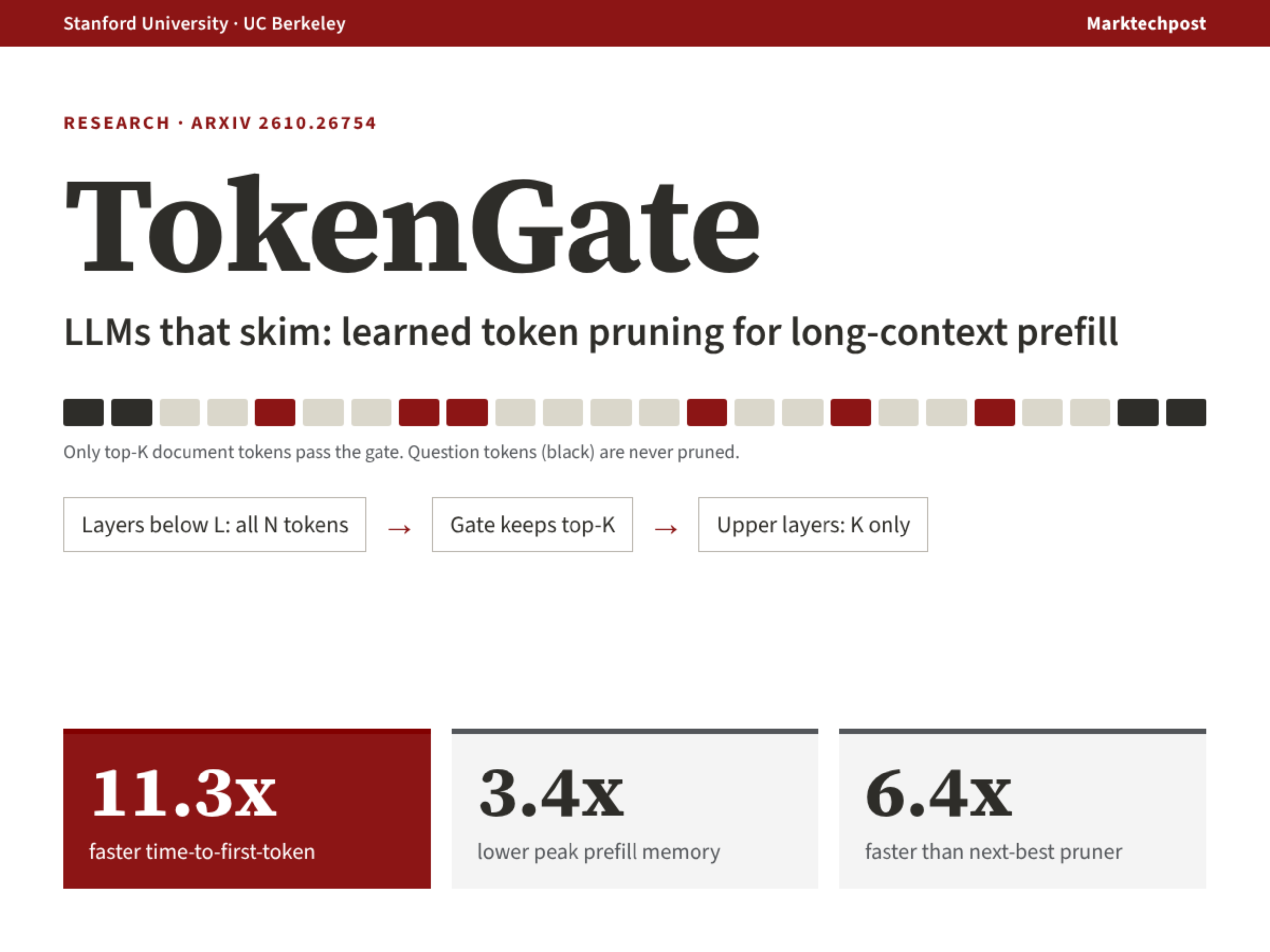
Researchers from Stanford and UC Berkeley Introduce TokenGate: Token-Gated Attention Makes Long-Context Prefill Up to 11.3x Faster

Researchers from Stanford University and the University of California, Berkeley have introduced TokenGate—a plug-and-play, learnable token-pruning module designed for existing large language models (LLMs). This approach accelerates the first-token generation time (TTFT) for long-context prefill by 1.4 to 11.3 times without sacrificing accuracy, while reducing peak memory usage by 1.5 to 3.4 times. The associated code and checkpoints have been made open source.

Researchers from Stanford and UC Berkeley Introduce TokenGate: Token-Gated Attention Makes Long-Context Prefill Up to 11.3x Faster
Timeline and related coverage

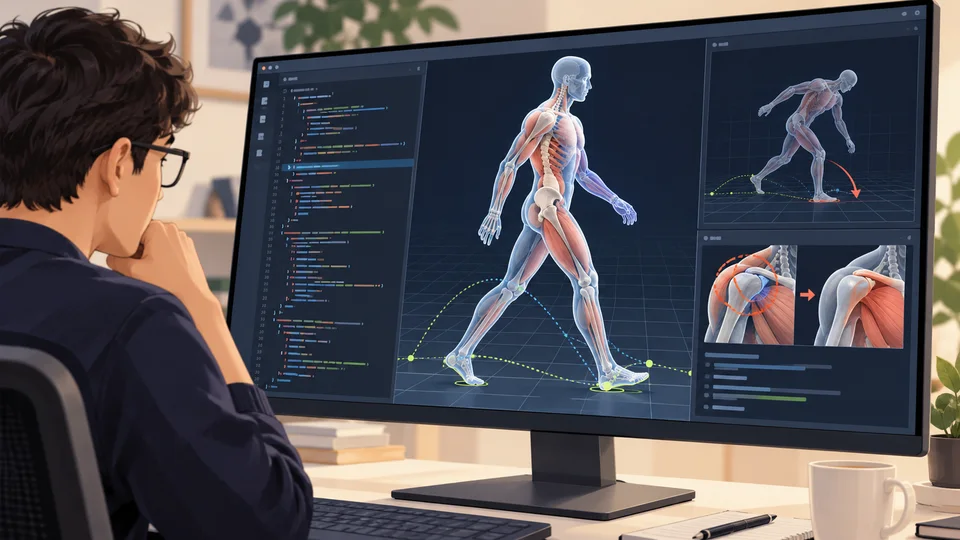
Kimi releases K3.1 Pro: Terminal task capabilities top the charts, with simulation debugging and multimodal programming showcasing the nascent form of embodied intelligence.

On October 25, 2026, Kimi released the K3.1 Pro model, which ranked first in the Terminal-Bench 4.0 terminal task benchmark with a 67.2% success rate. Its capabilities—including autonomously fixing emulator errors, performing physics simulations, conducting audio analysis, constructing 3D scenes, and editing videos—point toward exploring pathways in embodied intelligence technology.

根据报道中的虚拟人行走训练和模拟器调试制作的编辑示意,非软件实拍截图

Why it matters:The material is based on a hands-on test report published with authorization from Titanium Media, covering authoritative third-party benchmark data (such as Artificial Analysis and Terminal-Bench 4.0), official self-test results, and the author’s multi-scenario functional validation. It highlights the K3.1 Pro’s substantial advancements in execution performance, simulation closed-loop capabilities, and multimodal programming, while clearly noting performance limitations and undisclosed information (e.g., Flash/Ultra has not yet been released), in compliance with fact-checking and source attribution requirements.

Timeline and related coverage

A quarter of PRs are “AI garbage”! The Linux Foundation has released a new report: AI writes code 52% faster, yet open-source maintainers are even more exhausted.

On October 20, the Linux Foundation released a report indicating that generative AI reduces the time required for code writing by an average of 52%; however, open-source project maintainers estimate that roughly 25% of pull requests are low-quality “AI slop,” with this figure rising to 31% in large-scale projects. The report highlights that the efficiency gains have not been matched by corresponding reductions in review and governance costs, as only 35% of projects have established formal AI contribution policies, underscoring growing developer burnout and a trust deficit.

Timeline and related coverage

Taking on NVIDIA head-on to challenge Apple—Microsoft’s high-end AI PC gamble

Microsoft is courting local AI developers and high-end creators with the Surface Laptop Ultra, which features NVIDIA RTX Spark. The hardware brings large-capacity unified memory, CUDA, and RTX graphics capabilities to a portable device, but whether it can sustain competition against Macs will still depend on app optimization, agent-based experiences, and real-world workflows.

Why it matters:Ultimately, this competition comes down to whether on-device AI can genuinely boost creativity and development efficiency, and whether the associated costs—hardware, software, and migration—are justified. Hardware opens up new possibilities, but the ecosystem and real-world user experience determine how many users those possibilities can reach.

Timeline and related coverage

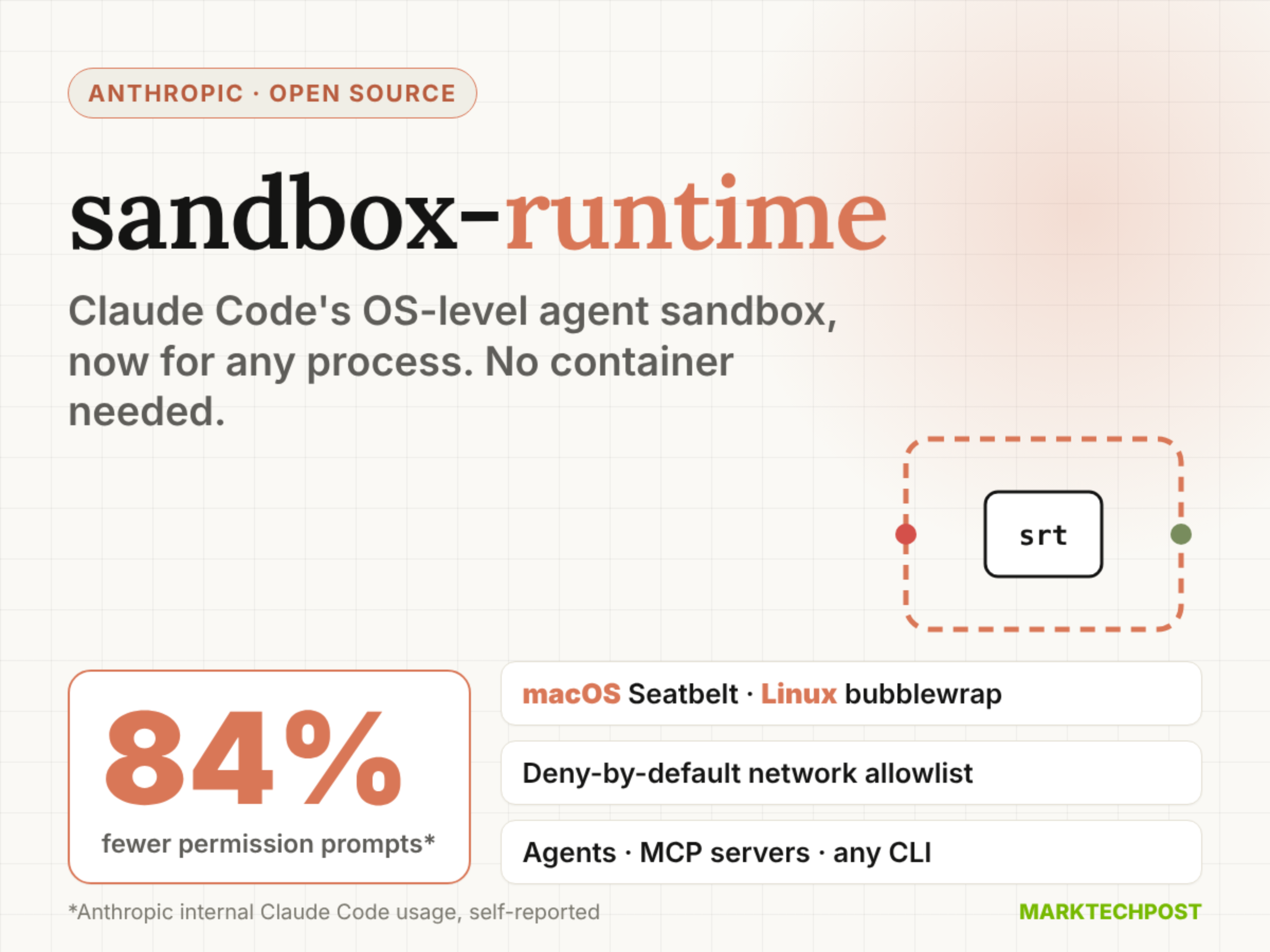
Anthropic open-sources the OS-level sandbox sandbox-runtime: providing container-free file and network isolation for AI agents.

On October 24, 2026, Anthropic open-sourced sandbox-runtime (srt), an OS-level sandboxing tool that operates without containers, designed to restrict file read/write and network access permissions for AI agents, MCP servers, and CLI tools. It supports macOS (Seatbelt), Linux (bubblewrap), and Windows (alpha), with npm package version 0.0.81 under the Apache-2.0 license.

Meet Anthropic’s sandbox-runtime: OS-Level Sandboxing for AI Agents, No Containers

Why it matters:This tool represents a significant advancement in AI security infrastructure—achieving fine-grained, full-process-tree coverage through the operating system’s native isolation mechanisms, directly addressing the risks of prompt injection and privilege escalation, and has already been deployed for internal validation within Claude Code.

Timeline and related coverage

Amazon QuickSight’s layered maps now support GeoJSON point and line features, enabling the visualization of locations and routes together.

Amazon QuickSight’s layered maps now support the GeoJSON formats for Point and LineString geometries, enabling users to overlay store locations, delivery routes, or flight trajectories on the same map. This capability requires no third-party services, but it does demand that GeoJSON files adhere to the proper structure, with matching keys and static updates.

Timeline and related coverage

Bayer Crop Science has built the multi-agent decision-making engine ADE based on Amazon Bedrock AgentCore.

Bayer Crop Science has built the Agentic Decision Engine (ADE) on Amazon Bedrock AgentCore—a natural-language multi-agent platform for breeding experts, analysts, and researchers—as an enhancement layer rather than a replacement for its existing Connected Decision Engine (CDE). The system is now live in production, serving over 100 R&D users and enabling approximately 80% of issues to be resolved independently through 22 domain-specific agents and about 20 API tools.

Timeline and related coverage

AI-driven retro game porting wave shakes up the traditional emulation community

Recently, thanks to new AI tools, numerous unofficial cross-platform porting projects of retro games—such as “Halo” running on the web, “The Wind Waker” arriving on iPhone, and “Super Smash Bros.” entering mixed reality—have been gaining popularity. However, this AI‑accelerated decompilation–recompilation (decomp/recomp) approach is sparking controversy and division within the old-school game preservation community.

Timeline and related coverage

Building a Production-Ready AI Service Framework: The New Focus of Enterprise AI Competition

As AI transitions from the experimental stage to large-scale production, corporate competitiveness is shifting from model selection to the serving harness—a suite of engineering systems that encompasses architecture design, memory management, scheduling strategies, and inference optimization. In an article published in MIT Technology Review, EXL points out that the key determinant of AI’s real-world impact is no longer model parameters or benchmark scores, but rather the ability to translate model capabilities into business value with controllable costs, reliable latency, and sustainable scalability.

Timeline and related coverage

IskayPet builds a multilingual enterprise knowledge assistant based on the Amazon Bedrock-hosted knowledge base.

Spanish pet-care company IskayPet leveraged Amazon Bedrock Managed Knowledge Bases to build an enterprise-grade knowledge assistant—covering Spain, Portugal, and France, and supporting four languages (Spanish, Portuguese, French, and English)—without needing to develop its own RAG infrastructure. The assistant supports business scenarios such as retail, veterinary care, onboarding, and procurement.

Timeline and related coverage

Amazon SageMaker launches the Training Session API: users can write custom training loops for large models without managing GPUs.

Amazon SageMaker has released the Training Sessions API, enabling users to implement custom large-model training workflows—such as SFT, RLHF, GRPO, and KTO—using pure Python scripts. GPU resource scheduling, fault tolerance, distributed execution, and checkpoint management are all handled by the service.

Timeline and related coverage

Amazon Quick has obtained HIPAA qualification, but compliance responsibility still rests with the customer.

Amazon Quick is an HIPAA‑compliant service offered by AWS that enables healthcare organizations to process Protected Health Information (PHI) upon signing a Business Associate Agreement (BAA); however, compliance with HIPAA does not equate to full regulatory compliance. Customers must rigorously manage its PHI processing workflows, encryption mechanisms, logging policies, and irreversible configuration requirements.

Timeline and related coverage

Moshi launches a real-time AI trading recommendation engine, focusing on workflow integration and trustworthy modeling of high-noise data.

Moshi, a startup founded by Anekha Sokhal, a former JPMorgan energy derivatives trader, has launched a real-time AI recommendation engine for commodity and macro traders. The platform integrates multi-source structured and unstructured market data, emphasizing deep workflow coupling, private model building, and trustworthy signal extraction. Currently in its early stages, the company has no publicly disclosed funding, revenue, or user data.

Timeline and related coverage

Moshi: A real-time AI recommendation engine for traders, reimagining market insights through workflow integration.

Former JPMorgan energy derivatives trader Anekha Sokhal founded Moshi to build a real-time AI recommendation system that integrates structured and unstructured data. Its core focus is not to replace Bloomberg, but rather to deeply embed AI into traders’ daily workflows, emphasizing trusted-source filtering, on-device processing of proprietary data, identification of conflicting signals, and customer‑driven product development.

Timeline and related coverage

The Hidden Storage Costs of AI Inference: The Data Bill Accumulating Behind Every Response

As the scale of generative AI inference surges, enterprises are facing significantly underestimated backend data storage costs—including logs, caches, intermediate rendering, security records, and more—often amounting to tens to hundreds of times the size of the user-visible output. IDC research shows that 95% of surveyed companies experienced an increase in data volume over the past year due to AI, with 61% reporting growth exceeding 25%, while storage spending has already begun outpacing compute budgets.

Timeline and related coverage

API Versioning Strategy: Ensuring Workflow Integration Stability

This article compares four mainstream API versioning strategies—URI, HTTP headers, dates, and query parameters—analyzing their differences in readability, cache compatibility, and debugging convenience, and provides a detailed explanation of how to achieve a smooth migration by actively monitoring deprecation/sunset headers, response codes (such as 410 Gone), and n8n’s built-in workflow mechanisms.

Timeline and related coverage

The U.S. nonprofit organization U.S. Hunger leverages Amazon QuickSight to make data-driven decisions in addressing hunger.

U.S. Hunger leveraged the AWS Social Entrepreneur Accelerator to integrate with Amazon QuickSight, consolidating multi-source operational data—from Impact Manager, NetSuite, Salesforce, and more—into the SPICE in-memory engine. This enables leadership to directly explore applicant profiles, share KPI definitions, and analyze policy impacts, with plans to build an enterprise‑level KPI framework by Q4 2026. Its data practices emphasize AI augmenting human judgment rather than replacing expert expertise.

Timeline and related coverage