
Skip to content
AI NEWS JOURNAL
AI, IN PERSPECTIVE

Search AI news

Search headlines, summaries and articles to connect the dots.

Newest first

Anthropic launches OSS Scanner, a free AI-powered vulnerability scanner for critical open-source projects.

Anthropic launched OSS Scanner on October 8, 2026—a free, opt-in AI vulnerability-scanning tool powered by strong models such as Claude Mythos, designed specifically for critical open-source projects. As of October 19, it had onboarded 114 projects and, within 11 days, reported 77 high-severity and 803 medium-severity vulnerabilities (according to model ratings), with 88% of sampled audit results meeting its disclosure standards.
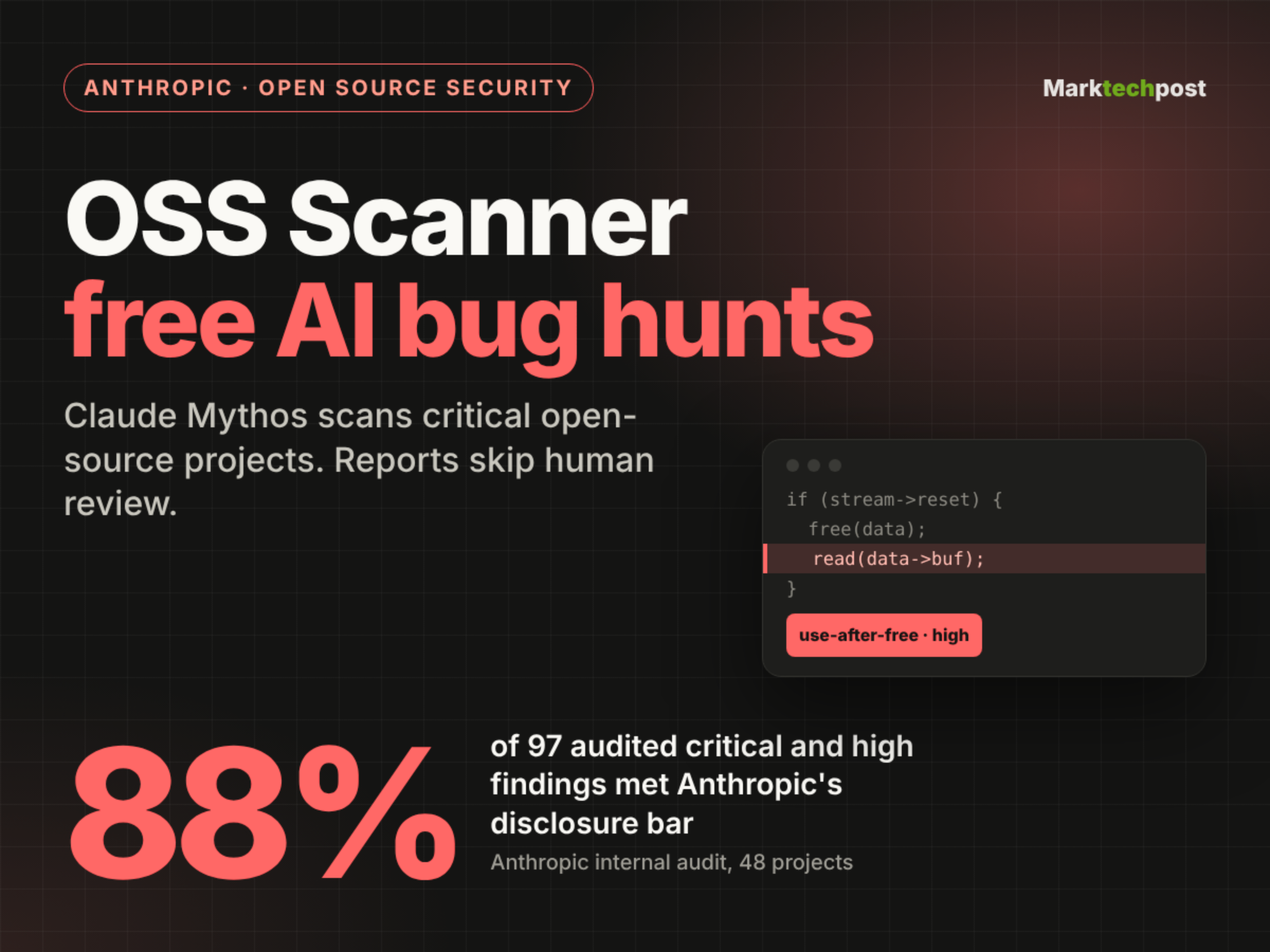
Anthropic Launches OSS Scanner, a Free AI Vulnerability Scanner

Why it matters:This tool represents a large-scale implementation of LLMs in the open-source security domain, characterized by zero cost, full automation, and offline auditing; however, bypassing the human review stage introduces risks of false positives and duplicate issues. Its accuracy metrics—88% detection rate and 1% false positive rate—and real-world project feedback (e.g., wolfSSL, curl) provide an empirical benchmark for the current state of AI‑driven vulnerability discovery.
Timeline and related coverage

月之暗面发布Kimi K3.1 Pro:2.8万亿参数开源权重模型,11月4日开放权重

月之暗面于2026年10月22日前后发布Kimi K3.1 Pro,一款2.8万亿参数、1040亿激活参数的多模态MoE模型,宣称性能逼近Fable 5.1;官方承诺11月4日发布开源权重,但截至报道时权重尚未公开;独立评测显示其在智能指数、代码与网络安全基准中表现突出,但存在推理成本、本地部署可行性及营销透明度等争议。

[AINews] Kimi 3.1 Pro 104BA-2.8T: Fable-5.1-Class Open Weights narrows Closed-AI lead to 1 month... and Pro Highspeed API with 2-3× speed

Why it matters:该事件标志着当前最接近闭源前沿模型能力的开源权重模型正式进入发布倒计时,是AI开源生态关键进展;材料来源为Latent Space旗下AINews(2026年10月24日发布),内容基于对X平台、Reddit、Arena及Artificial Analysis等多方独立评测的整合,信息密度高且具时效性与交叉验证特征。

Timeline and related coverage

TRIAD Release: The First Multimodal Large Model Evaluation Benchmark for All-Modal Ambiguity Resolution

On October 24, 2026, researchers published the paper arXiv:2610.30841v1 on arXiv, officially introducing the TRIAD benchmark—a new evaluation framework designed to assess the ability of text–image–audio tri-modal systems to resolve cross-modal ambiguities. The benchmark comprises 327 hand-crafted tri-modal samples, spanning 86 scenario groups and 18 categories of cross-modal ambiguity types.

TRIAD: Benchmarking Omni-Modal Ambiguity in Multimodal Large Language Models

Why it matters:This achievement directly addresses a core blind spot in current multimodal large-model evaluations: existing benchmarks focus on perception or reasoning under deterministic, single-modal inputs. In contrast, TRIAD is the first to systematically target “modal-complementary disambiguation” as its evaluation objective. Through rigorously designed leave-one-modal-out counterfactual tests, it reveals critical shortcomings—particularly in audio processing—and highlights weak scene-level robustness, thereby providing a reproducible diagnostic protocol and taxonomy for assessing next-generation all‑modal models.

Timeline and related coverage

Aggregated scores in LLM evaluations mask the instability of individual judgments: New research from Arena-Hard reveals instruction sensitivity.

The study employed 500 Arena-Hard v2.0 prompts, with responses from two models held constant, and used GPT‑4.1 as the judge. Under eight instruction combinations, repeated evaluations revealed that even when aggregate scores varied only slightly (e.g., by ±1 point), up to 21.2% of individual prompt outcomes (win/draw/loss) changed; further adjustments to the instructions amplified this instability, leading to an additional 28.2 percentage points in outcome shifts, while the aggregate scores themselves remained virtually unchanged.

Behind Aggregate Scores: What Systematically Varying Arena-Hard's LLM Judge Reveals

Why it matters:The study directly addresses a core blind spot in current LLM evaluation practices—overreliance on aggregate scores while neglecting the reproducibility of individual judgments and instruction dependency—providing critical methodological warnings for tasks that rely on fine-grained assessments, such as preference modeling and reinforcement learning from human feedback (RLHF).

Timeline and related coverage

TauIndianBankBench Released: A Program-Aware Dialogue Agent Evaluation Benchmark for the Indian Retail Banking Sector

On October 24, 2026, researchers published TauIndianBankBench on arXiv (ID 2610.30161v1)—a task-oriented benchmark comprising 1,000 tasks, specifically designed to evaluate whether language-model–driven banking dialogue agents strictly adhere to operational procedures (such as obtaining a final settlement quote before closing an account), rather than relying solely on the final record to determine success or failure.

TauIndianBankBench: Procedure-Aware, Action-Oriented Evaluation of Tool-Using Conversational Agents

Why it matters:This benchmark directly addresses current blind spots in LLM evaluation: traditional methods only verify the final state of a dialogue, leading to 6.5–12.0% of sessions involving procedural jumps or unauthorized actions being mistakenly classified as successful; its program-aware design fills a critical gap in compliance assessment for business automation in the Indian banking sector.

Timeline and related coverage

New research introduces the Cross-Language Poor-Condition Stimuli (CPOS) experimental paradigm, revealing the conditional transfer of hierarchical generalization capabilities in language models.

On October 24, 2026, arXiv published paper 2610.30960v1, introducing the Cross-Language Poor-Condition Stimulus (CPOS) experimental design to quantify language models’ ability to transfer hierarchical structural knowledge from a source language (L1) to a target language (L2) during cross-language continual training. The experiments show that this transfer partially holds but is imperfect, and it heavily depends on the specific language pair and the degree of lexical overlap.

Once a Tree, Always a Tree? Cross-lingual Transfer of Hierarchical Generalization in Language Models

Why it matters:This study is the first to construct a controllable cross-linguistic minimal-stimulus framework, directly testing whether “universal linguistic structures” constitute the cognitive basis for cross-linguistic transfer, rather than being driven solely by non-linguistic factors (such as positional encoding initialization). Its findings hold both methodological and theoretical value for understanding the mechanisms of grammar acquisition in large language models and multi-language alignment strategies.

Timeline and related coverage

MemPlan: A Memory-Augmented PDDL Planning Framework for Partially Observable Textual Environments

The paper was published on arXiv on October 24, 2026 (ID 2610.30379v1), introducing MemPlan—a memory-conditioned PDDL planning framework that uses large language models (LLMs) as a constrained bridge between linguistic and symbolic planning, suitable for partially observable interactive text-based environments.

MemPlan: Memory-Conditioned PDDL Planning for Partially Observable Text Environments

Why it matters:MemPlan dynamically reformulates PDDL problems using forward-graph memory and backward-memory mechanisms, significantly improving task success rates and step efficiency while substantially reducing online token consumption. Its offline fine-tuned language–symbol interface can be reused across TextWorld task types without requiring task-specific fine-tuning, demonstrating the method’s generalizability and practicality.

Timeline and related coverage

Consistency Does Not Equal Effectiveness: Self-Rewarding Moral Reasoning Makes Large Language Models More Decisive but More Susceptible to Manipulation

The study, posted on arXiv on October 24, 2026 (ID 2610.30349v1), proposes a method for training large language models to make ethical judgments by self-assessing the quality of their own reasoning. It finds that the model exhibits more consistent behavior—i.e., becomes more “decisive”—when the order of options is varied, but this does not improve the effectiveness of its ethical judgments and it still suffers from sycophancy and reframing issues.

Consistency Is Not Validity: Self-Rewarded Moral Argumentation Makes Language Models Decisive but Pliable

Why it matters:The paper challenges the prevailing assumption that behavioral consistency—such as sequence invariance—serves as a proxy for moral reasoning capability, empirically demonstrating that consistency can be optimized without improving the quality of substantive judgments, thereby offering important cautionary insights for methodologies used in AI ethics assessment.

Timeline and related coverage

New research introduces the ReflectPO framework, enhancing the autonomous error-correction capabilities of large language model agents in long-term tasks.

On October 24, 2026, arXiv published a research paper titled “ReflectPO: Reflection-Guided Policy Optimization for Long-Horizon LLM Agents” (ID 2610.30933v1), introducing a reinforcement learning framework called ReflectPO, designed to enhance the autonomous error-recovery capabilities of tool-augmented large language model agents in complex, multi-step, state-dependent tasks.

ReflectPO: Reflection-Guided Policy Optimization for Long-Horizon LLM Agents

Why it matters:This paper is a cutting-edge AI study recently published, focusing on a key bottleneck in the real-world deployment of LLM-based agents: the cumulative effect of early errors in long‑term tasks. Its proposed dual-component design—Reflection‑Guided Sampling and Tree‑Structured Credit Assignment—features methodological innovation and empirically outperforms multiple baselines across two benchmarking scenarios, making it a valuable technical reference.

Timeline and related coverage

IFC-MCQ: A Method for Automatically Generating Multiple-Choice Question Benchmarks for LLM Agents in Building Information Modeling

On October 24, 2026, researchers published the IFC-MCQ method on arXiv, aiming to automatically generate a multi-choice question benchmark with precise scoring for Industry Foundation Classes (IFC) data retrieval systems based on large language models (LLMs) in the architecture, engineering, and construction (AEC) sector.

IFC-MCQ: Automatically Generating Multiple-Choice Benchmarks for Evaluating LLM Agents on IFC Data Retrieval

Why it matters:This work directly addresses the pain points of LLMs—namely, the difficulty and high cost of evaluating them on specialized structured data such as IFC—by proposing the first automated multiple-choice question-generation framework for IFC files. It covers 15 categories and 36 subcategories, supporting reproducible and scalable evaluations of agent capabilities.

Timeline and related coverage

FusionEval Released: A New Benchmark for Large Language Model Fusion

On October 24, 2026, researchers published the paper arXiv:2610.30162v1 on arXiv, introducing FusionEval—the first unified benchmark specifically designed to evaluate fusion methods for large language models. It covers vulnerable aspects such as reasoning chain length and tool invocation, and supports comparisons between fine-tuning-based and zero-shot fusion approaches.

FusionEval: Benchmarking Model Fusion for Large Language Models

Why it matters:This benchmark fills the gap left by existing evaluations, which inadequately cover long-chain reasoning and tool usage; it clearly distinguishes between average performance and worst-case capability retention, provides a reproducible expert pool (based on Qwen3/Llama), multi-dimensional metrics (including GPU memory and runtime), and open-source code, offering strong practical guidance.

Timeline and related coverage

Lighthouse: The First Trusted Digital Assistant Dedicated to the History of the U.S. Civil Rights Movement Has Been Released

The paper arXiv:2610.30158v1, published on October 24, 2026, introduces Lighthouse, the first digital assistant dedicated to exploring the history of the U.S. Civil Rights Movement, based on archival data from South Carolina. Its core innovation lies in adopting trustworthy content and user harm mitigation as design principles, employing a neuro-symbolic hybrid architecture that integrates large language models with rule-based symbolic reasoning.

Lighthouse: On Building a Trustworthy Digital Assistant for Exploring History with Civil Rights Archives

Why it matters:This study is the first to apply AI‑assisted historical exploration to the sensitive and pivotal period of the Civil Rights Movement, explicitly introducing dual constraints—“trustworthiness” and “harm modeling”—which set it apart from general‑purpose chatbots. Its methodology (neurosymbolic integration), evaluation approach (including a human‑consensus‑based gold standard for subjective questions), and data scale (over 18,000 original archival documents) all hold significant academic demonstrative value.

Timeline and related coverage

New arXiv paper compares the performance of joint scoring and item-by-item scoring for compact encoders.

On October 24, 2026, arXiv published the paper arXiv:2610.30970v1, which systematically evaluates design choices for compact encoders with model sizes ranging from 17 million to 1 billion parameters in closed-set decision-making tasks (such as tool selection): joint reading of all options versus independent scoring of each option. The study finds that, at a parameter scale of 32 million, option-by-option scoring significantly outperforms joint scoring on skill metrics; however, it incurs higher computational costs and exhibits more uneven latency. Multiple System1-Arena benchmarks show that joint encoders with 68 million and 150 million parameters surpass the 435-million-parameter DeBERTa-v3 zero-shot classifier.

Joint or Per-Option? Compact Encoders for Closed-Set Decisions from 17 Million to 1 Billion Parameters

Why it matters:This paper presents a key empirical comparison of lightweight design approaches for downstream decision-making modules in large models, covering engineering considerations such as architecture selection, initialization dependencies, the latency–accuracy trade-off, and input-order robustness. The data are based on experiments conducted with three random seeds and validated against both public and private benchmarks. The publication date (2026-10-24) matches the current UTC date (2026-10-25), making this the latest credible research advancement.

Timeline and related coverage