

What is JAX?
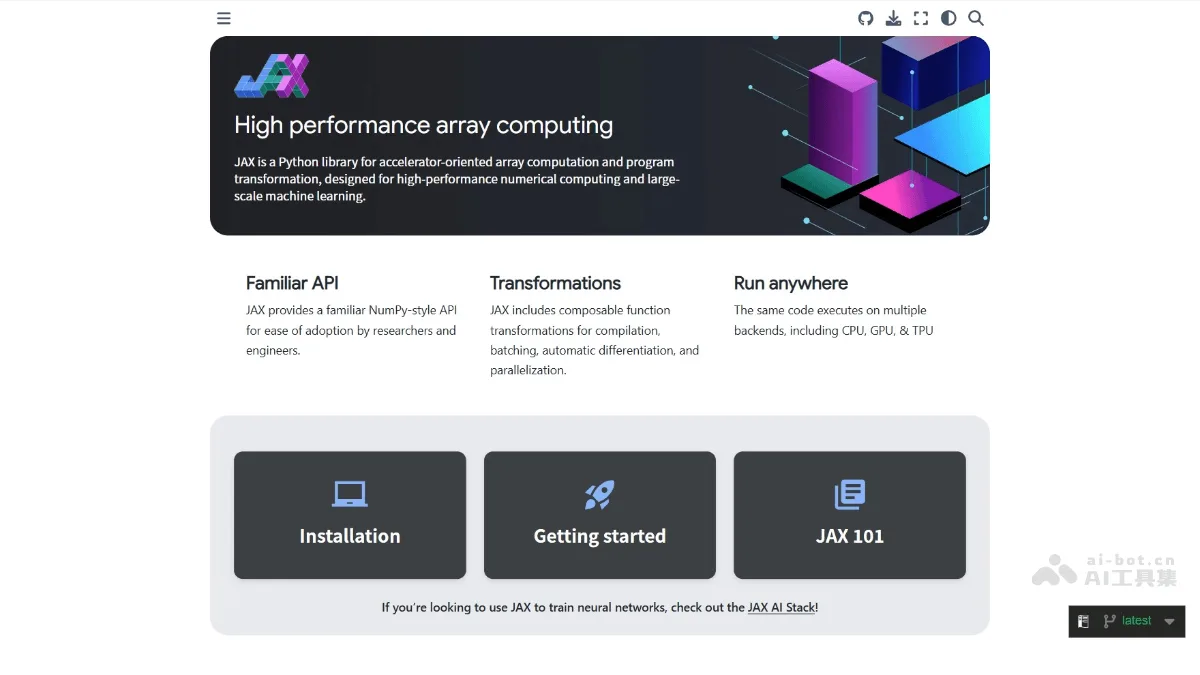
JAX is a Python numerical computing library designed for accelerators, specifically tailored for high-performance array computations and large-scale machine learning. It efficiently executes the same code across multiple hardware backends, including CPUs, GPUs, and TPUs. It offers a familiar NumPy-like API, significantly lowering the learning curve for researchers and engineers. Its built-in composable function transformation capabilities—including just-in-time compilation (jit), automatic differentiation (grad), vectorization (vmap), and parallelization (pmap)—allow developers to construct high-performance computational graphs using concise expressions. All transformations are based on pure functional semantics and immutable arrays, ensuring predictability and cross-platform consistency. JAX itself is lightweight and focused, while its ecosystem is expanded through specialized libraries such as Flax, Optax, and Equinox, covering full-stack needs like neural networks, optimizers, differential equation solvers, and data loading.
Key features
It provides a NumPy-like API, making it easy for researchers and engineers to get started quickly.
It features built-in composable function transformations, including just-in-time compilation (jit), automatic differentiation (grad), vectorization (vmap), and parallelization (pmap).
Use cases and audience
A Python library aimed at researchers and engineers, suitable for developers who require high-performance array computations, programmable transformations, and large-scale machine learning capabilities.
- Used for high-performance numerical computations, such as training large-scale machine learning models and scientific simulations.
- Implement composable function transformations such as automatic differentiation, vectorization, just-in-time compilation, and parallelization.
- Run the same code across CPU, GPU, and TPU backends, supporting multi-device and distributed computing.
Python functions, NumPy-style arrays, random keys, pytree-structured data, and more.
Transformed JAX arrays (DeviceArray), compiled executable objects (Compiled), gradient functions, vectorized functions, and others.
Frequently asked questions
Does JAX provide its own neural network framework?
JAX does not provide a high-level neural network framework itself, but it integrates with ecosystem libraries such as Flax, Equinox, and Keras. It is recommended to build models using the JAX AI Stack.
Can JAX run the same code across different hardware backends (such as CPU/GPU/TPU)?
Yes, one of the design goals of JAX is “Run anywhere,” meaning the same code can run natively on CPUs, GPUs, and TPUs.
How to use
- 01
Install the JAX library: pip install jax[jaxlib].
- 02
Import and use jax.numpy instead of NumPy for array operations.
- 03
Apply function transformations like jax.grad() to enable automatic differentiation or jax.jit() to accelerate execution.
- 04
Run the same code on CPUs, GPUs, or TPUs without modifying the logic.
Official website & sources
Sources
Updated on 2026-10-30