Skip to content
AI NEWS JOURNAL
AI, IN PERSPECTIVE

Search AI news

Search headlines, summaries and articles to connect the dots.

Newest first

Sebastian Raschka has released an eight-video course titled “Building a Reasoning Model from Scratch.”

On October 24, 2026, Sebastian Raschka published an eight-part, over-11-hour hands-on video course on Python and PyTorch in Ahead of AI magazine (magazine.sebastianraschka.com), systematically covering the evaluation of inference models, scaling during inference, reinforcement learning (RLVR), and knowledge distillation, with all methods implemented using the pre-trained Qwen3-0.6B model.

Why it matters:This course is the author’s advanced technical educational offering, following “Building Large Language Models from Scratch.” It focuses on the core evolutionary direction of today’s mainstream LLMs—enhancing inference capabilities—covering the entire technical pipeline from setting up the foundational environment to GRPO reinforcement learning and self‑distillation. The author explicitly states that all implementations are “hand‑crafted from scratch,” fully reproducible, and highly instructive with significant engineering reference value.

Timeline and related coverage

baseVultra: A novel compact nonlinear recurrent unit for focused candidate generation, outperforming LSTM and GRU in small-scale scenarios.

On October 24, 2026, arXiv published the paper arXiv:2610.30154v1, introducing a novel recurrent neural network unit called baseVultra. This model centralizes dense recurrent computations into a single H×H candidate generation matrix and replaces traditional gating matrices with O(H)-complexity diagonal interactions. Its effectiveness was validated in compact settings such as TinyShakespeare: under a 200K-parameter single-layer configuration, it achieved a validation loss of 1.594, outperforming LSTM (1.604) and GRU (1.616) with the same number of parameters, while its dense computation overhead is only about 54% of that of GRU.

baseVultra: Compact Nonlinear Recurrence with Reallocated Capacity

Why it matters:This study represents a new direction in the design of recurrent neural network architectures—shifting from a gate‑driven approach to a candidate‑generation‑driven one. Experiments span character‑level language modeling (TinyShakespeare, text8) and formal language probes (the Counter task), with results clearly demonstrating that its advantages are most pronounced in compact settings where hidden‑state capacity is limited (e.g., H=16), providing a well‑defined technical positioning supported by empirical evidence.

Timeline and related coverage

Aggregated scores in LLM evaluations mask the instability of individual judgments: New research from Arena-Hard reveals instruction sensitivity.

The study employed 500 Arena-Hard v2.0 prompts, with responses from two models held constant, and used GPT‑4.1 as the judge. Under eight instruction combinations, repeated evaluations revealed that even when aggregate scores varied only slightly (e.g., by ±1 point), up to 21.2% of individual prompt outcomes (win/draw/loss) changed; further adjustments to the instructions amplified this instability, leading to an additional 28.2 percentage points in outcome shifts, while the aggregate scores themselves remained virtually unchanged.

Behind Aggregate Scores: What Systematically Varying Arena-Hard's LLM Judge Reveals

Why it matters:The study directly addresses a core blind spot in current LLM evaluation practices—overreliance on aggregate scores while neglecting the reproducibility of individual judgments and instruction dependency—providing critical methodological warnings for tasks that rely on fine-grained assessments, such as preference modeling and reinforcement learning from human feedback (RLHF).

Timeline and related coverage

Research reveals that reward model scoring exhibits significant prompt dependency: pairwise evaluation fails to detect this bias.

An AI research paper published on arXiv on October 24, 2026, points out that current mainstream pairwise evaluation methods automatically cancel out the scoring components common to all responses under the same prompt, leaving a critical “prompt-level bias” in reward models unexamined. Using human ratings as a benchmark, the authors conducted an audit of 18 publicly available scorers and found that, on the HelpSteer2 dataset, 6 models exhibited 34%–64% of their rating variance attributable to the prompt itself—whereas human ratings show virtually no such phenomenon.

What Pairwise Evaluation Misses: Reward Scores across Prompts

Why it matters:The study highlights a long-overlooked fundamental flaw in the alignment process of large language models: reward model scores are heavily biased toward the prompt text rather than the actual quality of the response. Its methodology—human‑reference auditing, prompt substitution, and variance decomposition—is reproducible, and its conclusions are grounded in empirical analysis across multiple mainstream open-source scorers, offering direct implications for preference optimization, RLHF, and safety‑assessment practices.

Timeline and related coverage

IndoNutriQA, the Indonesian clinical nutrition Q&A benchmark, has been officially released.

On October 24, 2026, the research team published a paper on arXiv (ID 2610.31256v1), introducing IndoNutriQA, the first expert-annotated question-answering benchmark for the Indonesian-language clinical nutrition domain. It comprises 911 question–answer pairs derived from real clinical reports, focusing on evaluation rather than training, and supports generative, extractive, and retrieval-augmented question-answering tasks.

IndoNutriQA: An Indonesian Clinical Nutrition Question Answering Benchmark

Why it matters:This benchmark fills the gap in high-quality publicly available evaluation data for low-resource languages—particularly Indonesian—in the clinical nutrition NLP domain. It features comprehensive structured metadata, question types that strictly adhere to the Nutrition Care Process (NCP), and has undergone expert validation and multi‑model benchmarking, ensuring a clear research focus and rigorous methodology.

Timeline and related coverage

New research casts doubt on the effectiveness of context-enhanced methods in reasoning: any gains in accuracy may be due to random fluctuations.

An AI research paper published on October 24, 2026, on arXiv (ID 2610.30983v1) systematically evaluated five context‑enhanced reasoning methods and found that the reported accuracy improvements may not reflect genuine gains in capability but could instead stem from undirected perturbations—correcting some predictions while simultaneously undermining others.

A Reality Check of Inference-Time Context Augmentation Methods

Why it matters:This paper for the first time establishes a unified evaluation framework that spans methods, models, and datasets, pointing out that relying solely on performance gains can easily obscure reliability shortcomings. In particular, it warns that filler-token–based approaches (which do not introduce new information) primarily perturb predictions near the decision boundary and should therefore not be deployed directly in real-world applications.

Timeline and related coverage

Release of a new benchmark for Nepali–English mixed-language speech recognition and a two-stage adaptation framework from synthesis to real-world conditions

On October 24, 2026, researchers published a paper on arXiv (ID 2610.30860v1), introducing the first Nepali–English code-switching ASR benchmark for spontaneous podcast scenarios, comprising 13,044 real-world utterances (15.45 hours), and proposing a two-stage adaptation approach that combines synthetic and real data: first, fine-tuning with synthetic speech generated by a 0.95-hour multi-speaker TTS model as supervision; then, incorporating group relative policy optimization (GRPO) with script-based rewards.

Synthetic-to-Real Code-Switched ASR: A Spontaneous Nepali-English Podcast Benchmark

Why it matters:This work directly addresses the core challenges of script obfuscation and high error rates at switching points in code-switching ASR for low-resource languages, by rigorously auditing data to prevent machine translation leaks and acoustic loops, and by making all validation texts, timestamps, episode metadata, and reconstruction scripts publicly available. The experimental results are statistically significant (p ≤ 0.001) and demonstrate generalization stability on monolingual benchmarks.

Timeline and related coverage

New research introduces the ReflectPO framework, enhancing the autonomous error-correction capabilities of large language model agents in long-term tasks.

On October 24, 2026, arXiv published a research paper titled “ReflectPO: Reflection-Guided Policy Optimization for Long-Horizon LLM Agents” (ID 2610.30933v1), introducing a reinforcement learning framework called ReflectPO, designed to enhance the autonomous error-recovery capabilities of tool-augmented large language model agents in complex, multi-step, state-dependent tasks.

ReflectPO: Reflection-Guided Policy Optimization for Long-Horizon LLM Agents

Why it matters:This paper is a cutting-edge AI study recently published, focusing on a key bottleneck in the real-world deployment of LLM-based agents: the cumulative effect of early errors in long‑term tasks. Its proposed dual-component design—Reflection‑Guided Sampling and Tree‑Structured Credit Assignment—features methodological innovation and empirically outperforms multiple baselines across two benchmarking scenarios, making it a valuable technical reference.

Timeline and related coverage

Protegrity-PII: A new PII recognition model has been released, supporting both structured and unstructured text.

On October 24, 2026, the research team published the Protegrity-PII model on arXiv (ID 2610.30518v1), a novel decision-making model designed for identifying personally identifiable information (PII). On the new benchmark PII-SCOPE, it achieves a typological recall of 0.915 and a precision of 0.907, with an inference speed of 0.49 seconds per million characters and a cost of only $0.0005 per million characters (using a single RTX 6000 GPU in batch mode).

Protegrity-PII Technical Report

Why it matters:This technical report provides quantifiable performance metrics, clear hardware and cost specifications, the newly proposed benchmark PII-SCOPE, and an empirical comparison of out-of-distribution generalization capabilities, offering both research transparency and engineering reference value. Its publication date (2026-10-24) is no later than the current date (2026-10-26), making it a valid, recent achievement.

Timeline and related coverage

The study proposes to control the compilation of autoregressive large models into strategy-precise parallel inference, thereby enhancing the efficiency of hierarchical RAG.

A research paper published on October 24, 2026, on arXiv (ID 2610.30664v1) proposes a new method that compiles the autoregressive control logic of large language models in Hierarchical RAG into a policy-exact parallel inference pipeline, achieving a 35–47% reduction in control latency on MetaX devices while maintaining 84–89% policy consistency.

Compiling Autoregressive LLM Control into Policy-Exact Parallel Inference for Hierarchical RAG

Why it matters:This work addresses the bottleneck inherent in LLMs when used as structured decision‑making controllers—namely, their reliance on sequential text decoding—by proposing a theoretically provable parallelization compilation scheme. Experiments conducted on real hardware (MetaX, H800) and with multiple data partitions demonstrate strong efficiency and clear technical details, positioning this research as cutting‑edge optimization for trustworthy AI systems.

Timeline and related coverage

Research reveals that in multilingual evaluation, the effectiveness of “large models as referees” heavily depends on the choice of referee model.

A multilingual empirical study published on October 24, 2026, on arXiv found that current mainstream prompting strategies—such as chain-of-thought and role‑playing—lack cross‑model and cross‑language transferability in LLM‑as‑a‑Judge scenarios; the choice of the judge model exerts far greater influence than the prompting strategy itself, and the effectiveness of the strategy can even reverse direction across different judge models.

Prompting Strategy Effects Depend on the Judge: A Multilingual Study of LLM-as-a-Judge Robustness

Why it matters:This study is the first to systematically measure the interaction effects among nine prompting strategies, four open-source evaluation models, 27 languages, and 13 datasets, generating over one million human-validated point-by-point ratings and filling a critical gap between English-centric prompting research and fixed-template multilingual studies.

Timeline and related coverage

WikiOriginQA released: A question-answering dataset for assessing cultural bias, automatically constructed based on the creation times of multilingual Wikipedia editions.

On October 24, 2026, the research team published a paper on arXiv (ID 2610.30677v1), introducing WikiOriginQA, a fully automated question-answering dataset that leverages the creation dates of Wikipedia editions in various languages to objectively characterize the origins of knowledge, with the aim of enhancing the scalability of cultural bias assessment.

WikiOriginQA: Automated Construction of a QA Dataset with Knowledge Origins for Analyzing Cultural Bias

Why it matters:This study proposes a method for generating culturally grounded provenance data at scale across languages without manual annotation, and experimental results demonstrate that large language models exhibit systematic performance advantages on Anglophone cultural-related tasks, providing a new tool for the quantitative analysis of cultural bias.

Timeline and related coverage

The study proposes a new evaluation method and model to address annotation disagreements in identifying unstated arguments (enthymemes) within politically contentious discourse.

This paper, based on tweet data related to vaccination and immigration—each tweet independently annotated by five raters—finds that existing fine-tuned models consistently achieve an F1 score of around 0.67 on the enthymeme detection task. To address this, the authors propose abandoning the single-label evaluation paradigm in favor of a new metric that captures the distribution of annotators’ opinions, and they design a model capable of directly predicting this distribution, thereby better capturing human judgmental divergence without compromising the F1 score.

Interpretive Variation and Discourse Structure in Detecting Enthymemes in Controversial Political Discourse

Why it matters:The paper squarely confronts the long-neglected reality in NLP that “annotator disagreement is an essential characteristic”—particularly in politically sensitive contexts, where identifying enthymemes relies heavily on subjective reasoning. Its methodological shift—from point prediction to distributional prediction—and its empirical demonstration of the limitations of discourse‑structural analysis carry clear implications for the design of content‑moderation systems: models trained on majority‑vote criteria may systematically overlook implicit arguments that require deep contextual inference.

Timeline and related coverage

Research comparing the search-space complexity and efficiency of CTC and neural transcription models.

The paper was published on October 24, 2026, on arXiv (ID 2610.31259v1), and systematically compares the search-space complexity and inference efficiency of two types of end-to-end speech recognition (ASR) models—connectionist temporal classification (CTC) and neural transducer—under various pruning strategies and language-model configurations.

A Systematic Comparison of Search Space Complexity and Efficiency for Time-Synchronous End-to-End ASR Models

Why it matters:The paper, based on empirical analysis, points out that although end-to-end ASR models typically maintain a small search space most of the time, they exhibit significant transient spikes in the number of hypotheses during periods of speech uncertainty; dynamic score-based pruning can adapt to model uncertainty, substantially reducing the real-time factor (RTF) and providing practical guidance for efficient search.

Timeline and related coverage

Research reveals that open-source large models commonly exhibit list-filling phenomena in structured extraction.

An empirical study published on October 24, 2026, on arXiv (paper ID 2610.30997v1) found that when a JSON extraction schema specifies a minimum number of items in the list but the actual document content falls short, eight open-source weighting models generally treat this minimum value as a generation target rather than a constraint, resulting in 55.4% of output lists exceeding the true count (compared to a baseline of 34.5%). The filler items are often drawn from the original text, and about half pass the source‑consistency check; common mitigation strategies prove only marginally effective.

Padding to k: A Minimum Count in the Schema Makes Open-Weight Models Pad Their Extraction Lists

Why it matters:This study employed a preregistered protocol to systematically evaluate eight open-source models and six hosted-service models across 558 real-world documents and nine annotated datasets. With a rigorous methodology and publicly available data—both the code and results have been released on GitHub—it reveals a critical yet often overlooked deficiency in structured information extraction that undermines the reliability of downstream tasks: schema‑induced non‑faithful filling behavior.

Timeline and related coverage

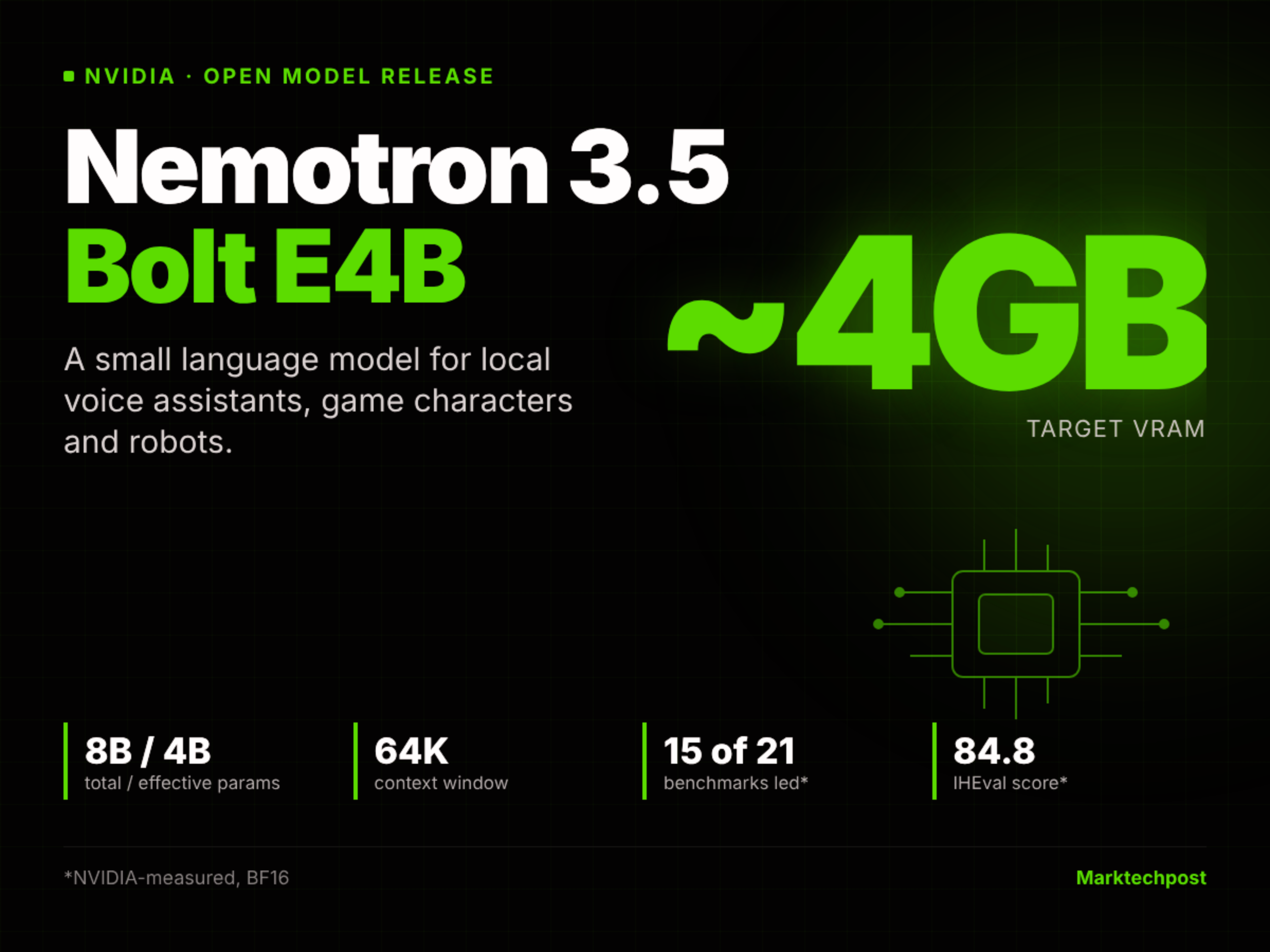
NVIDIA has released the open-source small language model Nemotron 3.5 Bolt E4B 4GB, optimized for on-device voice assistants, game NPCs, and robots.

NVIDIA, leveraging Google’s Gemma 4 E4B model and employing only reinforcement learning (RL) for post-training, has launched Nemotron 3.5 Bolt E4B 4GB—a small open-source language model with 8B total parameters, 4B effective parameters, and a 64K context window. It is designed to run on edge devices such as RTX and Jetson with approximately 4GB of VRAM, supporting multi-turn tool calls and low-latency voice interaction.

NVIDIA Releases Nemotron 3.5 Bolt E4B 4GB: An Open Small Language Model for Local Voice Agents, Game Characters and Robots
Timeline and related coverage

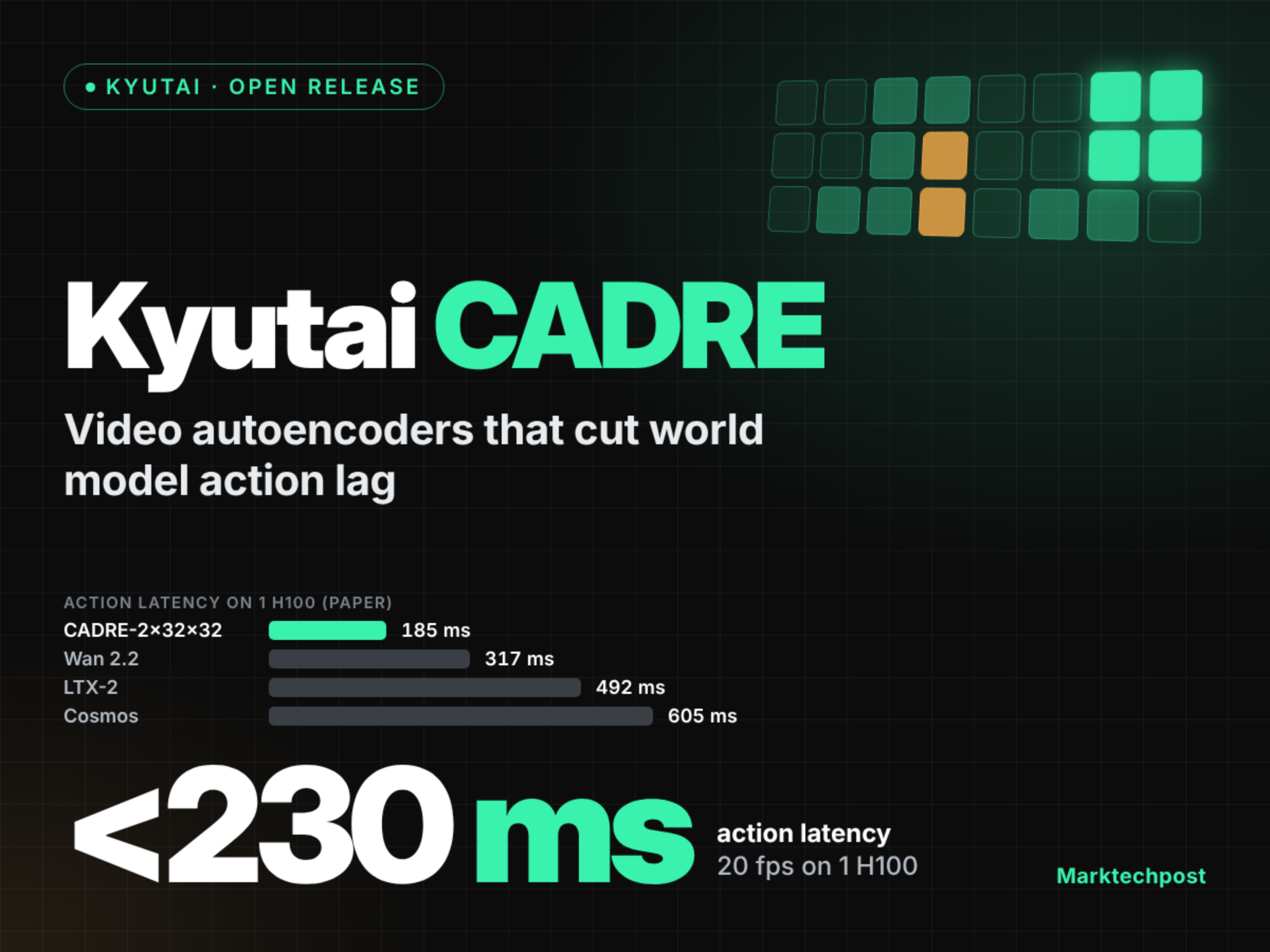
Kyutai releases the CADRE video autoencoder family: designed for interactive world models, with end-to-end action latency reduced to below 230 milliseconds.

On October 23, 2026, Kyutai unveiled CADRE—a family of seven open-source causal diffusion-based video autoencoders designed to reduce action latency in world models. On a single H100 GPU, measured response latency was as low as 185 ms, with inference throughput reaching 23.4 fps, and the scene FVD metric dropping to 162.6 (compared to 599.7 for Wan 2.2). However, in robotic manipulation tasks, its action following rate (ARR) lagged behind both Wan 2.2 and Cosmos.

Kyutai CADRE: Video Autoencoders That Cut World Model Lag Below 230 ms
Timeline and related coverage

Amazon SageMaker AI has launched a Multi-Step Reinforcement Learning (MTRL) framework, supporting end-to-end training of agents to accomplish multi-step tasks.

AWS has launched the Multi-Turn Reinforcement Learning (MTRL) feature, enabling users to train large‑model agents on SageMaker AI using full task trajectories and final outcome feedback, without requiring step‑level annotations. A end-to-end demonstration is provided using Wordle as an example, covering AgentCore deployment, data preparation, GRPO training, reward design, and cost analysis.

Timeline and related coverage

Amazon QuickSight’s layered maps now support GeoJSON point and line features, enabling the visualization of locations and routes together.

Amazon QuickSight’s layered maps now support the GeoJSON formats for Point and LineString geometries, enabling users to overlay store locations, delivery routes, or flight trajectories on the same map. This capability requires no third-party services, but it does demand that GeoJSON files adhere to the proper structure, with matching keys and static updates.

Timeline and related coverage

Black October: A Comprehensive Overview of the AI-Driven Cybersecurity Crisis—From Its Peak to Defensive Response

Around October 21–22, 2026, over a span of approximately 48 hours, more than a dozen high‑severity AI‑related vulnerabilities and intrusion incidents were reported worldwide, including PHP2Shell, GitLab RCE (CVSS 10), NGINX/HTTP/3 DoS, LiteLLM password theft, eMudhra CA key leakage, and Quest Diagnostics medical data exposure. State actors such as Storm‑0940 leveraged open‑source intelligent penetration‑testing frameworks like ARTEX to launch large‑scale attacks. Concurrently, AI security defense systems were rapidly being developed, encompassing formal verification, open‑source patching agents, standardization of agent capabilities, and hardware‑level optimizations.

Timeline and related coverage