Skip to content
AI NEWS JOURNAL
AI, IN PERSPECTIVE

Search AI news

Search headlines, summaries and articles to connect the dots.

Newest first

Low-Cost Intelligence vs. Expensive Ambitions: DeepInfer, DSX POD, and AI Investment Expansion

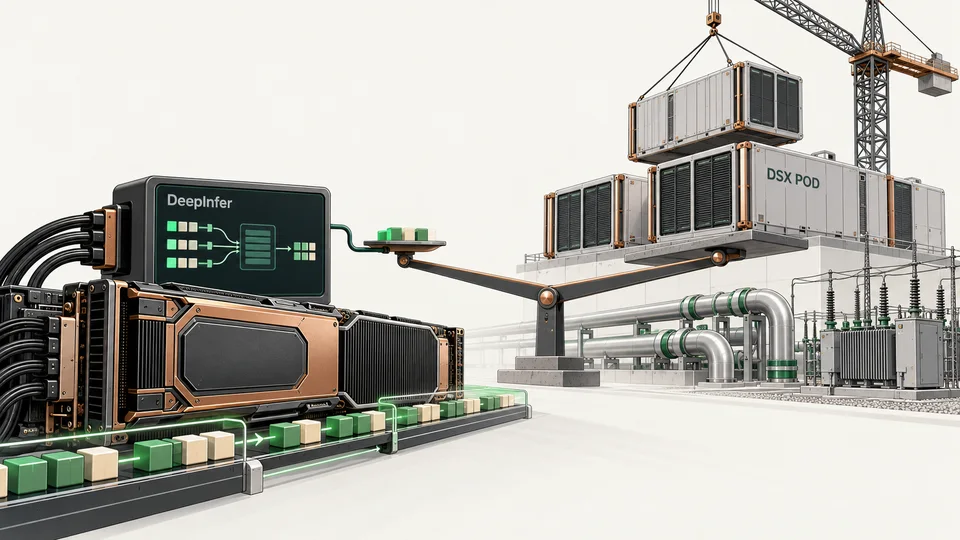
Issue 958 of “The Sequence Radar” examines inference software, modular AI factories, and enterprise AI investments side by side: cheaper per-inference does not necessarily mean lower overall industry spending. This article is compiled from the original publication and supplemented with technical scope and delivery terms based on DeepSeek and NVIDIA’s official materials.

推理软件效率与模块化AI基础设施投入的编辑示意,非实际产品照片
Timeline and related coverage

Kimi releases K3.1 Pro: Terminal task capabilities top the charts, with simulation debugging and multimodal programming showcasing the nascent form of embodied intelligence.

On October 25, 2026, Kimi released the K3.1 Pro model, which ranked first in the Terminal-Bench 4.0 terminal task benchmark with a 67.2% success rate. Its capabilities—including autonomously fixing emulator errors, performing physics simulations, conducting audio analysis, constructing 3D scenes, and editing videos—point toward exploring pathways in embodied intelligence technology.
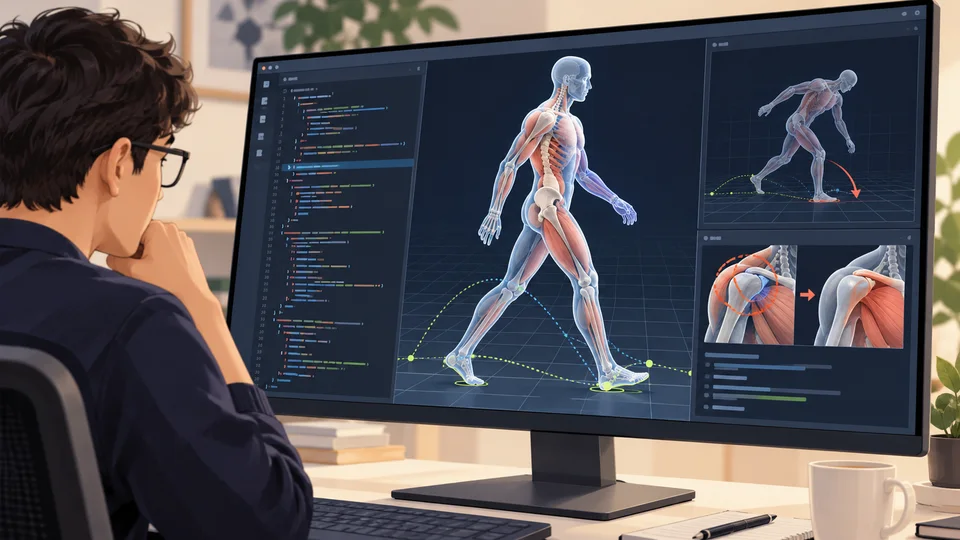
根据报道中的虚拟人行走训练和模拟器调试制作的编辑示意,非软件实拍截图

Why it matters:The material is based on a hands-on test report published with authorization from Titanium Media, covering authoritative third-party benchmark data (such as Artificial Analysis and Terminal-Bench 4.0), official self-test results, and the author’s multi-scenario functional validation. It highlights the K3.1 Pro’s substantial advancements in execution performance, simulation closed-loop capabilities, and multimodal programming, while clearly noting performance limitations and undisclosed information (e.g., Flash/Ultra has not yet been released), in compliance with fact-checking and source attribution requirements.

Timeline and related coverage

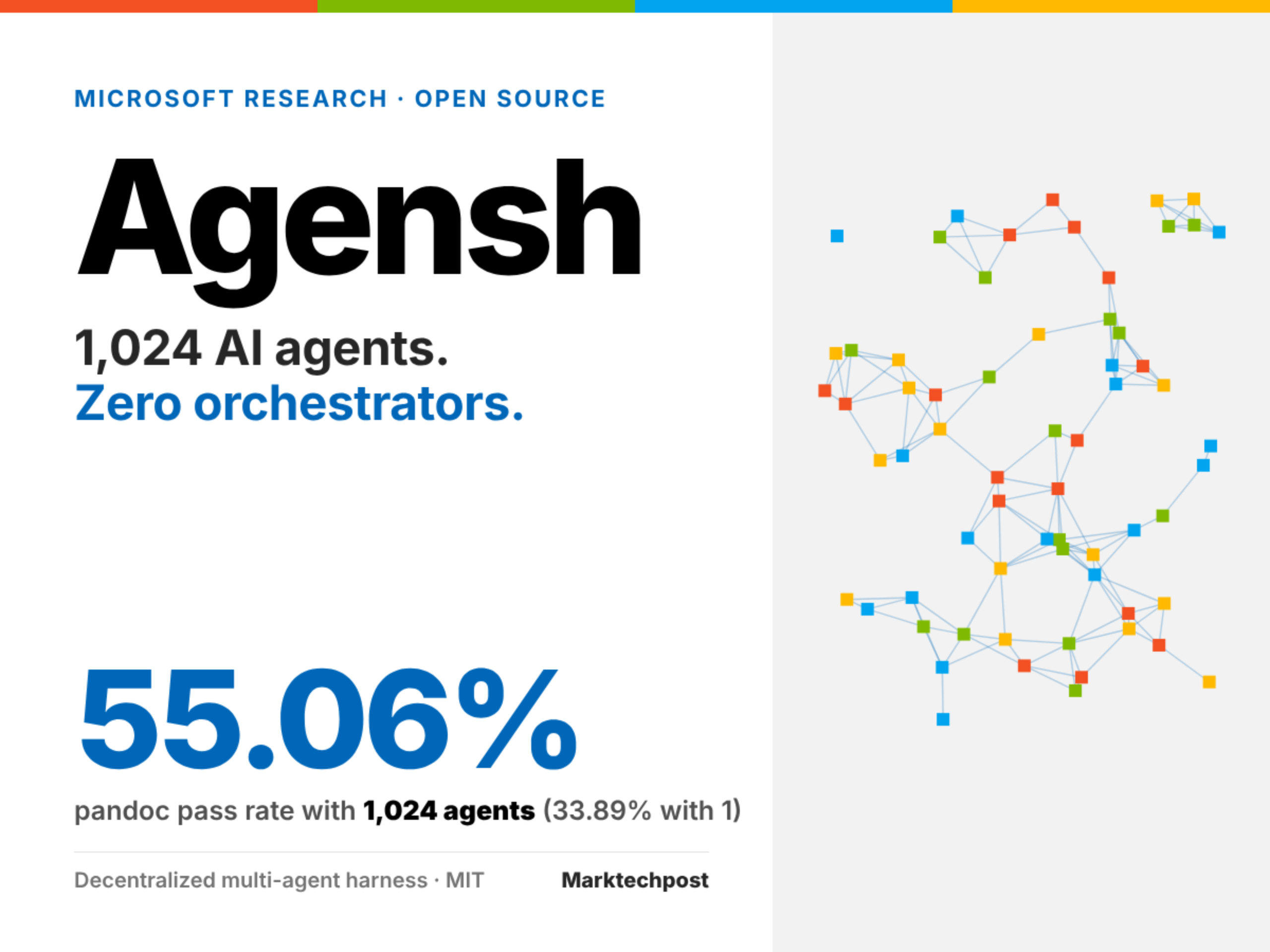
Microsoft open-sources Agensh: a decentralized framework that supports 1024 autonomous, collaboratively operating AI coding agents.

On October 25, 2026, Microsoft Research open-sourced Agensh, a multi-agent runtime framework that operates without a central coordinator, enabling 1 to 1,024 LLM-powered coding agents to self-organize and collaborate on ProgramBench. The system achieves decentralized coordination through shared dashboards inspired by Gitea, Mattermost, and DeLM, with all agents following the same prompt-driven five-step loop; its scalability has been validated in a Linux + Docker environment.

Microsoft Open-Sources Agensh: A Multi-Agent Harness for 1,024 Agents

Why it matters:This achievement represents a significant evolution in multi-agent system architectures—abandoning the traditional “master‑agent” paradigm and enabling large‑scale self‑organization through prompt engineering and lightweight service composition. Empirical results on ProgramBench (e.g., 128 agents achieving a 49% improvement in task load balancing across five tasks) establish a new benchmark for distributed AI engineering. Released under the MIT License and compatible with mainstream single‑agent tools such as Copilot CLI, it offers valuable guidance for practical development.

Timeline and related coverage

Taking on NVIDIA head-on to challenge Apple—Microsoft’s high-end AI PC gamble

Microsoft is courting local AI developers and high-end creators with the Surface Laptop Ultra, which features NVIDIA RTX Spark. The hardware brings large-capacity unified memory, CUDA, and RTX graphics capabilities to a portable device, but whether it can sustain competition against Macs will still depend on app optimization, agent-based experiences, and real-world workflows.

Why it matters:Ultimately, this competition comes down to whether on-device AI can genuinely boost creativity and development efficiency, and whether the associated costs—hardware, software, and migration—are justified. Hardware opens up new possibilities, but the ecosystem and real-world user experience determine how many users those possibilities can reach.

Timeline and related coverage

Sebastian Raschka has released an eight-video course titled “Building a Reasoning Model from Scratch.”

On October 24, 2026, Sebastian Raschka published an eight-part, over-11-hour hands-on video course on Python and PyTorch in Ahead of AI magazine (magazine.sebastianraschka.com), systematically covering the evaluation of inference models, scaling during inference, reinforcement learning (RLVR), and knowledge distillation, with all methods implemented using the pre-trained Qwen3-0.6B model.

Why it matters:This course is the author’s advanced technical educational offering, following “Building Large Language Models from Scratch.” It focuses on the core evolutionary direction of today’s mainstream LLMs—enhancing inference capabilities—covering the entire technical pipeline from setting up the foundational environment to GRPO reinforcement learning and self‑distillation. The author explicitly states that all implementations are “hand‑crafted from scratch,” fully reproducible, and highly instructive with significant engineering reference value.

Timeline and related coverage

谷歌I/O 2026发布Gemini for Science、WeatherNext与Antigravity 2.0等AI科研与健康工具

谷歌研究团队在I/O 2026大会上集中发布面向科学发现、气候预测、医疗健康与边缘计算的系列AI系统,包括多模态科研助手Gemini for Science、支持飓风预警的WeatherNext、可自主构建操作系统的Agentic平台Antigravity 2.0,以及开源量子芯片Willow等;所有成果均为实验性演示,尚无独立验证或监管批准。

Why it matters:人工审核

Timeline and related coverage