
Skip to content
AI NEWS JOURNAL
AI, IN PERSPECTIVE

Search AI news

Search headlines, summaries and articles to connect the dots.

Newest first

NVIDIA has released the open-source small language model Nemotron 3.5 Bolt E4B 4GB, optimized for on-device voice assistants, game NPCs, and robots.

NVIDIA, leveraging Google’s Gemma 4 E4B model and employing only reinforcement learning (RL) for post-training, has launched Nemotron 3.5 Bolt E4B 4GB—a small open-source language model with 8B total parameters, 4B effective parameters, and a 64K context window. It is designed to run on edge devices such as RTX and Jetson with approximately 4GB of VRAM, supporting multi-turn tool calls and low-latency voice interaction.
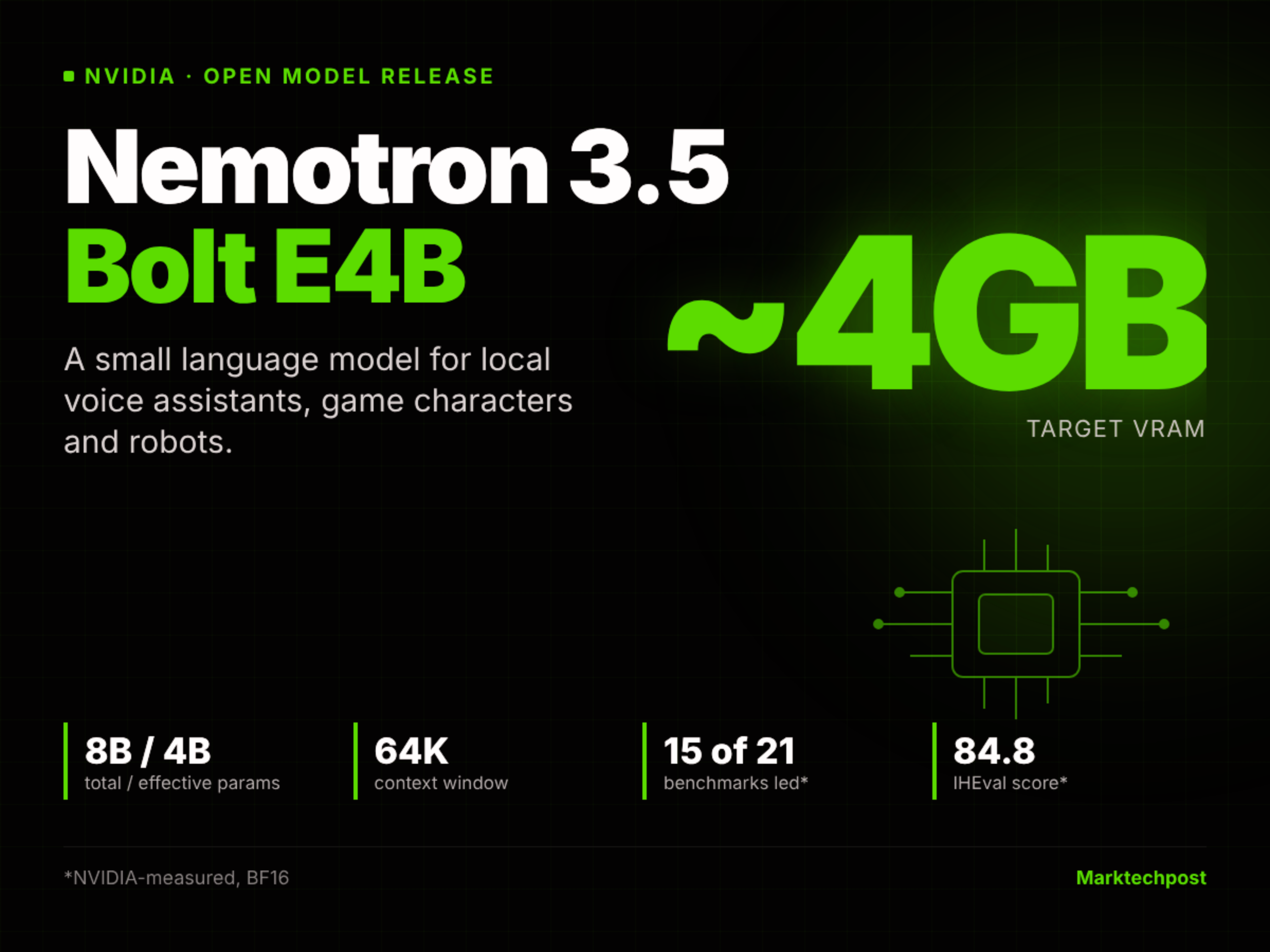
NVIDIA Releases Nemotron 3.5 Bolt E4B 4GB: An Open Small Language Model for Local Voice Agents, Game Characters and Robots
Timeline and related coverage

GTC Berlin 2026: Jensen Huang’s keynote comprehensively unveils the AI factory, security agents, and Europe’s AI ecosystem strategy.

At the GTC Berlin 2026 conference held at Berlin’s Tempodrom, NVIDIA CEO Jensen Huang unveiled several key advancements: the DSX POD modular AI factory, the Vera Rubin full-stack AI agent platform, the OpenShell security architecture, the Agent Knowledge Foundation knowledge layer, and the Agile ONE SN humanoid robot reference platform. He also announced a European AI investment commitment exceeding €10 billion, spanning more than 12,000 partners, while emphasizing that Europe is accelerating the development of an independent, controllable AI economic infrastructure.

Timeline and related coverage

Microduck open-source bipedal robot supports both simulation training and real-world deployment: NVIDIA Isaac Lab 3.0 enables a Sim-to-Real closed loop.

Pollen Robotics and Hugging Face have jointly unveiled Microduck, a low-cost, open-source bipedal robot, integrating NVIDIA Isaac Lab 3.0 and the Newton physics engine. It supports training walking policies in GPU-accelerated parallel simulations, with domain randomization and high-fidelity actuator modeling—including backlash, latency, and friction—enhancing robustness during simulation-to-real transfer. The resulting ONNX model can be directly deployed on the physical robot.

Timeline and related coverage