Skip to content
AI NEWS JOURNAL
AI, IN PERSPECTIVE

Search AI news

Search headlines, summaries and articles to connect the dots.

Newest first

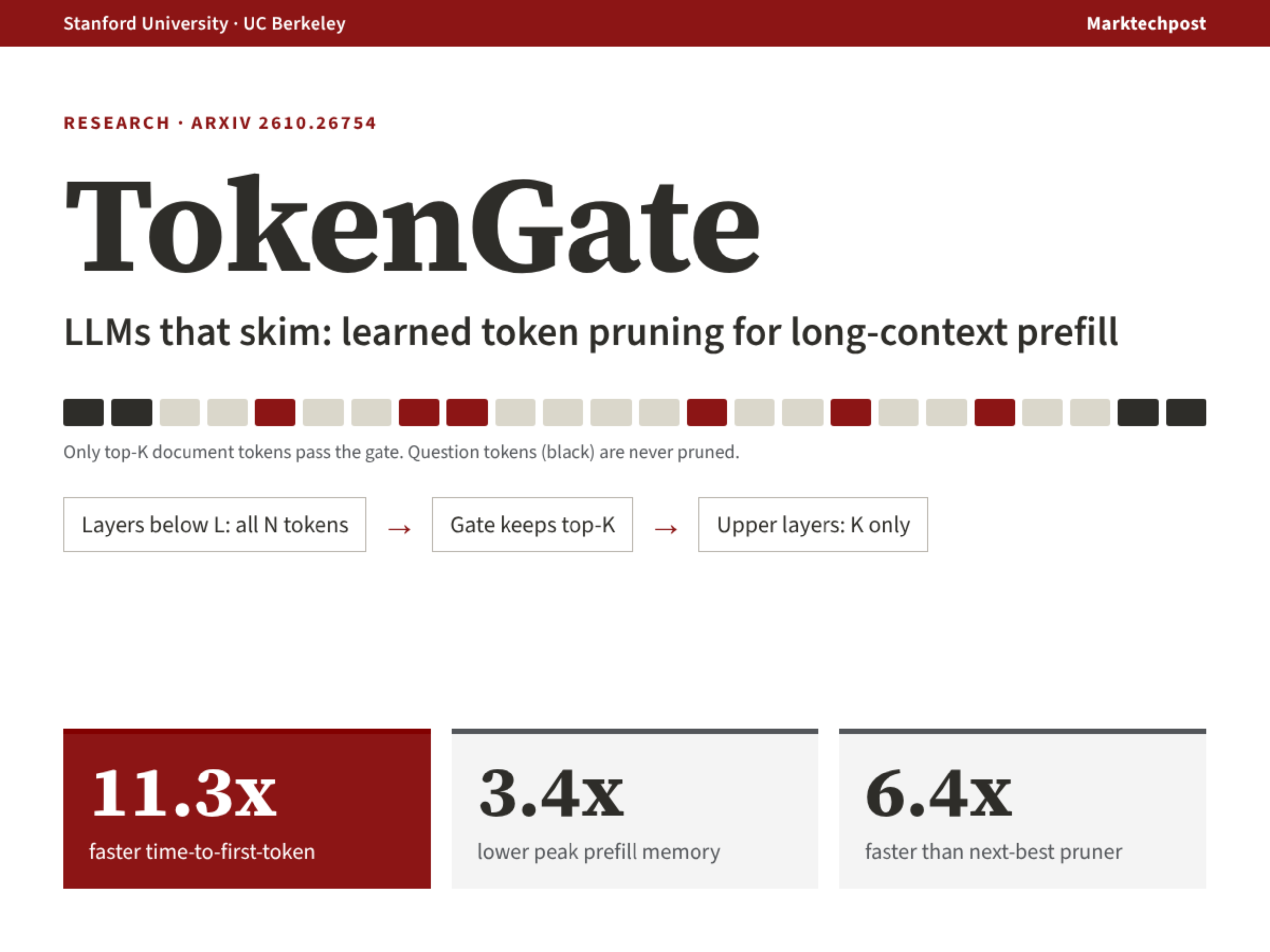
Researchers from Stanford and UC Berkeley Introduce TokenGate: Token-Gated Attention Makes Long-Context Prefill Up to 11.3x Faster

Researchers from Stanford University and the University of California, Berkeley have introduced TokenGate—a plug-and-play, learnable token-pruning module designed for existing large language models (LLMs). This approach accelerates the first-token generation time (TTFT) for long-context prefill by 1.4 to 11.3 times without sacrificing accuracy, while reducing peak memory usage by 1.5 to 3.4 times. The associated code and checkpoints have been made open source.

Researchers from Stanford and UC Berkeley Introduce TokenGate: Token-Gated Attention Makes Long-Context Prefill Up to 11.3x Faster
Timeline and related coverage

Sebastian Raschka has released an eight-video course titled “Building a Reasoning Model from Scratch.”

On October 24, 2026, Sebastian Raschka published an eight-part, over-11-hour hands-on video course on Python and PyTorch in Ahead of AI magazine (magazine.sebastianraschka.com), systematically covering the evaluation of inference models, scaling during inference, reinforcement learning (RLVR), and knowledge distillation, with all methods implemented using the pre-trained Qwen3-0.6B model.

Why it matters:This course is the author’s advanced technical educational offering, following “Building Large Language Models from Scratch.” It focuses on the core evolutionary direction of today’s mainstream LLMs—enhancing inference capabilities—covering the entire technical pipeline from setting up the foundational environment to GRPO reinforcement learning and self‑distillation. The author explicitly states that all implementations are “hand‑crafted from scratch,” fully reproducible, and highly instructive with significant engineering reference value.

Timeline and related coverage

ULME Framework Achieves True Unification of Text Embedding and Language Modeling: A New Paper on arXiv Proposes a Predictive Coupling Mechanism

On October 24, 2026, arXiv published the paper arXiv:2610.30705v1, introducing ULME—a post-training framework for causal-decoder–based large language models that, through a predictive coupling mechanism, achieves, for the first time, a mutually reinforcing unification of text embedding and language-generation capabilities. This approach was validated on the Qwen2.5/Qwen3 series (with 0.5B–8B parameters), yielding MTEB improvements of 3.3–4.1 points while maintaining performance on generation tasks such as MMLU.

ULME: Predictive Coupling for Mutually Reinforcing Embedding and Language Modeling

Why it matters:This paper directly addresses the core issue of fragmented multimodal LLM capabilities: embeddings and generation have long been handled either by separate models or by “pseudo-unified” models that rely solely on parameter sharing. ULME achieves a substantial architectural breakthrough by employing learnable slots and joint training with three objectives—including a stop-gradient prediction loss—enabling the generation process to actively shape the embedding representations. The study features broad experimental coverage, strong baselines, comprehensive metrics, and was published on a reputable preprint platform, balancing timeliness with technical rigor.

Timeline and related coverage

The study proposes a self-assessment reinforcement learning framework, SARL, which enhances the search state-awareness capability of retrieval-augmented large models.

On October 24, 2026, arXiv published the paper arXiv:2610.30435v1, introducing the Self-Assessment Reinforcement Learning (SARL) framework, which aims to address the issue in existing retrieval-augmented large language models where search agents lack the ability to perceive search states.

Self-Assessment Reinforcement Learning for Search-State Awareness in Retrieval-Augmented Large Language Models

Why it matters:This study addresses a critical limitation of retrieval-augmented large language models—namely, their tendency to generate hallucinatory reasoning and prematurely terminate searches when they fail to recognize previously acquired or missing information in complex tasks. It proposes an end-to-end reinforcement learning approach that requires no additional evaluation during testing, achieving significant performance improvements on multi-hop reasoning and deep-research benchmarks.

Timeline and related coverage

New research casts doubt on the effectiveness of context-enhanced methods in reasoning: any gains in accuracy may be due to random fluctuations.

An AI research paper published on October 24, 2026, on arXiv (ID 2610.30983v1) systematically evaluated five context‑enhanced reasoning methods and found that the reported accuracy improvements may not reflect genuine gains in capability but could instead stem from undirected perturbations—correcting some predictions while simultaneously undermining others.

A Reality Check of Inference-Time Context Augmentation Methods

Why it matters:This paper for the first time establishes a unified evaluation framework that spans methods, models, and datasets, pointing out that relying solely on performance gains can easily obscure reliability shortcomings. In particular, it warns that filler-token–based approaches (which do not introduce new information) primarily perturb predictions near the decision boundary and should therefore not be deployed directly in real-world applications.

Timeline and related coverage

Research finds that word length can directly indicate the identity of Mandarin homophones: a new arXiv paper reveals the cognitive link between word frequency and pronunciation duration.

On October 24, 2026, arXiv published a new paper titled “Direct Prompting of Word Length for Lexical Identity: Evidence from Mandarin Chinese Homophones” (arXiv:2610.30682v1), reporting experiments that show that, in the absence of other phonetic cues or under high-noise conditions, native Mandarin speakers can infer word frequency based on differences in the pronunciation duration of disyllabic homophones—shorter pronunciations tend to be identified as high-frequency words. This suggests that word length may be encoded as a phonetic detail in the mental lexicon and contribute to spoken-word recognition.

Direct cueing of word identity through word duration: evidence from Mandarin homophones

Why it matters:This study takes the rich inventory of disyllabic homophones in Chinese as its starting point, employs a homophone ranking task while controlling for word frequency, and tests the functional role of word length under stringent auditory conditions. The findings provide new evidence for a cross-linguistic phonological implementation mechanism underlying the “word-frequency effect” and challenge the traditional view that word length is merely a paralinguistic phenomenon, bearing dual implications for psycholinguistics and speech-perception theory.

Timeline and related coverage

AQL-Lite Released: An Efficient Continuous Pre-training Framework for Modern Standard Arabic

On October 24, 2026, arXiv published paper 2610.30344v1, introducing the AQL-Lite framework, which significantly enhances the adaptability of multilingual large models to Modern Standard Arabic (MSA) through quality-first data filtering and continuous pre-training of selected parameters (CPT).

AQL-Lite: Enabling Efficient Knowledge Acquisition for Arabic LLMs via Data-Centric Continual Pretraining

Why it matters:This study directly addresses key challenges in training large Arabic-language models—namely, the abundance of noisy data, dialectal diversity, and the high costs associated with continuous pre-training—by proposing a reproducible, lightweight, and cost-effective technical approach, which has been validated on multiple authoritative Arabic-language benchmarks. All conclusions are based on the experimental setup and results explicitly reported in the paper, without any external extrapolation.

Timeline and related coverage

New research reveals that AI content moderation systems exhibit linguistic and cultural biases: the misclassification rate for African American English is as high as twice that of standard English.

An arXiv paper published on October 24, 2026 (ID 2610.31047v1) points out that current automated safety systems rely on lexical‑level features to assess harm, leading to systemic biases: African American English (AAE) is flagged as “offensive” up to twice as often as other English varieties; well‑known drag queen accounts are rated as more toxic than white supremacist accounts; and safety practices that work in English completely fail in low‑resource languages.

Harm Is Behavioural, Moderation Is Lexical: How Language and Culture Decide Whom Automated Safety Systems Protect and Whom They Silence

Why it matters:This study, based on an empirical evaluation protocol, covers five open-source systems and 11 languages, encompassing a total of 55 system–language combinations. It finds that 93% of these combinations fail to achieve native-speaker-level performance in hazard function recognition; moreover, improvements in model capabilities have inadvertently widened the protection gap across languages, highlighting a crisis in algorithmic fairness. The source is the arXiv preprint server, with a clearly stated publication date (2026-10-24), and the content focuses on verifiable technical flaws and cross-language empirical findings.

Timeline and related coverage