
Skip to content
AI NEWS JOURNAL
AI, IN PERSPECTIVE

Search AI news

Search headlines, summaries and articles to connect the dots.

Newest first

The study proposes a knowledge graph quality assessment framework for the era of large language models.

A paper published on October 26, 2026, on arXiv (ID 2610.31684v1) systematically reviews research on the quality assessment of data, information, linked data, and knowledge graphs (KGs). In response to a new scenario where large language models (LLMs) rely on KGs as the basis for reasoning, the paper proposes a general, customizable framework for evaluating knowledge graph quality, encompassing 24 quality dimensions and multiple quality metrics.

Knowledge Graphs Quality Assessment in the Era of LLMs: A Conceptual Framework

Why it matters:This paper directly addresses the critical issue of knowledge trustworthiness in the context of the deep integration of large language models (LLMs) and knowledge graphs (KGs). For the first time, it integrates quality-assessment theories from multiple domains to construct a comprehensive evaluation framework tailored to real-world applications. Its publication date—2026-10-26—matches the current date, making it one of the most recent academic advances, and it was posted on the authoritative preprint platform arXiv, ensuring clear provenance and adherence to academic standards.
Timeline and related coverage

Research reveals that activation interventions struggle to achieve conditional reuse in tool usage models.

The paper was posted on arXiv on October 26, 2026 (ID 2610.31686), and, based on the Qwen3.5-27B model, it systematically examined the impact of activation interventions on “conditional reuse” capabilities in tool-use tasks that depend on temporal or permission-based eligibility assessments. The experiments showed that while the intervention significantly improved the accuracy of target selection, it failed to generalize in scenarios involving fact‑based and identifier‑recombination tasks, and it did not enhance independent judgments of candidate eligibility.

From Target Selection to Condition Reuse: Auditing Residual Interventions in Tool-Use Models

Why it matters:This study is the first to clearly distinguish among three types of capabilities—“goal-selection control,” “condition-sensitive judgment,” and “complete-action correctness”—and demonstrates that merely optimizing output answers is insufficient to ensure that a model truly understands and reuses the conditions set by an intervention (such as time or permissions), thereby offering methodological implications for trustworthy tool invocation and the design of controllable AI systems.

Timeline and related coverage

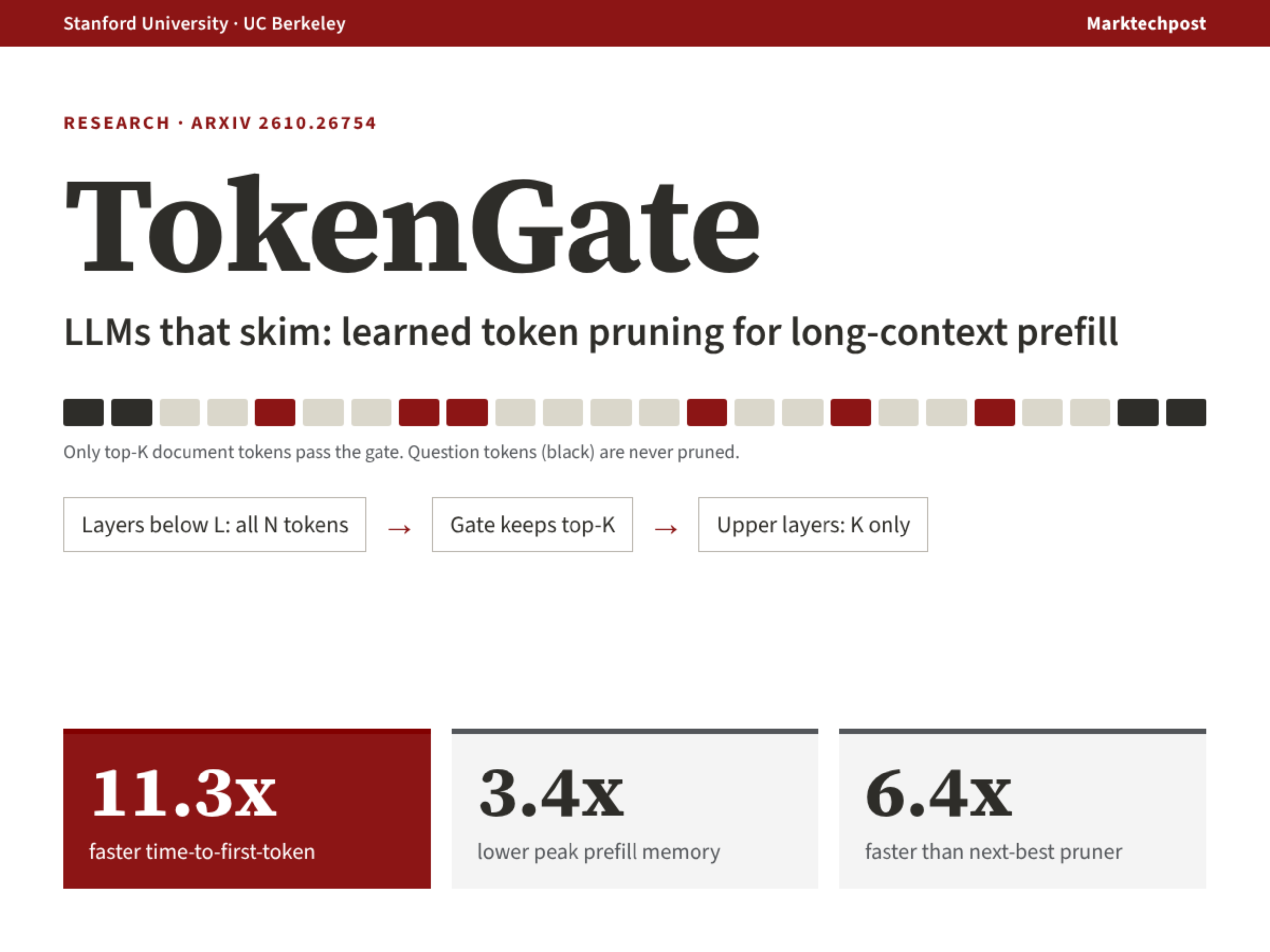
Researchers from Stanford and UC Berkeley Introduce TokenGate: Token-Gated Attention Makes Long-Context Prefill Up to 11.3x Faster

Researchers from Stanford University and the University of California, Berkeley have introduced TokenGate—a plug-and-play, learnable token-pruning module designed for existing large language models (LLMs). This approach accelerates the first-token generation time (TTFT) for long-context prefill by 1.4 to 11.3 times without sacrificing accuracy, while reducing peak memory usage by 1.5 to 3.4 times. The associated code and checkpoints have been made open source.

Researchers from Stanford and UC Berkeley Introduce TokenGate: Token-Gated Attention Makes Long-Context Prefill Up to 11.3x Faster
Timeline and related coverage

Sebastian Raschka has released an eight-video course titled “Building a Reasoning Model from Scratch.”

On October 24, 2026, Sebastian Raschka published an eight-part, over-11-hour hands-on video course on Python and PyTorch in Ahead of AI magazine (magazine.sebastianraschka.com), systematically covering the evaluation of inference models, scaling during inference, reinforcement learning (RLVR), and knowledge distillation, with all methods implemented using the pre-trained Qwen3-0.6B model.

Why it matters:This course is the author’s advanced technical educational offering, following “Building Large Language Models from Scratch.” It focuses on the core evolutionary direction of today’s mainstream LLMs—enhancing inference capabilities—covering the entire technical pipeline from setting up the foundational environment to GRPO reinforcement learning and self‑distillation. The author explicitly states that all implementations are “hand‑crafted from scratch,” fully reproducible, and highly instructive with significant engineering reference value.

Timeline and related coverage

ULME Framework Achieves True Unification of Text Embedding and Language Modeling: A New Paper on arXiv Proposes a Predictive Coupling Mechanism

On October 24, 2026, arXiv published the paper arXiv:2610.30705v1, introducing ULME—a post-training framework for causal-decoder–based large language models that, through a predictive coupling mechanism, achieves, for the first time, a mutually reinforcing unification of text embedding and language-generation capabilities. This approach was validated on the Qwen2.5/Qwen3 series (with 0.5B–8B parameters), yielding MTEB improvements of 3.3–4.1 points while maintaining performance on generation tasks such as MMLU.

ULME: Predictive Coupling for Mutually Reinforcing Embedding and Language Modeling

Why it matters:This paper directly addresses the core issue of fragmented multimodal LLM capabilities: embeddings and generation have long been handled either by separate models or by “pseudo-unified” models that rely solely on parameter sharing. ULME achieves a substantial architectural breakthrough by employing learnable slots and joint training with three objectives—including a stop-gradient prediction loss—enabling the generation process to actively shape the embedding representations. The study features broad experimental coverage, strong baselines, comprehensive metrics, and was published on a reputable preprint platform, balancing timeliness with technical rigor.

Timeline and related coverage

baseVultra: A novel compact nonlinear recurrent unit for focused candidate generation, outperforming LSTM and GRU in small-scale scenarios.

On October 24, 2026, arXiv published the paper arXiv:2610.30154v1, introducing a novel recurrent neural network unit called baseVultra. This model centralizes dense recurrent computations into a single H×H candidate generation matrix and replaces traditional gating matrices with O(H)-complexity diagonal interactions. Its effectiveness was validated in compact settings such as TinyShakespeare: under a 200K-parameter single-layer configuration, it achieved a validation loss of 1.594, outperforming LSTM (1.604) and GRU (1.616) with the same number of parameters, while its dense computation overhead is only about 54% of that of GRU.

baseVultra: Compact Nonlinear Recurrence with Reallocated Capacity

Why it matters:This study represents a new direction in the design of recurrent neural network architectures—shifting from a gate‑driven approach to a candidate‑generation‑driven one. Experiments span character‑level language modeling (TinyShakespeare, text8) and formal language probes (the Counter task), with results clearly demonstrating that its advantages are most pronounced in compact settings where hidden‑state capacity is limited (e.g., H=16), providing a well‑defined technical positioning supported by empirical evidence.

Timeline and related coverage

The study proposes a self-assessment reinforcement learning framework, SARL, which enhances the search state-awareness capability of retrieval-augmented large models.

On October 24, 2026, arXiv published the paper arXiv:2610.30435v1, introducing the Self-Assessment Reinforcement Learning (SARL) framework, which aims to address the issue in existing retrieval-augmented large language models where search agents lack the ability to perceive search states.

Self-Assessment Reinforcement Learning for Search-State Awareness in Retrieval-Augmented Large Language Models

Why it matters:This study addresses a critical limitation of retrieval-augmented large language models—namely, their tendency to generate hallucinatory reasoning and prematurely terminate searches when they fail to recognize previously acquired or missing information in complex tasks. It proposes an end-to-end reinforcement learning approach that requires no additional evaluation during testing, achieving significant performance improvements on multi-hop reasoning and deep-research benchmarks.

Timeline and related coverage

Research reveals systematic differences in evidence-location sensitivity among models with varying long-context lengths.

An empirical study published on October 24, 2026, on arXiv (paper ID 2610.31135v1) compared the positional bias of Transformer, state-space, and hybrid Mamba architectures in long-context question-answering tasks. It found that Transformer models generally exhibit an advantage in leveraging evidence from the initial positions, whereas state-space models lack this characteristic; however, both types of models tend to favor evidence from the end positions.

Mixing Matters: Evidence Position Bias Across Sequence Mixers in Long-Context Question Answering

Why it matters:This study, based on a controlled experimental design (with nine perturbed documents fixed and a single golden document slid), for the first time conducts a cross‑comparison of the positional sensitivity of three mainstream sequence‑modeling architectures within a unified evaluation framework. It reveals the strong coupling between model capabilities and architecture type, prompt engineering, and task characteristics, offering direct guidance for the design and tuning of long‑context AI systems.

Timeline and related coverage

RIFT proposes a dynamic KV cache compression strategy to mitigate the issue of decoding staleness and improve speculative decoding quality.

On October 24, 2026, arXiv published the paper arXiv:2610.31098v1, introducing RIFT—a dynamic KV cache compression method for drafter models in speculative decoding. By balancing pre-filled information with newly generated tokens and incorporating compressibility training, RIFT enables the Qwen3.5-4B drafter model to maintain over 98% of its full cached receptive length when performing long-context generation at the scale of Qwen3.5-122B, all within an 8K-token KV cache budget.

RIFT: KV Cache Compression for Draft Models with Complementary Compressibility Training

Why it matters:This study directly addresses the trade-off between hardware costs and accuracy degradation caused by KV cache bloat in long‑sequence generation. It is the first to formally define and quantify the phenomenon of “decode staleness,” and proposes a practical refresh mechanism along with a training–inference co‑optimization scheme. The experimental setup is well specified (32K input / 4K output / 8K cache), and the results offer valuable engineering insights. The paper is an arXiv preprint, with a publication date (2026-10-24) that matches the system’s current date (2026-10-25), ensuring strong timeliness.

Timeline and related coverage

IndoNutriQA, the Indonesian clinical nutrition Q&A benchmark, has been officially released.

On October 24, 2026, the research team published a paper on arXiv (ID 2610.31256v1), introducing IndoNutriQA, the first expert-annotated question-answering benchmark for the Indonesian-language clinical nutrition domain. It comprises 911 question–answer pairs derived from real clinical reports, focusing on evaluation rather than training, and supports generative, extractive, and retrieval-augmented question-answering tasks.

IndoNutriQA: An Indonesian Clinical Nutrition Question Answering Benchmark

Why it matters:This benchmark fills the gap in high-quality publicly available evaluation data for low-resource languages—particularly Indonesian—in the clinical nutrition NLP domain. It features comprehensive structured metadata, question types that strictly adhere to the Nutrition Care Process (NCP), and has undergone expert validation and multi‑model benchmarking, ensuring a clear research focus and rigorous methodology.

Timeline and related coverage

New research casts doubt on the effectiveness of context-enhanced methods in reasoning: any gains in accuracy may be due to random fluctuations.

An AI research paper published on October 24, 2026, on arXiv (ID 2610.30983v1) systematically evaluated five context‑enhanced reasoning methods and found that the reported accuracy improvements may not reflect genuine gains in capability but could instead stem from undirected perturbations—correcting some predictions while simultaneously undermining others.

A Reality Check of Inference-Time Context Augmentation Methods

Why it matters:This paper for the first time establishes a unified evaluation framework that spans methods, models, and datasets, pointing out that relying solely on performance gains can easily obscure reliability shortcomings. In particular, it warns that filler-token–based approaches (which do not introduce new information) primarily perturb predictions near the decision boundary and should therefore not be deployed directly in real-world applications.

Timeline and related coverage

A comparative study of the conceptual structures of 81 languages reveals an intertwined pattern of linguistic relativity and universality.

A study published on October 24, 2026, on the arXiv platform (ID 2610.30778v1) used two multilingual word‑embedding models to analyze the semantic relationships among 196 basic concepts across 81 languages. The findings revealed that cross‑linguistic correspondences for socio‑cultural concepts are significantly stronger than those for natural and motion‑related concepts, and this difference was consistently replicated across different models and classification methods. Within the socio‑cultural domain, the greater the geographic distance and the weaker the linguistic affinity, the larger the divergence in conceptual relationships.

Where meanings converge and diverge: Revisiting linguistic relativity across 81 languages

Why it matters:This study, grounded in large-scale cross-linguistic computational semantic analysis, provides new empirical evidence for linguistic relativity (the Sapir–Whorf hypothesis): it neither supports strong determinism nor outright universalism, but rather reveals their dynamic coexistence across different semantic domains. The findings exhibit model robustness and cross-classification consistency, and are explicitly confined to the linguistic structures encoded by the word‑embedding models employed, without extrapolation to cognitive processes or neural mechanisms.

Timeline and related coverage

Release of a new benchmark for Nepali–English mixed-language speech recognition and a two-stage adaptation framework from synthesis to real-world conditions

On October 24, 2026, researchers published a paper on arXiv (ID 2610.30860v1), introducing the first Nepali–English code-switching ASR benchmark for spontaneous podcast scenarios, comprising 13,044 real-world utterances (15.45 hours), and proposing a two-stage adaptation approach that combines synthetic and real data: first, fine-tuning with synthetic speech generated by a 0.95-hour multi-speaker TTS model as supervision; then, incorporating group relative policy optimization (GRPO) with script-based rewards.

Synthetic-to-Real Code-Switched ASR: A Spontaneous Nepali-English Podcast Benchmark

Why it matters:This work directly addresses the core challenges of script obfuscation and high error rates at switching points in code-switching ASR for low-resource languages, by rigorously auditing data to prevent machine translation leaks and acoustic loops, and by making all validation texts, timestamps, episode metadata, and reconstruction scripts publicly available. The experimental results are statistically significant (p ≤ 0.001) and demonstrate generalization stability on monolingual benchmarks.

Timeline and related coverage

Researchers have reengineered a neural machine translation system for Sicilian, improving the quality of translations for low-resource languages.

A technical paper published on October 24, 2026, on arXiv (ID 2610.30374v1) reports the reconstruction of a small-scale neural machine translation (NMT) system for Sicilian: it leverages high-quality parallel corpora extracted from PDFs of the bilingual journal “Arba Sicula,” improves sentence alignment, tokenization, and subword segmentation that is sensitive to word stems, and migrates the original Perl‑dependent pipeline to a Perl‑free implementation. Experimental comparisons between a small Transformer trained from scratch and a fine-tuned pre-trained NLLB model demonstrate that the latter performs significantly better, particularly when translating into Sicilian.

Climbing the Ladder: Automating Data Pipelines and Reproducing Baselines in Low-Resource Settings

Why it matters:This paper presents a reproducible, engineered NMT pipeline for the endangered/low-resource language Sicilian, covering key stages such as corpus construction, model adaptation, and optimization of training strategies. All evaluations are conducted on the frozen “Arba Sicula” test set, with transparent methods and clearly defined limitations, making it a valuable technical reference.

Timeline and related coverage

New research reveals that open-book assessments primarily measure reading behavior rather than knowledge retention.

An arXiv paper published on October 24, 2026 (2610.31017v1) points out that, in document-level LoRA adapter evaluations, open-book scoring relies heavily on the model’s ability to read on the fly, rather than on whether the adapter has truly encoded knowledge specific to the document; random adapters can reproduce 82% of the performance advantage of expert adapters on open-book tasks, but on cloze tasks involving unstructured text, they only replicate 2%—statistically indistinguishable from zero.

Mostly Reading: What Open-Book Scores Measure in Document-Level LoRA Adapters

Why it matters:This study, through systematic controlled experiments—comprising 150 Wikipedia articles, the Llama-3.1-8B-Instruct model, and a two-task comparison—reveals the fundamental limitations of the current open-book evaluation paradigm: it fails to effectively distinguish between “reading” and “remembering,” posing methodological challenges to the practical utility of knowledge-editing and retrieval‑oriented adapters. The paper also reports four silent errors that lead to “clean yet incorrect results,” highlighting risks to reproducibility.

Timeline and related coverage

The study proposes to control the compilation of autoregressive large models into strategy-precise parallel inference, thereby enhancing the efficiency of hierarchical RAG.

A research paper published on October 24, 2026, on arXiv (ID 2610.30664v1) proposes a new method that compiles the autoregressive control logic of large language models in Hierarchical RAG into a policy-exact parallel inference pipeline, achieving a 35–47% reduction in control latency on MetaX devices while maintaining 84–89% policy consistency.

Compiling Autoregressive LLM Control into Policy-Exact Parallel Inference for Hierarchical RAG

Why it matters:This work addresses the bottleneck inherent in LLMs when used as structured decision‑making controllers—namely, their reliance on sequential text decoding—by proposing a theoretically provable parallelization compilation scheme. Experiments conducted on real hardware (MetaX, H800) and with multiple data partitions demonstrate strong efficiency and clear technical details, positioning this research as cutting‑edge optimization for trustworthy AI systems.

Timeline and related coverage

The study proposes Delta N-grams: a forward-only, continuous-writing method for native N-gram tables in language models.

On October 24, 2026, arXiv published the paper arXiv:2610.31125v1, introducing Delta N-grams—a novel mechanism that does not modify the pre-trained N-gram table T⁰, but instead writes sparse incremental patches Δ via forward propagation, enabling efficient and reversible continual memory updates.

Delta N-gram: Forward-Only Continual Writing into a Language Model's Native N-gram Memory

Why it matters:This work addresses the issue of large perturbations to a model’s base parameters in continual learning by proposing a memory-enhanced pathway that is lightweight in structure (4.1M parameters), computationally efficient (purely forward pass), and fully invertible (resetting Δ restores the original model). Its superior document-specificity and robustness against interference have been validated on models such as Qwen3.8-Flash-Next, making it a cutting-edge contribution to trustworthy AI systems research.

Timeline and related coverage

AQL-Lite Released: An Efficient Continuous Pre-training Framework for Modern Standard Arabic

On October 24, 2026, arXiv published paper 2610.30344v1, introducing the AQL-Lite framework, which significantly enhances the adaptability of multilingual large models to Modern Standard Arabic (MSA) through quality-first data filtering and continuous pre-training of selected parameters (CPT).

AQL-Lite: Enabling Efficient Knowledge Acquisition for Arabic LLMs via Data-Centric Continual Pretraining

Why it matters:This study directly addresses key challenges in training large Arabic-language models—namely, the abundance of noisy data, dialectal diversity, and the high costs associated with continuous pre-training—by proposing a reproducible, lightweight, and cost-effective technical approach, which has been validated on multiple authoritative Arabic-language benchmarks. All conclusions are based on the experimental setup and results explicitly reported in the paper, without any external extrapolation.

Timeline and related coverage

Natural language autoencoders can effectively verbalize activation differences in large models, supporting model differentiation and interpretability research.

A paper published on October 24, 2026, on arXiv (arXiv:2610.30934v1) systematically evaluates the generalization capabilities of natural language autoencoders (NLAs) in representing differences across activation spaces, with experiments demonstrating robust performance across four dimensions: compositionality, fine-tuning model adaptation, fine-tuning target recovery, and model-difference specialization.

Verbalizing Activation Differences with Natural Language Autoencoders

Why it matters:This study is based on four reproducible experimental designs, covering four large language models from three families, and provides the most systematic evidence of generalization to date in the emerging interpretability direction of verbalization. All conclusions are strictly confined to the experimental settings and observed results reported in the paper and do not extend to untested model sizes or tasks.

Timeline and related coverage

The study proposes a new evaluation method and model to address annotation disagreements in identifying unstated arguments (enthymemes) within politically contentious discourse.

This paper, based on tweet data related to vaccination and immigration—each tweet independently annotated by five raters—finds that existing fine-tuned models consistently achieve an F1 score of around 0.67 on the enthymeme detection task. To address this, the authors propose abandoning the single-label evaluation paradigm in favor of a new metric that captures the distribution of annotators’ opinions, and they design a model capable of directly predicting this distribution, thereby better capturing human judgmental divergence without compromising the F1 score.

Interpretive Variation and Discourse Structure in Detecting Enthymemes in Controversial Political Discourse

Why it matters:The paper squarely confronts the long-neglected reality in NLP that “annotator disagreement is an essential characteristic”—particularly in politically sensitive contexts, where identifying enthymemes relies heavily on subjective reasoning. Its methodological shift—from point prediction to distributional prediction—and its empirical demonstration of the limitations of discourse‑structural analysis carry clear implications for the design of content‑moderation systems: models trained on majority‑vote criteria may systematically overlook implicit arguments that require deep contextual inference.

Timeline and related coverage