
Skip to content
AI NEWS JOURNAL
AI, IN PERSPECTIVE

Search AI news

Search headlines, summaries and articles to connect the dots.

Newest first

Researchers from Stanford and UC Berkeley Introduce TokenGate: Token-Gated Attention Makes Long-Context Prefill Up to 11.3x Faster

Researchers from Stanford University and the University of California, Berkeley have introduced TokenGate—a plug-and-play, learnable token-pruning module designed for existing large language models (LLMs). This approach accelerates the first-token generation time (TTFT) for long-context prefill by 1.4 to 11.3 times without sacrificing accuracy, while reducing peak memory usage by 1.5 to 3.4 times. The associated code and checkpoints have been made open source.
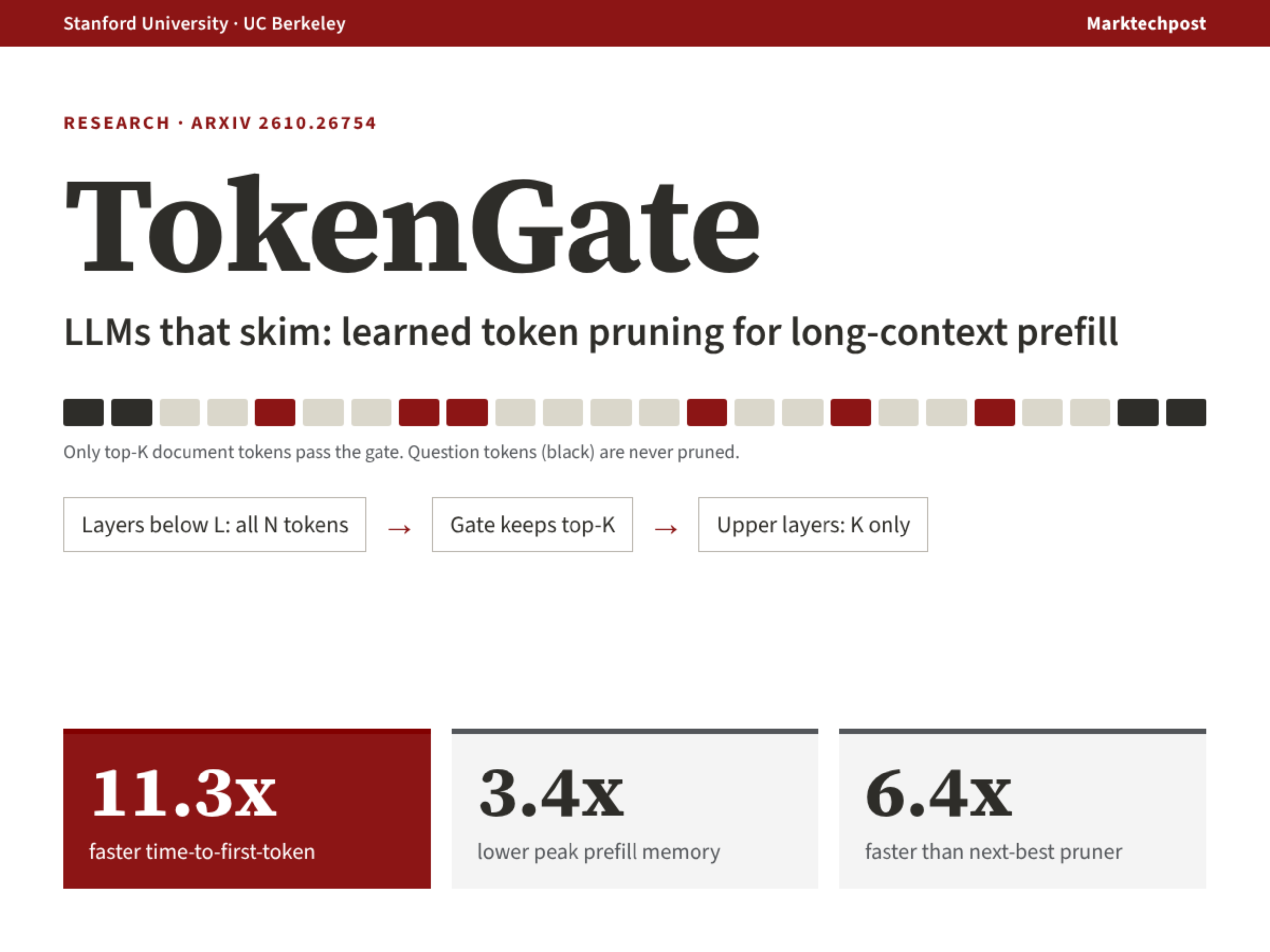
Researchers from Stanford and UC Berkeley Introduce TokenGate: Token-Gated Attention Makes Long-Context Prefill Up to 11.3x Faster
Timeline and related coverage

IskayPet builds a multilingual enterprise knowledge assistant based on the Amazon Bedrock-hosted knowledge base.

Spanish pet-care company IskayPet leveraged Amazon Bedrock Managed Knowledge Bases to build an enterprise-grade knowledge assistant—covering Spain, Portugal, and France, and supporting four languages (Spanish, Portuguese, French, and English)—without needing to develop its own RAG infrastructure. The assistant supports business scenarios such as retail, veterinary care, onboarding, and procurement.

Timeline and related coverage

Flint-interactive: An interactive data visualization programming language for AI agents

Microsoft Research has unveiled Flint-interactive, a domain-specific language for building highly expressive, semantically rich interactive data visualizations. Its compiler automatically maps user interactions—such as clicks and brush selections—to semantic events and uses high-level operators to drive coordinated updates across multiple elements, including charts, tables, and text, significantly reducing the cost and development complexity of creating reliable interactive visualizations with AI agents.

Timeline and related coverage

IBM releases the Granite time-series integration forecasting model: a four-model, zero‑fine‑tuning ensemble that delivers a robust default forecasting solution.

IBM Research has released the open-source Granite Timeseries Ensemble (v1), which integrates four types of pre-trained architectures—PatchTST-FM-r1/r2, FlowState, and Tiny Time Mixers—and supports probabilistic ensemble forecasting with zero fine-tuning. By default, it employs equal-weight probabilistic pooling (Probabilistic Ensemble), while also offering an IQR-based adaptive weighting scheme (IQR Ensemble). On the GIFT-Eval benchmark (as of the October 20, 2026 snapshot), its point forecast error (MASE = 0.683) slightly outperforms that of the best single model, with significantly improved overall robustness.

Timeline and related coverage

Google Cloud and NVIDIA have announced the official commercial availability of the NVIDIA Vera Rubin infrastructure: A5X instances are now live, focusing on large-scale reinforcement learning and agent reasoning.

Google Cloud and NVIDIA have announced that the A5X instances, built on the Vera Rubin architecture, will officially go commercial starting next month, initially available in the United States and later expanding to Europe. The platform integrates NVL72 GPUs, ConnectX-9 SuperNICs, the Virgo network, and fourth-generation liquid cooling technology, and is specifically designed for high-density computing workloads such as large-scale reinforcement learning and generative agent inference.

Timeline and related coverage

NVIDIA releases Kumo Forecast: a multivariate forecasting model that integrates pre-trained time-series representations, historical pattern retrieval, and interpretability.

NVIDIA has launched the open-source time-series forecasting model Kumo Forecast (formerly NV-Tesseract Forecasting), which is built on the MOMENT-1-large Transformer architecture. It supports both direct prediction and dual-path inference via Domain-Aware Representation and Retrieval (DARR), and includes a built-in interpretability framework that requires no modifications to the model structure.

Timeline and related coverage