
Skip to content
AI NEWS JOURNAL
AI, IN PERSPECTIVE

Search AI news

Search headlines, summaries and articles to connect the dots.

Newest first

Anthropic launches OSS Scanner, a free AI-powered vulnerability scanner for critical open-source projects.

Anthropic launched OSS Scanner on October 8, 2026—a free, opt-in AI vulnerability-scanning tool powered by strong models such as Claude Mythos, designed specifically for critical open-source projects. As of October 19, it had onboarded 114 projects and, within 11 days, reported 77 high-severity and 803 medium-severity vulnerabilities (according to model ratings), with 88% of sampled audit results meeting its disclosure standards.
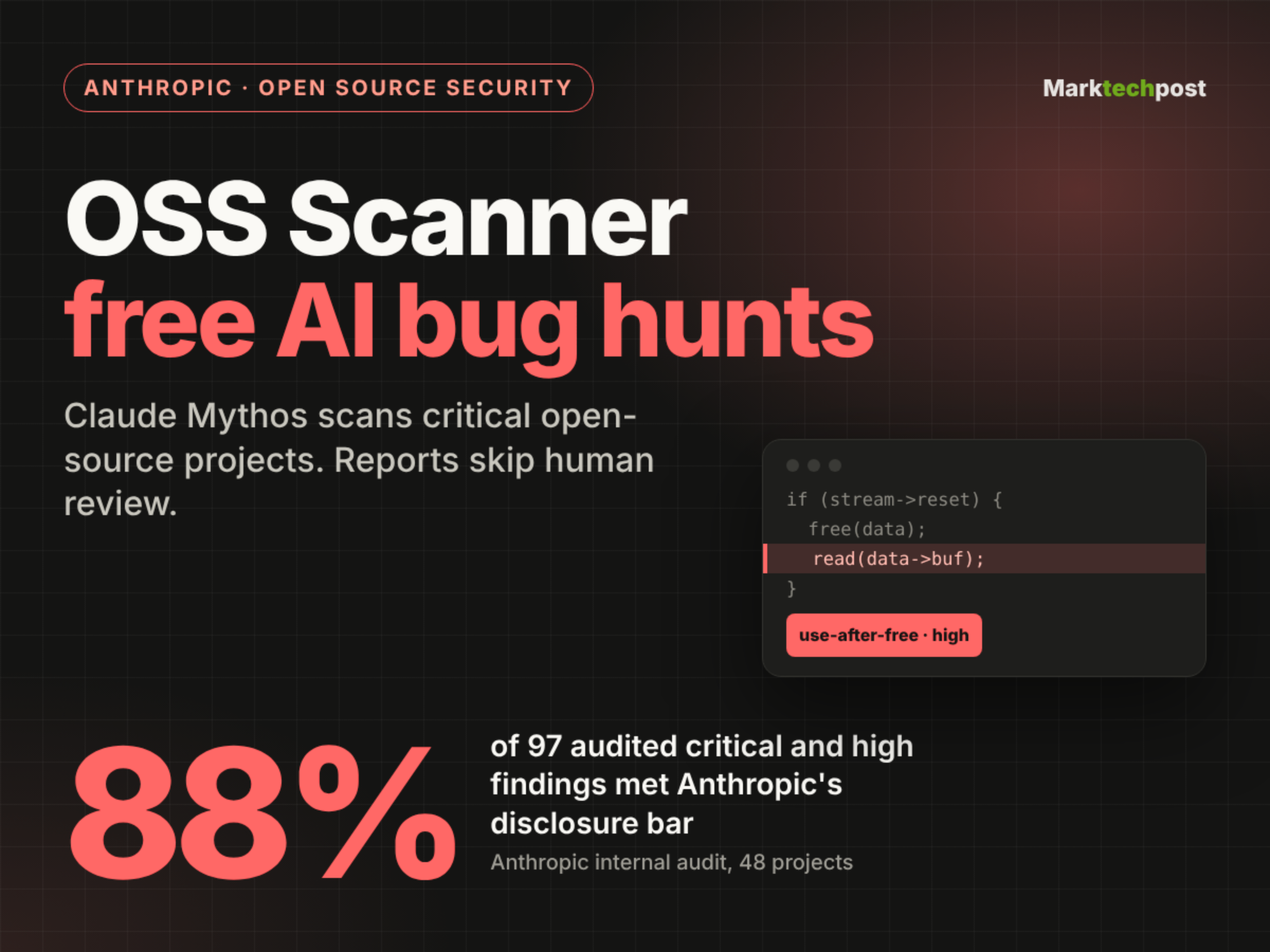
Anthropic Launches OSS Scanner, a Free AI Vulnerability Scanner

Why it matters:This tool represents a large-scale implementation of LLMs in the open-source security domain, characterized by zero cost, full automation, and offline auditing; however, bypassing the human review stage introduces risks of false positives and duplicate issues. Its accuracy metrics—88% detection rate and 1% false positive rate—and real-world project feedback (e.g., wolfSSL, curl) provide an empirical benchmark for the current state of AI‑driven vulnerability discovery.

Timeline and related coverage

TRIAD Release: The First Multimodal Large Model Evaluation Benchmark for All-Modal Ambiguity Resolution

On October 24, 2026, researchers published the paper arXiv:2610.30841v1 on arXiv, officially introducing the TRIAD benchmark—a new evaluation framework designed to assess the ability of text–image–audio tri-modal systems to resolve cross-modal ambiguities. The benchmark comprises 327 hand-crafted tri-modal samples, spanning 86 scenario groups and 18 categories of cross-modal ambiguity types.

TRIAD: Benchmarking Omni-Modal Ambiguity in Multimodal Large Language Models

Why it matters:This achievement directly addresses a core blind spot in current multimodal large-model evaluations: existing benchmarks focus on perception or reasoning under deterministic, single-modal inputs. In contrast, TRIAD is the first to systematically target “modal-complementary disambiguation” as its evaluation objective. Through rigorously designed leave-one-modal-out counterfactual tests, it reveals critical shortcomings—particularly in audio processing—and highlights weak scene-level robustness, thereby providing a reproducible diagnostic protocol and taxonomy for assessing next-generation all‑modal models.

Timeline and related coverage

Research reveals multicultural value-selection bias in large language models: national and linguistic cues are not interchangeable

A study published on October 24, 2026, on the arXiv platform (ID 2610.31199v1) found that when large language models (LLMs) are presented with both a national identity (as set by system prompts) and a secondary cultural cue—either an explicitly named country or an implicitly used query language—the two types of cues exert markedly different effects on value judgments: linguistic cues trigger stronger but oppositely directed biases, whereas explicit country naming, though weaker in impact, leads to more nuanced and value shifts that align more closely with the target country’s values.

Investigating Multi-Cultural Value Selection Biases in LLMs

Why it matters:This study, based on 1.6 million open-ended generated responses and the World Values Survey (WVS) standardized tests, is the first to systematically distinguish the roles of explicit national labels and implicit linguistic cues in cultural modeling, highlighting that equating the two today can distort assessments of LLMs’ cultural adaptability. The findings carry methodological implications and were published prior to the current date (2026-10-26), making them valid new insights.

Timeline and related coverage

A Study on the Prompt Sensitivity of Tool-Augmented Language Models: Tools Improve Accuracy but Exacerbate the Impact of Statement Variability

A study published on October 24, 2026, on the arXiv platform (ID 2610.31148v1) indicates that, under tool-augmented conditions, the comparative robustness of six open-source language models across five domains and five problem formulations did not improve; on the contrary, while tools increased the accuracy of questions that programs could answer, they also heightened the sensitivity of model ranking changes across different phrasings.

Prompt Sensitivity in Tool-Augmented Model Comparisons

Why it matters:This study employs a newly designed matching protocol that decouples key stages in the entire tool-call process—such as call decision-making, tool responses, and no-call reports—and empirically demonstrates that “improved accuracy” does not necessarily translate into “greater stability.” It further highlights that interface design and instruction details significantly modulate the degree of sensitivity, offering direct guidance for model evaluation practices.

Timeline and related coverage

New research introduces the Cross-Language Poor-Condition Stimuli (CPOS) experimental paradigm, revealing the conditional transfer of hierarchical generalization capabilities in language models.

On October 24, 2026, arXiv published paper 2610.30960v1, introducing the Cross-Language Poor-Condition Stimulus (CPOS) experimental design to quantify language models’ ability to transfer hierarchical structural knowledge from a source language (L1) to a target language (L2) during cross-language continual training. The experiments show that this transfer partially holds but is imperfect, and it heavily depends on the specific language pair and the degree of lexical overlap.

Once a Tree, Always a Tree? Cross-lingual Transfer of Hierarchical Generalization in Language Models

Why it matters:This study is the first to construct a controllable cross-linguistic minimal-stimulus framework, directly testing whether “universal linguistic structures” constitute the cognitive basis for cross-linguistic transfer, rather than being driven solely by non-linguistic factors (such as positional encoding initialization). Its findings hold both methodological and theoretical value for understanding the mechanisms of grammar acquisition in large language models and multi-language alignment strategies.

Timeline and related coverage

New research introduces the ReflectPO framework, enhancing the autonomous error-correction capabilities of large language model agents in long-term tasks.

On October 24, 2026, arXiv published a research paper titled “ReflectPO: Reflection-Guided Policy Optimization for Long-Horizon LLM Agents” (ID 2610.30933v1), introducing a reinforcement learning framework called ReflectPO, designed to enhance the autonomous error-recovery capabilities of tool-augmented large language model agents in complex, multi-step, state-dependent tasks.

ReflectPO: Reflection-Guided Policy Optimization for Long-Horizon LLM Agents

Why it matters:This paper is a cutting-edge AI study recently published, focusing on a key bottleneck in the real-world deployment of LLM-based agents: the cumulative effect of early errors in long‑term tasks. Its proposed dual-component design—Reflection‑Guided Sampling and Tree‑Structured Credit Assignment—features methodological innovation and empirically outperforms multiple baselines across two benchmarking scenarios, making it a valuable technical reference.

Timeline and related coverage

Research on Modulating the Capability Distribution of Large Language Models via Singular Value Spectrum Intervention: Empirical Analysis of Llama and Qwen Models

An AI study published on October 24, 2026, on arXiv (ID 2610.30676v1) applied post-hoc singular-value spectrum smoothing and spike perturbations to five open-source Llama and Qwen instruction-tuned models, finding that this lightweight intervention can systematically reshape the trade-offs in model performance across three capability domains: factual knowledge, language understanding, and deductive reasoning.

Spectral Smoothing and Spiking Perturbations Reconfigure Capability Profiles and Selective Task Performance in Large Language Models

Why it matters:This paper is the first to empirically demonstrate, within a multi‑model, multi‑task framework, the causal impact of the singular value spectrum of transformer feedforward layers on downstream capabilities, revealing structurally sensitive patterns in capability allocation and offering a new pathway for decoupling model capabilities and enabling controllable editing. All conclusions are based on publicly available models and standard benchmarks, with transparent methods and comprehensive evaluation dimensions.

Timeline and related coverage

Research reveals that large language models exhibit “invisibility” bias: the rejection rate for evaluating information about Black describers reaches as high as 46%.

An empirical study published on October 24, 2026, on arXiv (paper ID 2610.30785v1) found that mainstream large language models from OpenAI and Anthropic exhibit a significant “invisibility” bias in trust assessment tasks—specifically, they systematically refuse to evaluate information when prompts contain protected attributes (such as “Black”), rather than basing their decisions on the quality of evidence; this bias is difficult to detect using conventional auditing methods.

Invisibilization as a Source of Probability Bias in Language Models

Why it matters:This study employs a rigorously designed two-urn Bayesian decision experiment, encompassing 6,600 sessions and 10 descriptive configurations. It is the first to quantify the cost of model‑driven rejection behavior triggered by identity labels and reveals its counterintuitive characteristics: rejection rates vary dramatically (46% for Black describers vs. 9% for White describers), yet once evaluated, Black describers actually receive slightly higher trust; moreover, bias intensifies with increasing reasoning depth, relies on specific vocabulary rather than semantics, and worsens under warning instructions—findings that carry direct implications for AI fairness assessment and alignment practices.

Timeline and related coverage

Research reveals the “norm–oracle gap” problem in benchmarking coding agents.

A paper published on arXiv on October 24, 2026, points out that current mainstream benchmarks for coding AIs—such as SWE-Milestone—suffer from a “specification–oracle gap”: the natural-language descriptions of tasks fail to capture crucial implementation details required for testing (e.g., constant names, module paths, and precise error messages), resulting in evaluations that measure the ability to reproduce upstream code rather than genuine understanding and reasoning.

What the Specification Did Not Say: Specification-Oracle Gaps in Test-Graded Coding-Agent Benchmarks

Why it matters:This study is the first to formally define this type of bias, develop a static analysis tool covering five languages (with 89.2% precision and 92.9% recall), and empirically demonstrate in SWE-Milestone that 25 milestone tasks contain non-inferable implicit dependencies, significantly increasing the failure rate (80.6% vs. 48.4%). These findings reveal that current leaderboards may systematically favor “name‑copying” agents. The results have been made publicly available, including the open-source auditing tool and corrective resources, offering both methodological and practical value.

Timeline and related coverage

Research reveals that more metadata does not necessarily improve the accuracy of large model museum descriptions: field types and image quality are even more critical.

The study was published on October 24, 2026, on the arXiv platform (arXiv:2610.31193v1). Using a two-stage empirical framework, it analyzes how metadata composition influences large language models’ generation of artifact descriptions. The findings reveal that the sheer quantity of metadata does not account for differences in generative behavior; rather, the type of metadata field determines whether the model accurately anchors to factual information, ignores it, or fabricates details. Additionally, images can both support visual anchoring and exacerbate unfounded inferences.

When More Metadata Misleads: Probing Field-Level Grounding in LLM-Generated Museum Descriptions

Why it matters:This study challenges the common assumption that “more metadata necessarily enhances grounding,” designing controlled experiments based on the heterogeneity and regional imbalances of real museum collection metadata. It proposes that metadata-driven data-to-text systems should be evaluated at the field- and claim-level for support, rather than relying on coarse-grained metrics such as overall input coverage or reference similarity.

Timeline and related coverage

Microsoft’s MAI-DxO system achieves 83% accuracy in diagnosing complex cases, but most of the improvement stems from the underlying large model.

According to research published in Science, Microsoft’s AI diagnostic system MAI-DxO achieved an accuracy of 83% in simulating the diagnosis of complex cases, significantly outperforming general practitioners at 36%; however, analysis indicates that this performance improvement stems primarily from the advanced foundation models it leverages—such as GPT-5.5—while the marginal gains attributable to its proprietary DxO orchestration architecture are limited, and no clear advantages were observed in routine settings like emergency departments.

Timeline and related coverage

Rescale leverages the AWS AI-DLC framework and Strands Agents to rapidly build an AI test traffic-splitting proxy.

Rescale, in collaboration with AWS engineers and leveraging the AI-Driven Development Lifecycle (AI-DLC) methodology, the Strands Agents framework, and Amazon Bedrock (Claude Opus 4.8), completed within five days a production-ready AI test-routing agent designed to automatically classify and route nighttime end-to-end test failures, and rolled out this human-AI collaborative development paradigm across the organization.

Timeline and related coverage

Several leading financial institutions in Europe have adopted open-source large models to build proprietary intelligent systems.

At the GTC Berlin conference, European financial institutions including Revolut, Starling Bank, Lloyds, and Santander announced that they are building production‑grade AI capabilities based on NVIDIA’s accelerated computing platform and open‑source weight models—such as PRAGMA, the Nemotron series, and the Kumo family—covering core use cases like trading analytics, speech recognition, fraud detection, and data pipeline acceleration, while emphasizing data sovereignty, cost control, and compliant deployment.

Timeline and related coverage

NVIDIA’s open-source models are helping to bring AI projects in the public sector to fruition across multiple European countries.

NVIDIA, in collaboration with governments and technology partners across multiple European countries, is advancing sovereign, controllable AI applications—leveraging open-source large models such as Nemotron and synthetic persona datasets—in Germany, Poland, the United Kingdom, France, Greece, and other nations. These efforts span areas including medical image analysis, employment services, digital government assistants, classified information processing, and localized language modeling.

Timeline and related coverage

Claude Mods: The first implementation of an attention interface, a human-programmable agent interaction layer

Claude Mods is Anthropic’s programmable plugin system for Claude Code, representing an early form of the “Attention Interface”—it shifts the traditional machine-oriented agent harness toward a customizable interaction layer centered on human attention. Users can write Mods in TypeScript/JS or have Claude generate them automatically using natural language, thereby determining when to be interrupted, what content to see, and what decisions to make.

Timeline and related coverage

Claude Mods: A programmable attention interface that reshapes the collaboration paradigm between humans and AI agents

Claude Mods is a programmable plugin system for developers launched by Anthropic, marking a shift of the ‘agent harness’ from a machine-side interface to a human-side interface—namely, the ‘Attention Interface’. It enables users to customize Claude Code’s behavior, rendering, and interaction logic via TypeScript/JavaScript, thereby facilitating co-design workflows between humans and AI. This mechanism has already been applied to built-in features (such as You Should Know) and supports users in building plugins themselves or having them generated with Claude’s assistance.

Timeline and related coverage