
Skip to content
AI NEWS JOURNAL
AI, IN PERSPECTIVE

Search AI news

Search headlines, summaries and articles to connect the dots.

Newest first

Anthropic launches OSS Scanner, a free AI-powered vulnerability scanner for critical open-source projects.

Anthropic launched OSS Scanner on October 8, 2026—a free, opt-in AI vulnerability-scanning tool powered by strong models such as Claude Mythos, designed specifically for critical open-source projects. As of October 19, it had onboarded 114 projects and, within 11 days, reported 77 high-severity and 803 medium-severity vulnerabilities (according to model ratings), with 88% of sampled audit results meeting its disclosure standards.
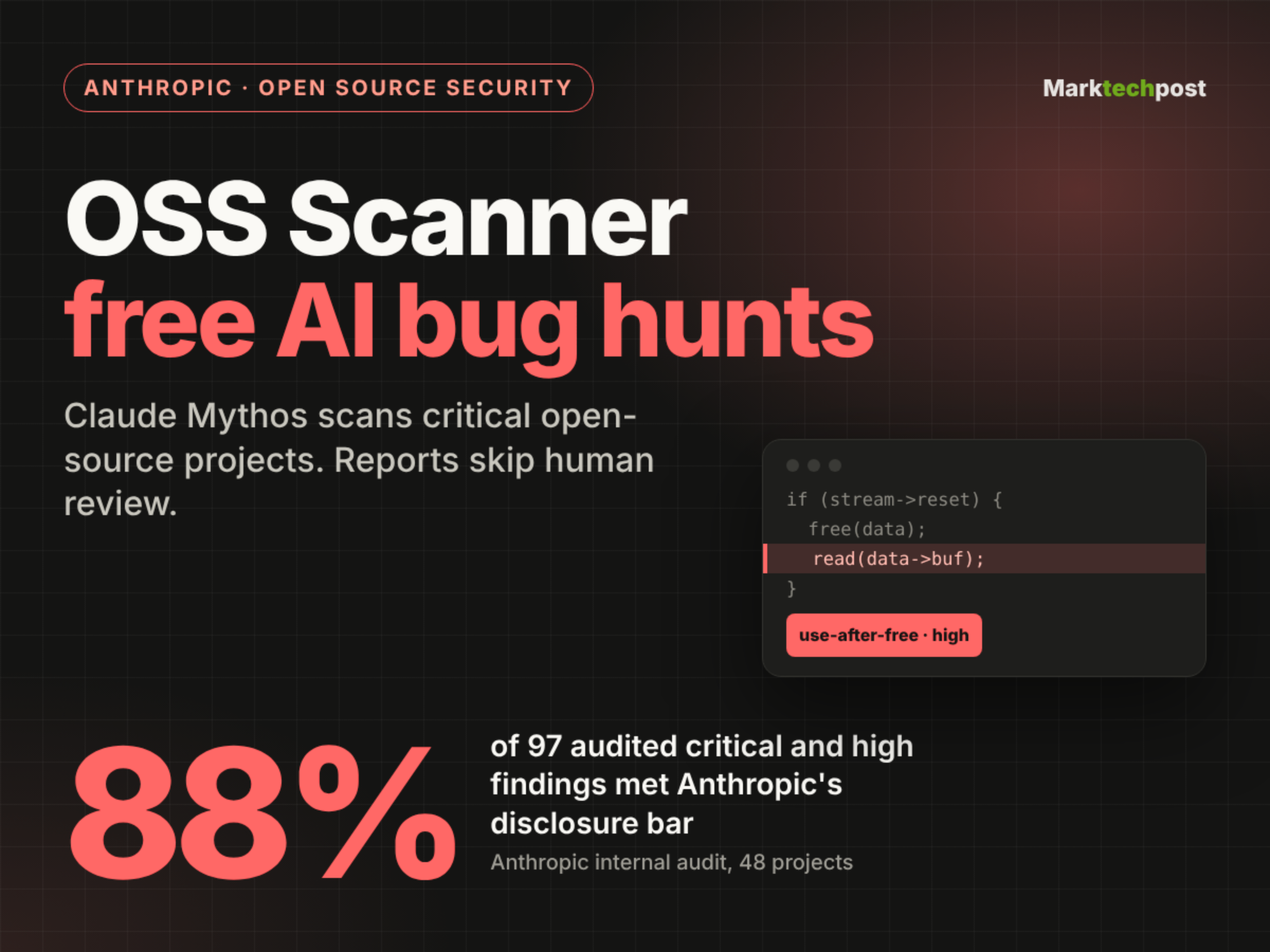
Anthropic Launches OSS Scanner, a Free AI Vulnerability Scanner

Why it matters:This tool represents a large-scale implementation of LLMs in the open-source security domain, characterized by zero cost, full automation, and offline auditing; however, bypassing the human review stage introduces risks of false positives and duplicate issues. Its accuracy metrics—88% detection rate and 1% false positive rate—and real-world project feedback (e.g., wolfSSL, curl) provide an empirical benchmark for the current state of AI‑driven vulnerability discovery.

Timeline and related coverage

Microsoft’s MAI-DxO system achieves 83% accuracy in diagnosing complex cases, but most of the improvement stems from the underlying large model.

According to research published in Science, Microsoft’s AI diagnostic system MAI-DxO achieved an accuracy of 83% in simulating the diagnosis of complex cases, significantly outperforming general practitioners at 36%; however, analysis indicates that this performance improvement stems primarily from the advanced foundation models it leverages—such as GPT-5.5—while the marginal gains attributable to its proprietary DxO orchestration architecture are limited, and no clear advantages were observed in routine settings like emergency departments.

Timeline and related coverage

Rescale leverages the AWS AI-DLC framework and Strands Agents to rapidly build an AI test traffic-splitting proxy.

Rescale, in collaboration with AWS engineers and leveraging the AI-Driven Development Lifecycle (AI-DLC) methodology, the Strands Agents framework, and Amazon Bedrock (Claude Opus 4.8), completed within five days a production-ready AI test-routing agent designed to automatically classify and route nighttime end-to-end test failures, and rolled out this human-AI collaborative development paradigm across the organization.

Timeline and related coverage

Several leading financial institutions in Europe have adopted open-source large models to build proprietary intelligent systems.

At the GTC Berlin conference, European financial institutions including Revolut, Starling Bank, Lloyds, and Santander announced that they are building production‑grade AI capabilities based on NVIDIA’s accelerated computing platform and open‑source weight models—such as PRAGMA, the Nemotron series, and the Kumo family—covering core use cases like trading analytics, speech recognition, fraud detection, and data pipeline acceleration, while emphasizing data sovereignty, cost control, and compliant deployment.

Timeline and related coverage

NVIDIA’s open-source models are helping to bring AI projects in the public sector to fruition across multiple European countries.

NVIDIA, in collaboration with governments and technology partners across multiple European countries, is advancing sovereign, controllable AI applications—leveraging open-source large models such as Nemotron and synthetic persona datasets—in Germany, Poland, the United Kingdom, France, Greece, and other nations. These efforts span areas including medical image analysis, employment services, digital government assistants, classified information processing, and localized language modeling.

Timeline and related coverage

Claude Mods: The first implementation of an attention interface, a human-programmable agent interaction layer

Claude Mods is Anthropic’s programmable plugin system for Claude Code, representing an early form of the “Attention Interface”—it shifts the traditional machine-oriented agent harness toward a customizable interaction layer centered on human attention. Users can write Mods in TypeScript/JS or have Claude generate them automatically using natural language, thereby determining when to be interrupted, what content to see, and what decisions to make.

Timeline and related coverage

Claude Mods: A programmable attention interface that reshapes the collaboration paradigm between humans and AI agents

Claude Mods is a programmable plugin system for developers launched by Anthropic, marking a shift of the ‘agent harness’ from a machine-side interface to a human-side interface—namely, the ‘Attention Interface’. It enables users to customize Claude Code’s behavior, rendering, and interaction logic via TypeScript/JavaScript, thereby facilitating co-design workflows between humans and AI. This mechanism has already been applied to built-in features (such as You Should Know) and supports users in building plugins themselves or having them generated with Claude’s assistance.

Timeline and related coverage