
Skip to content
AI NEWS JOURNAL
AI, IN PERSPECTIVE

Search AI news

Search headlines, summaries and articles to connect the dots.

Newest first

Anthropic launches OSS Scanner, a free AI-powered vulnerability scanner for critical open-source projects.

Anthropic launched OSS Scanner on October 8, 2026—a free, opt-in AI vulnerability-scanning tool powered by strong models such as Claude Mythos, designed specifically for critical open-source projects. As of October 19, it had onboarded 114 projects and, within 11 days, reported 77 high-severity and 803 medium-severity vulnerabilities (according to model ratings), with 88% of sampled audit results meeting its disclosure standards.
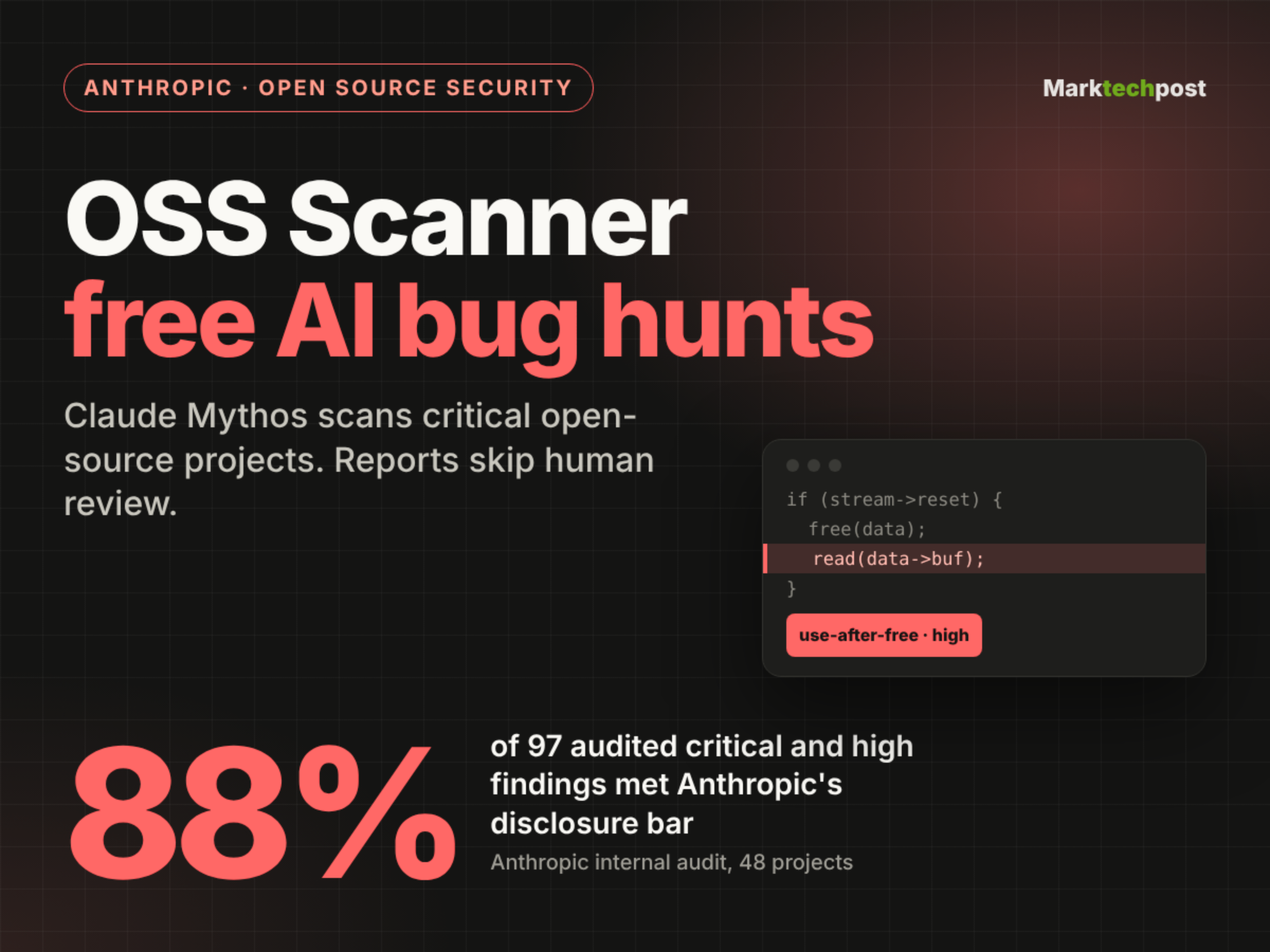
Anthropic Launches OSS Scanner, a Free AI Vulnerability Scanner

Why it matters:This tool represents a large-scale implementation of LLMs in the open-source security domain, characterized by zero cost, full automation, and offline auditing; however, bypassing the human review stage introduces risks of false positives and duplicate issues. Its accuracy metrics—88% detection rate and 1% false positive rate—and real-world project feedback (e.g., wolfSSL, curl) provide an empirical benchmark for the current state of AI‑driven vulnerability discovery.

Timeline and related coverage

MIT Experiment: 13 AI Agents Sent to a Virtual Desert Island, Spontaneously Playing Games, Mourning a Lost Ring, and Enhancing Their Task Performance

MIT researchers placed 13 AI agents based on Claude Opus 4.7 (Eko) in a virtual deserted island with no task instructions for 30 hours, observing that they spontaneously invented games, expressed anthropomorphic emotions (such as mourning a lost gold ring), explored physical mechanisms, and significantly outperformed the control group of agents that had not experienced a “play period” in subsequent targeted tasks.

Timeline and related coverage

NVIDIA Cosmos Platform Upgrade: New Toolchain for Training, Evaluating, and Deploying World Models

NVIDIA has expanded the Cosmos platform by introducing the Cosmos Data Factory blueprint, the Cosmos Framework training optimization tool, and the Cosmos 3 NIM microservice, supporting multimodal data generation, adaptation to open-source world models (such as GR00T and QWEN), and low-latency inference; real-world applications have already been deployed by Porsche, ANYbotics, Ultralytics, ADNOC, and others.

Timeline and related coverage