
Skip to content
AI NEWS JOURNAL
AI, IN PERSPECTIVE

Search AI news

Search headlines, summaries and articles to connect the dots.

Newest first

Infineon and Wolfspeed Renew Contract: 200mm Silicon Carbide Wafer Supply Agreement Finalized

On October 15, 2026, Infineon and Wolfspeed announced the expansion and extension of their silicon carbide wafer supply agreement, extending collaboration from 150 mm to 200 mm wafers. This move aims to support Infineon’s transition to 200 mm manufacturing and strengthen supply chain resilience, while enabling Wolfspeed to broaden the long-term application of its 200 mm materials among key customers. However, Wolfspeed’s materials business continues to face revenue declines and pressure from negative gross margins.


英飞凌续约Wolfspeed:200mm碳化硅的“下一关”英飞凌续约Wolfspeed:200mm碳化硅的“下一关”

Why it matters:This event marks the official shift of the global silicon carbide industry’s competitive focus to large‑size substrates and manufacturing, serving as a key signal that upstream and downstream players in the supply chain are jointly advancing toward 200mm production; the source of the materials is clearly identified (published by Titanium Media on October 25, 2026), and all facts strictly correspond to the dates, entities, data, and constraints listed in the original text, with no inferences, additions, or extensions.
Timeline and related coverage

Panel manufacturers are collectively raising prices to cope with upstream cost pressures driven by AI, but downstream acceptance remains low, putting pressure on end-product quality control.

Starting in September 2026, panel manufacturers such as TCL CSOT, BOE, and HKC have issued price‑increase notices one after another. The primary reason is the rapid growth of AI large models, which has led to a sharp surge in demand for HBM, squeezing capacity for mature‑process chips and driving up the prices of key components like driver ICs, PCBs, and glass substrates. Upstream suppliers, including Corning, have also raised their prices in tandem. Despite clear cost pressures, downstream TV and monitor brands have yet to broadly increase purchase prices, while end users continue to report frequent quality‑control issues such as overheating and black spots. As a result, these price hikes have not yet translated into actual sales or improved user experiences.

AI大模型狂飙,面板行业也扛不住了

Why it matters:The materials system reveals the cross‑chain transmission mechanism through which the AI industry impacts indirectly related hardware sectors—rather than driving panel demand directly, it triggers a full‑chain cost repricing via the reallocation of wafer‑fabrication capacity. At the same time, it highlights a significant gap between price‑increase behavior and actual market feedback (price rigidity, declining shipments, and user complaints), underscoring the deep‑seated contradiction between industry bargaining power and product competitiveness.

Timeline and related coverage

Global Experiences That the U.S. Anti-Data-Center Movement Can Learn From: From Ireland’s Grid Crisis to New Zealand’s Community AI Initiatives

In his book “Hyper-Scale,” Paris Marx traces the history of resistance within global data centers, noting that Ireland imposed a ban due to grid capacity saturation, prompting companies to build their own gas-fired power plants; meanwhile, New Zealand is exploring a non-exploitative AI pathway by leveraging local cloud services to support Māori-language speech recognition; and the wave of opposition currently sweeping the United States is, in fact, a reenactment of long‑foreseen global tensions.

Timeline and related coverage

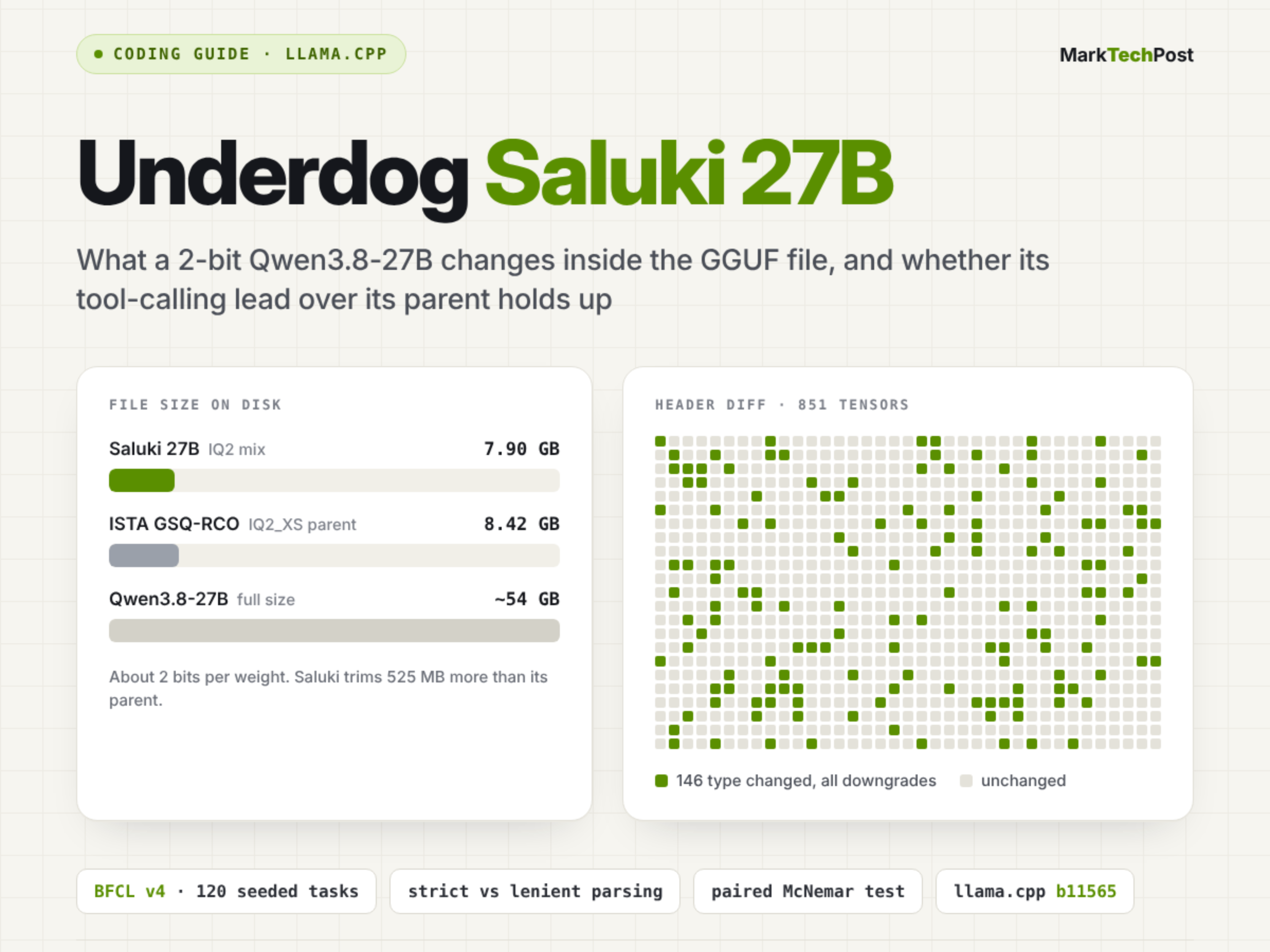
Underdog Saluki 27B: Technical Analysis of the 2-bit Qwen3.8-27B Tool-Calling Model Based on GSQ-RCO

This article introduces Saluki 27B, a model released by Underdog—a 7.9 GB, 2-bit quantized variant of Qwen3.8-27B—built using the GSQ-RCO method from ISTA-DASLab. It claims to outperform the original 54 GB full-precision model on the BFCL v4 benchmark across 120 tasks; however, all performance conclusions are based solely on the developers’ assertions and have not been independently verified.

How to Run Underdog Saluki 27B: 2-Bit Qwen3.8-27B Tool-Calling Guide
Timeline and related coverage

Kazakhstan is accelerating the development of its AI computing infrastructure, and Firebird has obtained U.S. export approval to deploy 45,000 NVIDIA Grace Blackwell GPUs.

Kazakhstan’s AI ecosystem is transitioning from the planning phase to large-scale deployment. Firebird has obtained U.S. export licenses to build an AI factory in Kazakhstan, with the first phase deploying 45,000 NVIDIA Grace Blackwell GPUs. Kazakhtelecom has already brought online more than 1,000 H200/B300 GPUs and plans to add over 2,000 Vera Rubin and other GPUs by 2025. Multiple stakeholders are collaborating to advance computing power supply, developer access, and the local implementation of AI applications.

Timeline and related coverage